From tampons to tap water, from cereal boxes to vaccines, nearly every modern health scare rests on the same myth: chemicals are killing us. This fear—chemophobia—has become one of the most powerful engines of misinformation worldwide.
The World Health Organization (WHO) lists vaccine hesitancy as a top global health threat, but I’d argue that chemophobia is even more pervasive. It’s the common thread that links all forms of science rejection; it fuels fear around vaccines, food, medicine, agriculture, and cosmetics.
Chemophobia, the irrational fear or aversion to chemicals, is everywhere—whispered in parenting Facebook groups, shouted by influencers, amplified by media outlets that should know better, and weaponized by politicians.
Chemophobia is the hidden language of health misinformation.

You’ve seen it:
- Headlines about “heavy metals in tampons”
- Myths about vaccines containing “toxic” ingredients
- Legislative bans on synthetic food dyes
- Public outcry against fluoride in drinking water
- The Environmental Working Group’s annual Dirty Dozen list, warning about “toxic pesticides” in produce
- “Paraben-free” or “preservative-free” marketing slapped on cosmetics, sunscreens, and even foods
If you didn’t know better, you might think you and your family are in constant danger. You’re not. Instead of protecting people, chemophobia increases costs, reduces safety, harms public health, and stalls lifesaving science.
What Is Chemophobia?
Chemophobia claims that synthetic chemicals are inherently harmful, while “natural” chemicals are safe—a textbook example of the appeal to nature fallacy.
Chemophobia gained traction in the mid-twentieth century, following real industrial disasters such as Love Canal, Three Mile Island, and the Bhopal gas leak. Those events, which led to justifiable concern, were used to demonize all “synthetic” chemicals.
Rachel Carson’s Silent Spring (1962) fueled the flame:
“The chemicals to which life is asked to make its adjustment are no longer merely the calcium and silica and copper … they are the synthetic creations of man’s inventive mind … Such ingenious manipulations have produced a battery of poisons of truly extraordinary power.”
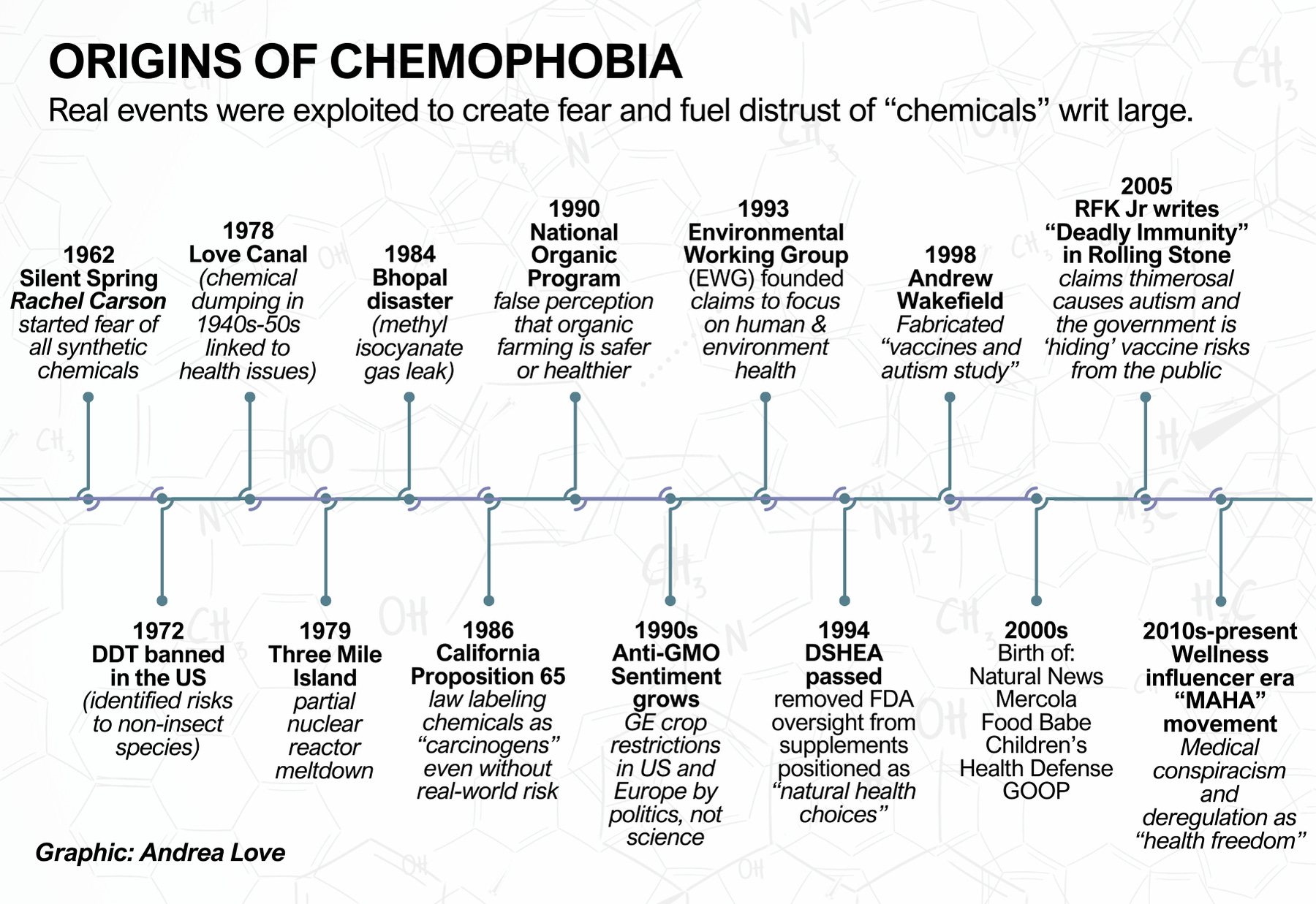
Carson was a gifted writer and a marine biologist. Her work contributed to the EPA’s creation and the restriction of DDT use, which previously helped eliminate endemic malaria in the United States during World War II.
While DDT saved lives from mosquito-borne disease, it caused ecological damage in birds, where exposure thinned bald eagle eggshells, leading to fragile eggs and high chick mortality. Once malaria was controlled and the off-target effects were understood, the ecological risks outweighed the benefits, though the danger was not to humans.
Carson contributed to important scientific efforts in her field, but she wasn’t a chemist or toxicologist.
Yet, when she framed all “synthetic creations” as a “battery of poisons,” Carson unintentionally left a legacy of exaggerated distrust toward synthetic chemicals.
That distrust metastasized into today’s chemophobia, where people are terrified of anything artificial, even while scientific principles tell us that the source of a chemical has no bearing on its potential harm or safety.
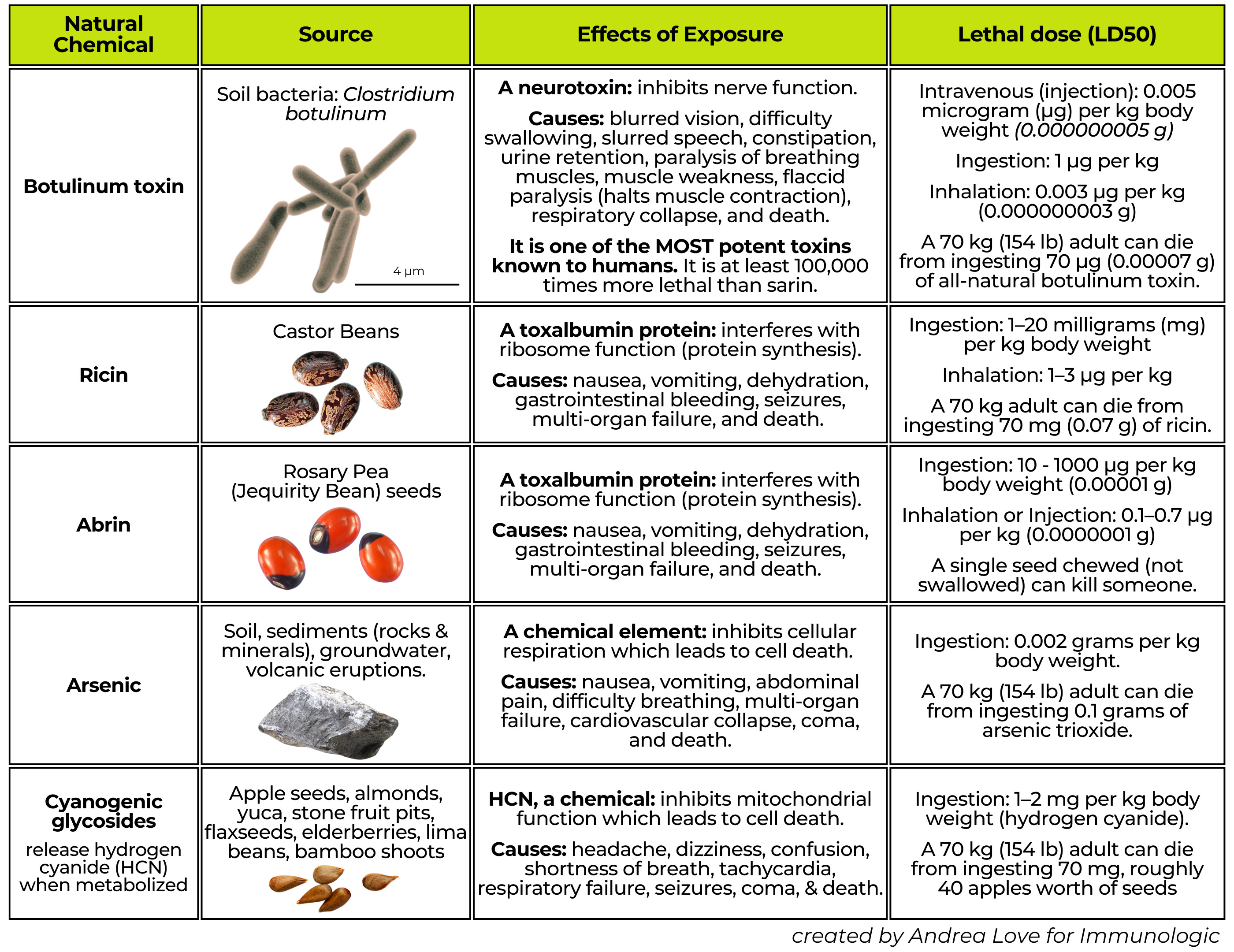
Many of the most toxic chemicals are all-natural, including Botulinum toxin, abrin, ricin, arsenic, and cyanide.
On the flip side, countless synthetic chemicals are lifesaving.
Chemistry enables scientists to harness our knowledge, nature, and chemical synthesis to expand our health-improving resources.
Aspirin (acetylsalicylic acid) exists because chemists improved upon the natural compound salicin found in willow bark to make a safer and more effective pain reliever. Many lifesaving chemotherapies are synthetic derivatives of natural chemicals altered to improve effectiveness and safety (read more on that, below)
Chemophobia paints synthetic chemicals as universal villains. You’ve heard the commonly repeated claims:
- “I only want natural ingredients.”
- “If you can’t pronounce it, don’t eat it.”
- “Vaccines are filled with harmful chemicals.”
- “GMOs aren’t natural, so they must be bad.”
Fear in a soundbite beats nuance, especially when leveraged as a marketing ploy by the wellness industry.
Their tactic: if synthetic is “bad,” then the “natural” alternatives they promote must be safer, healthier, more beneficial, and even more eco-friendly—because they are trying to convince you that modern science and tools developed by it are evil.
But your body doesn’t care if a molecule was isolated from a plant or synthesized in a lab.
Vitamin C is vitamin C (scientifically, it’s actually (5R)-5-[(1S)-1,2-Dihydroxyethyl]-3,4-dihydroxy-5H-furan-2-one), whether it’s extracted from a lime or fully synthesized in a laboratory.
Formaldehyde is formaldehyde (and yes, your body makes much higher levels of formaldehyde every day than you would ever encounter in a vaccine).
What matters is dose, not origin. All-natural botulinum toxin is a million times more toxic than synthetic sarin—yet people willingly inject that into their faces while fearing preservatives in bread.
This context is almost always omitted from public discourse, where media outlets, influencers, and even policymakers repeat false claims about chemicals without scientific evidence.
Even among individuals who vocally proclaim to support science, you see anti-science actions rooted in chemophobia. That’s why Democratic governors ban artificial food colorings without considering that they’ll be replaced with naturally derived coloring chemicals that are less studied, less safe, and more ecologically damaging (yes, I am talking to you, Gavin Newsom).
That’s why Democratic legislators move to restrict the use of glyphosate, one of the safest herbicides, while conveniently ignoring that this would force farmers to use weed control measures that are more toxic, less effective, and have broader ecological impacts. That’s also why European governments restrict genetic technologies in farming, even while they embrace the same science for cancer therapies.

Chemophobia Thrives on Low Chemistry Literacy
Only 28 percent of Americans are civically scientifically literate, meaning they can find, understand, and apply science to policy decisions.
So, when voters are told fluoride is “toxic,” they predictably vote to remove it. When they’ve heard for decades that glyphosate causes cancer, despite data showing otherwise, they support bans.
And when new parents are bombarded with disinformation from Moms across America or the Environmental Working Group (EWG), they make choices that don’t actually protect their families but do drive profits for those very people spreading the fear. While many believe these organizations have their best interests in mind, they are major contributors to disinformation.
Moms Across America is an activist organization founded in 2013 that spreads pseudoscience and chemophobia about GMOs, pesticides, vaccines, and food additives.
EWG is a nonprofit and lobbying organization best known for its annual “Dirty Dozen” list and alarmist rankings of consumer products and foods. Most people don’t know that they also spread objective lies about vaccines—something they have attempted to scrub from their history. EWG is one of the biggest propagators of chemophobia, routinely exaggerating risks of chemicals for their financial benefit.
This isn’t just an American problem, either.
In Europe, 40 percent of adults say they’d prefer to “live in a world without chemicals,” and nearly a third openly fear them. Ninety-one percent don’t grasp that toxicity depends on dose, and 82 percent don’t realize that table salt is always sodium chloride (NaCl), whether isolated from nature or synthesized in a laboratory.
Too many people forget that chemistry shapes their existence—food, medicine, clean water, even their smartphones and homes—until it is used to stoke fear. Combine that with a “do your own research” culture where Google and TikTok pass for toxicology training, and chemophobia spreads unchecked.
Chemophobia Shapes Policy—and Not in a Good Way
Chemophobia doesn’t just distort individual choices; it influences lawmaking across political ideologies and harms public health as a result.
Chemophobia hinders the development of crops using genetic engineering that can withstand more extreme climates, grow in places that were previously inhospitable, and produce higher yields with fewer pesticides. Chemophobia drives anti-vaccine opposition, slows development of novel therapeutics, fuels unfounded fears about medicine ingredients, and erodes trust in evidence-based science and medicine.
Chemophobia leads to banning safe food ingredients and demonization of healthy fruits and vegetables, causing people to avoid nutritious food, which, unlike the pesticide residues they fear, actually does pose a health risk. Chemophobia forces consumer product companies to kowtow to public outcry and remove safe and effective ingredients (such as preservatives like parabens), increasing costs, reducing safety, damaging the environment, and legitimizing misinformation.
The most dangerous expression of chemophobia right now is RFK Jr.’s “Make America Healthy Again” agenda.
Now that he has co-opted the Department of Health and Human Services, he is wreaking havoc on public health, trust in science, and our safety guardrails. MAHA gains appeal because it’s marketed as a bipartisan “health” platform: rhetoric around healthy foods, chronic health issues, and environmental contaminants.
But peel back the façade?
MAHA is a full-blown chemophobia manifesto, the magnum opus of RFK Jr.’s forty-year anti-science career. None of it will make Americans healthier.
MAHA appeals to anti-GMO and anti-pesticide sentiment among left-leaning people who, ironically, have been misled by decades of anti-science rhetoric by RFK Jr. and his allies. Organic purity narratives blend with “ban preservatives” rhetoric, while building on distrust of corporations and “Big Food.” This same tactic fueled the original anti-vaccine activists, many of them left-leaning individuals concerned about toxic vaccine ingredients.
MAHA appeals to the right by branding chemophobia as government overreach: the FDA and EPA are “poisoning” citizens with vaccines, fluoridated water, and processed foods. It feeds broader anti-regulation, anti-institution ideology that led to the 1994 Dietary Supplement Health and Education Act (DSHEA), which removed FDA oversight of dietary supplements and drove exponential growth of the wellness industry.
Chemophobia is uniquely dangerous because it transcends political lines. RFK Jr. doesn’t need to persuade people on policy specifics; he only needs to stoke distrust in “chemicals” or legitimate qualified experts who try to educate people, and fear does the rest.
MAHA positions have already seeped into legislation.
- The Department of Health and Human Services adopted a federal policy legitimizing falsehoods about thimerosal, used globally to prevent contamination in multi-dose vaccines.
- They have halted $500 million in funding for mRNA vaccine research, claiming it is a “risky” technology.
- Multiple states around the country are pursuing bans on “genetic medicines” based on the same reasoning.
- This year Utah and Florida banned fluoridation of public water, even while nearly eighty years demonstrate its benefit for dental and overall health.
- Legal challenges that block cultivation of golden rice, a lifesaving farming technology, have drawn support from environmental activists and conservative conspiracy platforms alike.
- California food dye bans were cheered by left- and right-leaning wellness influencers similarly touting it as the path to healthy food. It isn’t; it instead legitimizes false claims that these colorings are harmful while global experts have asserted their safety.
Chemophobia is the common theme.
Chemophobia thrives on the risk perception gap between real and perceived risks. People fixate on Red Dye 40 in snacks while ignoring real systemic factors that impact health, such as healthcare inequities, income inequality, and food deserts.. They avoid nutritious foods because of unfounded pesticide fears but freely consume unregulated supplements full of untested compounds. This double standard distorts personal decisions and public policy and harms society.
Chemophobia has staying power because it is applicable to every single topic in science and health. Today it’s food dyes, tomorrow it’s pesticides, next week it’s vaccines. The narrative doesn’t require data—only fear of the chemical boogeyman.
We All Must Recognize Chemophobia as a Global Health Threat
If we want better health and smarter policy, we must confront chemophobia. That starts with science literacy—basic chemistry, toxicology, biology, and, yes, media literacy. Education matters, but so does accountability.
Stop confusing notoriety with expertise. A podcaster saying “trust me” is not a credential. Journalists need to quit amplifying clickbait and start quoting real experts, not wellness influencers. And elected officials must write laws based on evidence, not vibes, polls, or lobbyists’ checks. Scientists can contribute by meeting the public where they are, using plain language, acknowledging fears, and fact-checking loudly and often. If we don’t, misinformation gets a free pass.
Chemistry underpins everything—medicine, food, clean water, sustainability, climate science. Yet public fear of “chemicals” stalls progress, raises costs, and undermines safety. Chemophobia thrives because fear is profitable, politically useful, and amplified by powerful networks. Scientists fighting it do so on our own time, without the money or infrastructure backing the fear machine. Until society treats chemophobia as the public health crisis it is, we’ll keep losing ground.
Chemophobia isn’t a nuisance; it’s a global health threat. If you consider yourself a skeptic, this is your call to action: challenge chemical fearmongering wherever you see it—even in yourself. Our health, our safety, and our future depend on it.
Dr. Andrea Love, a microbiologist and immunologist, provides the facts (and the data!) on science and health topics. Follow Andrea on X @dr_andrealove
A version of this article was originally posted at Immunologic and has been reposted here with permission. Any reposting should credit the original author and provide links to both the GLP and the original article.