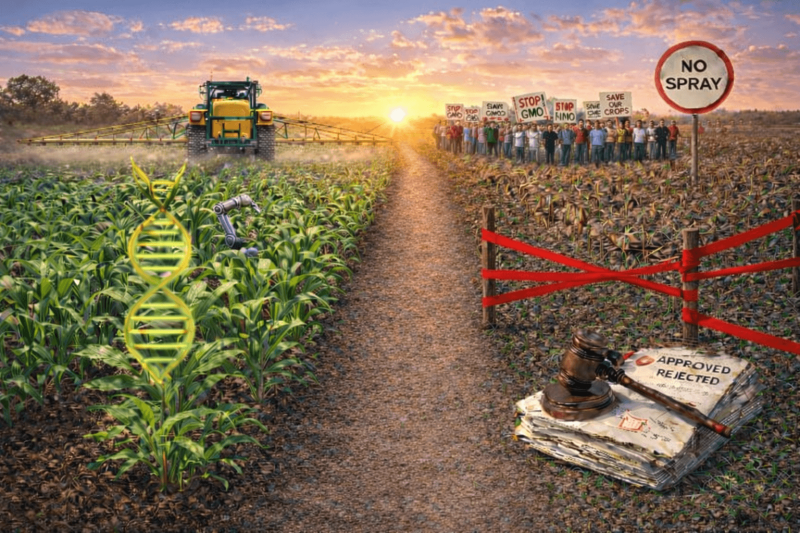
Global farming and food policy is under intensive attack from an alliance of left-leaning environmental activists and the ideologically mushy MAHA movement. These attacks are intensifying just as we are seeing the imposition of Trump-era cuts to research and regulatory agencies that have weakened science-based oversight, leaving farmers with fewer tools and more uncertainty.
Critics of conventional farming frame their critique on two principles: genetic engineering, which has led to the development of a slew of genetically modified crops, is an inherent health risk with unknown and potentially catastrophic environmental consequences; and that it is heavily dependent on the use of ‘dangerous’ crop chemicals, which they claim are health and environmental time bombs.
They are wrong on both counts.
These critics have attempted to frame modern farming tools as inherently dangerous, ignoring decades of toxicology, risk assessment, and real-world data. Around the world, similar rhetoric is pressuring regulators and policymakers to restrict proven technologies while offering no scalable alternative to feed billions of people.
Modern conventional agriculture — systems that integrate genetic engineering, advanced plant breeding, precision application of crop protection chemicals, and data-driven farm management, recently turbo-charged by AI — is not only essential for global food security but demonstrably safer and more productive than any alternative. Over three decades of evidence show that genetically engineered (GE) crops reduce overall pesticide use and toxicity while increasing yields.
Comprehensive safety assessments by the U.S. National Academy of Sciences (2016), the European Commission (reviewing 25 years of research), the World Health Organization, and the American Medical Association — among dozens of independent agencies — have reviewed thousands of studies and reached a consensus: approved GM crops are no riskier to human health or the environment than conventionally bred crops, a conclusion grounded in thousands of feeding, toxicology, and environmental studies.
The activist environmental movement, aligned closely with organic agriculture (recently rebranded as “regenerative” farming) supporters, focuses much of its criticism on the alleged overuse of crop chemicals. They claim these chemicals are largely unnecessary, claiming organic farmers have shown that their practices are higher-yield and environmentally safer. They are wrong on both counts. Their argument is mostly driven by chemophobia — embraced and promoted by environmental activists, and the motivating centerpiece of Robert F. Kennedy, Jr. and his MAHA supporters.
Chemophobia impacts far more than health and medicine: it’s the ideological underpinning that props up the organic farming movement. It claims, falsely, that technology-shaped land-preserving agriculture is dependent on the use of ‘dangerous’ chemicals. The ongoing legal battle over glyphosate is a prime example. Despite decades of regulatory review by dozens of scientific chemical risk bodies, including the Environmeantal Protection Agency, Health Canada, European Food Safety Authority, and numerous World Health Organizations, that have found glyphosate safe when used as directed, opportunistic lawyers, misled activists, and irresponsible media outlets have framed the herbicide as uniquely toxic (it’s toxicological profile is actually very mild: less toxic than table salt). This disconnect between science and public perception has created massive instability for farmers, discouraged investment, and pushed companies to abandon effective tools. That is chemophobia in action: fear overriding data.
“Chemical” is not a synonym for “toxic,” and “organic” is not a synonym for “nature-friendly,” safer, or healthier. Critics of conventional farming often claim that it’s chemically intensive and harmful to the environment as compared to organic farming. That’s simplistic and, in many (if not most) cases, wrong.
Organic agriculture is not pesticide-free or even a low-pesticide farming model. It still relies on pesticides (both natural and synthetic), some of which are less targeted, more toxic, and must be applied more frequently. One startling statistic: the United States uses about half the amount of toxic chemicals per acre as Belgium and France, mostly because of its embrace of genetically modified crops paired with glyphosate, the most effective and least toxic herbicide in the world. The widespread adoption of GM crops has also led to extensive use of no-till farming, which is not the standard in organic farming. Tilling is an outdated, nightmare technology that results in the release of carbon dioxide and other greenhouse gases, which are mostly eliminated using GM technology.
More importantly, organic systems typically yield less, sometimes by as much as 40%, requiring more land, water, and energy to produce the same amount of food. Expanding farmland to compensate for lower productivity can cause more habitat loss and emissions than high-yield conventional farming ever would. Additionally, many regenerative practices — such as cover cropping or reduced tillage — are already widely used in conventional systems without sacrificing productivity.
Moreover, the stated goals of organic and regenerative agriculture, such as protecting biodiversity and preserving soil health, are shared by all farmers. Organic labels and “GMO-Free” campaigns are little more than branding techniques that discourage innovation and confuse consumers. As we note in numerous articles, these labels serve mostly as marketing campaigns for those who stand to financially benefit from attacking conventional farming.
As the global population grows and climate stress intensifies, these misleading marketing tactics distract from very real challenges. Simply put, agriculture must produce more food on less land with fewer inputs and reduced environmental impact. Organic farming has a role in this solution, but a modest one. Misinformation that treats modern farming tools, which are essential to meet this challenge, as inherently dangerous undermines food security and environmental goals.
To more effectively challenge this type of misinformation, the Genetic Literacy Project is transitioning to the Science Literacy Project — a name that better captures our expanded focus and the growing urgency of the moment. This evolution is not a departure from our origins, but a renewed and broadened commitment to challenging misinformation wherever it threatens evidence-based understanding, public policy, and trust in science. As scientific issues become increasingly entangled with ideology, high-impact debates and emerging technologies have become prime targets for distortion.
As GLP becomes SLP, we will maintain our longstanding deep reporting on agricultural innovation, crop protection, and advances in gene editing and gene-based medicine. At the same time, we will broaden our coverage to additional areas where misinformation is pervasive, including vaccines and public health, chemical risk assessment, energy technologies such as nuclear, fracking, and geothermal, and the rapidly accelerating influence of artificial intelligence.
Our six-part retrospective of major features that have run on the GLP over the past year exemplifies this expanded and yet more targeted mission. Organized into thematic sections, these feature articles highlight both the breadth of modern science and the recurring tactics — ideological framing, influencer amplification, and monetized activism — used to misrepresent scientific evidence and shape policy debates.
- Politicization of Health & Science
- Vaccines Under Fire
- Deadly Rise of Wellness Grift
- Disinformation Attacks on Food and Farming
- Chemophobia and Monetized Activism
- AI’s Open Questions
In Part 4, we examine how chemophobia, misinformation, and reckless activism undermine food security. Anti-GMO and chemical-free organic marketing campaigns employ fear-based messaging, despite broad scientific consensus that conventional farming practices are safe and often-times more environmentally sustainable. This misleading branding benefits ideological rejectionists, including predatory tort lawyers (like RFK, Jr.) who have made billions of dollars targeting modern science while inhibiting innovations that increase food security and are more sustainable.
Future of Food & Farming: Year in Review
While agricultural biotechnology could dramatically boost yields, cut emissions, and strengthen food security, outdated regulations and aggressive workforce cuts at USDA, FDA, and EPA threaten to stall innovation and undermine science-based deregulation needed to keep U.S. agriculture competitive.

Viewpoint: Farmers take a hit—Trump agriculture and biotechnology budget cuts are hampering U.S. innovation by Emily Bass
Often maligned by fear-baiting activists, food mutations — whether natural, induced, or precisely edited — are the foundation of modern agriculture, and gene-editing tools like CRISPR simply extend a long, safe history of plant breeding while offering faster, more precise ways to improve crops for nutrition, resilience, and food security.
Beautiful and delicious mutants on your plate: The misunderstood world of crop improvement by Henry Miller
The media-driven apocalyptic claims about soil degradation and climate-driven food collapse are unsupported by evidence. While organic and regenerative agriculture often present their approaches as better for the climate, many of their practices result in lower yields, require more land, increase emissions, and pose greater risks to food security than climate change itself.
Viewpoint: Organic fantasies—Why rejecting industrial agriculture for regenerative farming would be a big mistake for food security and sustainability by Alex Smith
Meeting future global food demand while meeting climate goals requires high-yield, biotechnology-driven agriculture, as demonstrated in Brazil. However, framing agriculture as a binary choice between conventional and organic farming is misleading, and an “all tools in the toolbox” approach — combining biotechnology, modern chemicals, soil-focused practices, and innovation — is the most realistic path to achieving food security and environmental goals.
Viewpoint: Organic or intensive agriculture? Brazil reframes the debate over the most promising future for farming by Jon Entine
RFK, Jr. and the MAHA movement continue to spread misinformation and fear about pesticides, fertilizers, and modern farming practices. These anti-scientific narratives destabilize U.S. agriculture, confuse consumers, and, when applied to policy, inhibit innovation. MAHA’s ongoing campaign against glyphosate serves as an example of the movement’s unscientific, fear-based activism.
Viewpoint: MAHA’s chemophobic agriculture recommendations take a back seat to industry and science as Republican farm policy comes into focus by Emily Bass
Looking back better prepares us to challenge misformation, profiteering narratives, and fear-mongering as agriculture continues to innovate, adapt, and evolve. These five pieces from 2025 on farming, food, and anticipated future challenges for the sector, in terms of both policy and sustainability, illustrate our refined focus going forward.
Follow our six-part Year in Review series on Instagram
Jon Entine is the founding executive director of the Genetic Literacy Project and winner of 19 major journalism awards. He has written extensively in the popular and academic press on agricultural and population genetics. You can follow him on X @JonEntine
Henry I. Miller, a physician and molecular biologist, is the Glenn Swogger Distinguished Fellow at the Science Literacy Project. He was the founding director of the FDA’s Office of Biotechnology. Find him on his website: henrymillermd.org
Emily Bass is Associate Director of Federal Policy, Food and Agriculture at Breakthrough Institute. Follow Emily on X @EmilyJane_Bass
Alex Smith is a Senior Food and Agriculture Analyst at Breakthrough. Follow Alex on X @alexjmssmith