
The numbers upend a familiar narrative. While stronger gun laws are linked to fewer firearm deaths overall, the real story lies in the details: suicide rates drop far more sharply than homicides. This research challenges blanket policy approaches and demands a more tailored response to two very different crises.

A new research letter offers a different take on the now-time-worn Pavlovian-like debate over state gun laws and firearm-related deaths. The analysis is based on crude firearm death rates from the CDC, census data, and a scoring of the strength of state gun laws. The scoring system was developed by the Gifford Law Center, an organization founded by a victim of firearms violence, Congresswoman Gabby Gifford.
In 2022, firearms caused 48,204 deaths in the US, and as expected, stronger gun laws correlated with decreasing firearm death rates—stronger gun laws, fewer firearm deaths.
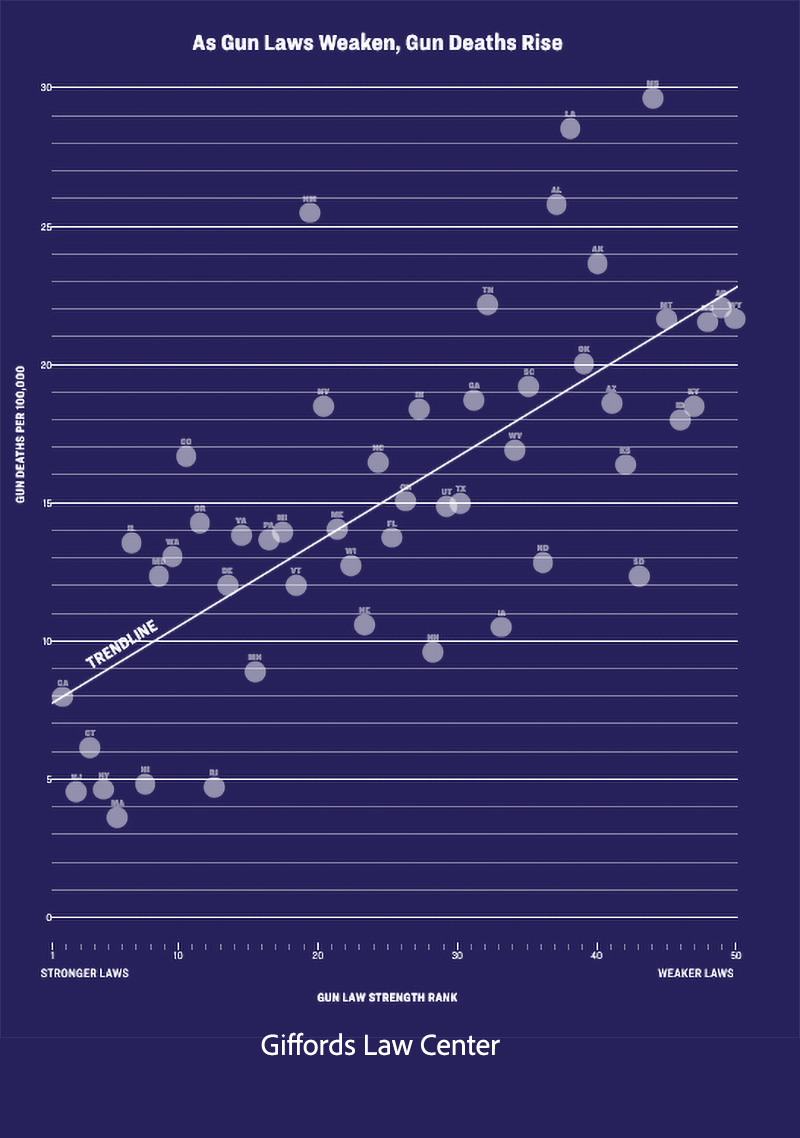
The researchers then differentiated firearm-related deaths as homicides or suicides, and here is where the narrative shifts dramatically. Stronger gun laws showed a significantly stronger correlation for reduced suicides compared to homicides.
Using the R2 value, a statistical measure of how well a model explains the data, stronger gun laws had R2 values of 0.6 to 0.7 for suicides, and only 0.1 or slightly greater for homicides. In the graphic, which shows the trend for stronger gun laws and all deaths, the R2 value reflects how closely the data points cluster next to the trend line.

Suicides
After controlling for sociodemographic factors, the gun law categories with the strongest correlation to suicide prevention were “’Regulation of Sales and Transfers,’ ‘Firearms in Public Places,’ ‘Gun Owner Accountability,’ and ‘Classes of Weapons.’” As I have suggested in the past, suicides are often a “crime” of opportunity, an in-the-moment decision, so these particular laws, which restrict access to firearms during crises or limit certain types of weapons, seem to be particularly impactful for suicide prevention.
Homicides
“While some gun law categories were correlated with decreased firearm homicide, sociodemographic factors, such as unemployment, poverty, and insurance status, correlated with larger changes, suggesting policies that address root causes of violence through economic mobility and access to robust social, health, and educational services may be associated with a greater reduction in homicides.”
While it is easy to note that when stratified by “race” (Asian, Black, Hispanic, White), being “Black” showed the highest correlation with homicides, while being “White” showed the highest correlation with suicides, that avoids a greater, more nuanced ground truth. Poverty and its fellow travelers, unemployment and annual income, all demonstrated a strong correlation with homicide, for suicides, income, and disability.
As it turns out, neither a one-size-fits-all message on stronger gun laws nor stronger gun laws by themselves are solutions. As the researchers write, what is required is a “nuanced understanding of potential outcomes associated with tailored policy interventions.” In combating firearm deaths by suicide, policies regulating “firearm sales, transfers, and permitting laws” are supported. For firearm homicides, we must address the more entangled and ultimately costly “root causes of violence through economic mobility and access to robust social, health, and educational services.”
It’s tempting to look for one-size-fits-all solutions, but the data often reveals a more complicated truth. Policies restricting access to firearms during vulnerable moments can prevent suicides, but reducing homicides demands something deeper—economic opportunity, healthcare access, and education. If we want to save lives, we must speak of and embrace more than a policy “vibe,” and instead, discuss and choose policies grounded in nuance, empathy, and evidence.
Criteria include background checks and access to firearms, regulation of sales and transfers, gun owner accountability, firearms in public places, classes of weapons and ammunition/magazines, consumer and child safety, investigating gun crimes, state authority to regulate, community violence intervention initiatives, and other.
Dr. Charles Dinerstein, M.D., MBA, FACS is the Medical Director at the American Council on Science and Health. He has over 25 years of experience as a vascular surgeon. He completed his MBA with distinction in the George Washington University Healthcare MBA program and has served as a consultant to hospitals. While no longer clinically active, he has had his writing featured at KevinMD and Doximity.
A version of this article was originally posted at American Council on Science and Health and has been reposted here with permission. Any reposting should credit the original author and provide links to both the GLP and the original article. Find American Council on Science and Health on X @ACSHorg