‘Animal uplift’: Could we—and should we—make animals smarter?

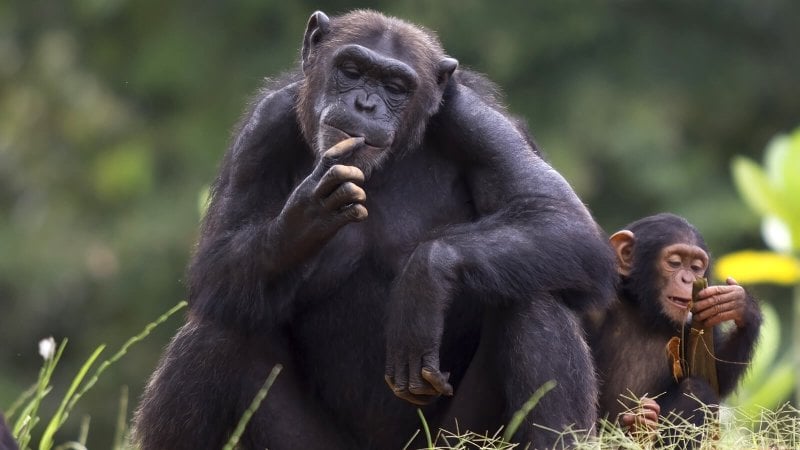
chimpanzee with baby

Advances in neural implants and genetic engineering suggest that in the not–too–distant future we may be able to boost human intelligence. If that’s true, could we—and should we—bring our animal cousins along for the ride?

There’s already tantalizing evidence of the idea’s feasibility. As detailed in BBC Future, a group from MIT found that mice that were genetically engineered to express the human FOXP2 gene linked to learning and speech processing picked up maze routes faster. Another group at Wake Forest University studying Alzheimer’s found that neural implants could boost rhesus monkeys’ scores on intelligence tests.

The concept of “animal uplift” is most famously depicted in the Planet of the Apes movie series, whose planet–conquering protagonists are likely to put most people off the idea.

[D]eveloping the technology to uplift animals will likely require lots of very invasive animal research that will cause huge suffering to the animals it purports to help. This is problematic enough with normal animals, but could be even more morally dubious when applied to ones whose cognitive capacities have been enhanced.

We’re already likely to face considerable competition from smart machines in the coming decades if you believe the hype around AI. So maybe adding a few more intelligent species to the mix isn’t the best idea.

Read full, original post: If We Could Engineer Animals to Be as Smart as Humans—Should We?

{{ reviewsTotal }}{{ options.labels.singularReviewCountLabel }}
{{ reviewsTotal }}{{ options.labels.pluralReviewCountLabel }}
{{ options.labels.newReviewButton }}
{{ userData.canReview.message }}

Related Articles

Infographic: Global regulatory and health research agencies on whether glyphosate causes cancer

Infographic: Global regulatory and health research agencies on whether glyphosate causes cancer

Does glyphosate—the world's most heavily-used herbicide—pose serious harm to humans? Is it carcinogenic? Those issues are of both legal and ...

Most Popular

wuhan institute of virology main entrance
​​COVID lab leak? Making a case that the Wuhan market origins theory is wrong
Screenshot-2026-06-17-at-9.44.03-AM
Viewpoint: Embryos are becoming the newest battleground of love, loss, and legal uncertainty
Screenshot-2026-06-18-at-11.41.51-AM
Viewpoint—Protecting baloney science: Far right senators move to protect the phony homeopathy industry
ChatGPT-Image-Jun-9-2026-01_11_37-PM
Turmeric supplements: More risks than benefits
Screenshot-2026-06-17-at-11.57.12-AM
Viewpoint: Raw milk and the myth of safety—ProPublica exposes the growing anti-homogenization movement
Screenshot-2026-06-18-at-2.52.05-PM
Activist organization accuses Trump of protecting methane-generating stripper wells to benefit billionaire and donor Jeffrey Hildebrand 
Screenshot-2026-06-16-at-10.02.22-PM
Viewpoint: ‘Industrial food’ primer—Challenging the dangerous delusions of the alternative food movement
ChatGPT-Image-Mar-10-2026-01_39_01-PM
Viewpoint—“Miracle molecule” debunked: Why acemannan supplements don’t work
ChatGPT-Image-Jun-18-2026-02_32_04-PM
Can illegal social media content be stopped before it goes viral? UK is going to try.
ChatGPT-Image-Jun-4-2026-03_07_27-PM
AAP v. Kennedy: While a court challenge grinds on, RFK Jr. quietly advances his anti-vaccine conspiracy agenda

Sorry. No data so far.

glp menu logo outlined

Get news on human & agricultural genetics and biotechnology delivered to your inbox.