Synthetic biology startup Ginkgo Bioworks wants to print ‘designer’ DNA

wkrnd st nijfidnkmwftwz orbxglt s zoy ps vb xx
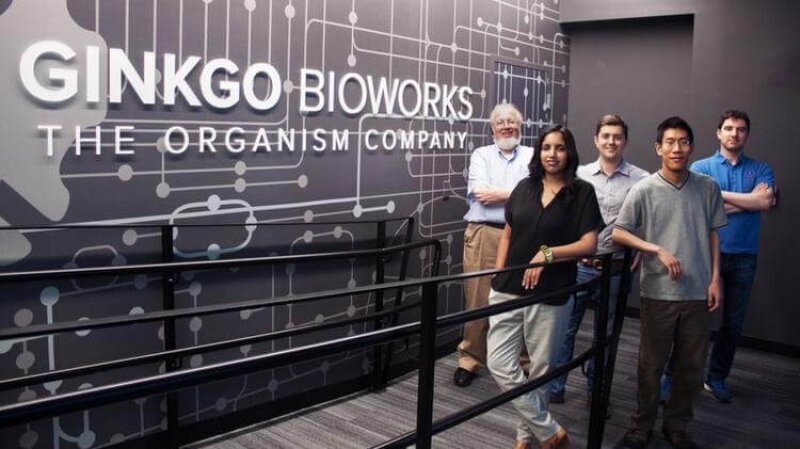
Founders of Ginkgo Bioworks include MIT researcher Tom Knight, left, and fellow MIT graduates Reshma Shetty, Barry Canton, Austin Che and Jason Kelly. Image credit: Boston Business Journal

Over the last several years, Ginkgo [Bioworks] has developed an automated process for combining genetic parts that has made it the largest designer of printed DNA in the world. That breakthrough has positioned the start-up to change the face of a variety of industries and helped to earn it the No. 21 spot on the 2018 CNBC Disruptor 50 list.

Last October, Ginkgo entered into a $100 million partnership with the global health-care and agriculture giant Bayer to engineer microbes capable of producing fertilizer for crops, like corn, wheat and rice.

…

Essentially, synthetic biology involves reconfiguring the genome of an organism to get it to do something entirely new. [CEO Jason] Kelly likens it to computer programming, only with genetic sequences. So think of DNA as computer code, and then imagine you can design sequences of DNA on the computer, physically print out those sequences, and insert them into microorganisms such as yeast and bacteria so they make products like rose-scented oil for perfume or sweeteners for beverages.


“We’re learning how to rewrite the code of life,” said Frances Arnold, a professor of chemical engineering, bioengineering, and biochemistry at the California Institute of Technology. “We’re seeing a move toward making things that either chemistry cannot make or can’t make efficiently but biology does.”

Read full, original post: Why Bill Gates is betting on a start-up that prints synthetic DNA

Related Articles

Infographic: Global regulatory and health research agencies on whether glyphosate causes cancer

Infographic: Global regulatory and health research agencies on whether glyphosate causes cancer

Does glyphosate—the world's most heavily-used herbicide—pose serious harm to humans? Is it carcinogenic? Those issues are of both legal and ...

Most Popular

ChatGPT-Image-Mar-10-2026-01_39_01-PM
Viewpoint—“Miracle molecule” debunked: Why acemannan supplements don’t work
Prescription Capsules Scattered on Twenty-Dollar Bills
Facts & Fallacies podcast: America's health care system is broken. A doctor explains how to fix it, Part 2
MAHA-MOMS-Supporters-at-the-Rally
Viewpoint: How 'MAHA men' hijacked the female-built food and wellness movement
Dissolving-Tablets-in-Waves
Viewpoint: How the anti-abortion movement twists medical facts and promotes science misinformation
Executive-Greeting-in-a-Futuristic-Boardroom
Viewpoint: RFK Jr. touts AI to guide health care…but searches using the technology he champions expose him as scientifically illiterate
Screenshot-2026-10-12-at-10.44.38-AM
Widely condemned as unethical, hepatitis B vaccine study funded by RFK Jr’s CDC gets a final greenlight
Personalized-Cancer-mRNA-Vaccine-Vial
Personalized mRNA vaccines are poised to revolutionize cancer treatments. Here are the barriers.
Deepfake Democracy Media Mosaic
31 states have passed a patchwork of laws to limit election deepfake commercials. They’re not working very well.
Cross and Syringe Standoff
Viewpoint: Hijacking Jesus: How anti-vaccine fanatics are exploiting religious exemptions and killing children
Golden Wheat Under a Starry Sky
Viewpoint: ‘Bureaucratic and economic obstacles’ to agricultural biotechnology: Europe creeps into the 21st century, but blocks remain
Caution-Taped-Fresh-Produce-Aisle
Should we be afraid of our food?
Screenshot-2026-09-22-at-10.54.12-AM
‘They misunderstand science’: Research attempting to tie autism to changes in the gut microbiome comes under fire
Screenshot-2026-09-22-at-12.26.15-PM
‘Forever chemical’ concerns: Separating hysteria from reasonable concern in the debate over PFAS danger
glp menu logo outlined

Get news on human & agricultural genetics and biotechnology delivered to your inbox.