Transplant shortage? Don’t generate human organs in animals, use stem cell technology to develop organoids

e d a a b d dd d e hairycell
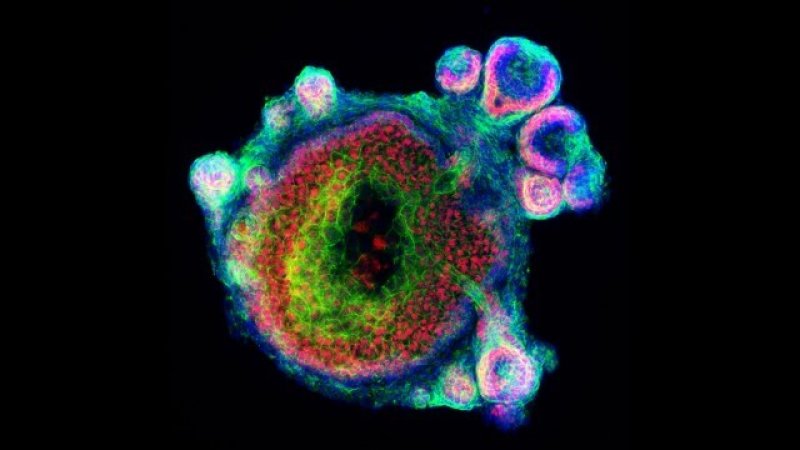
A spherical skin organoid showing the generation of multiple cell layers. Image: Jiyoon Lee/Karl Koehler

Xenotransplantation experiments, generating human organs in animals for transplantation, are being conducted in sheep, pigs, and, recently, in nonhuman primates. Last month, a group of scientists from Spain and the US began to examine the use of monkeys as animal hosts to produce human organs. 

…

There are many scientific and ethical issues emerging from xenotransplantation technologies. For example, will it be ethical to do the experiments necessary to ensure that human stem cells introduced into the animal embryo to form a kidney will not migrate to the animal’s brain to generate human-like behaviors in such animal chimeras?  

…

There is an alternative that we believe avoids several of these scientific and ethical concerns—the use of stem cell technology to develop human organoids. 

…

[There are] scientific groups that are using 3-D technologies to develop mini-organs such as liver, placenta, stomach, lymph nodes, and even brain. 

…

Without making a final ethical judgment on future research using human-animal chimeras as a source of human transplantable organs, we believe that developing human organoids might offer a faster and better scientific and ethical platform to address the crisis in organ transplantation.    

Read full, original post: Develop Organoids, Not Chimeras, for Transplantation

Related Articles

Infographic: Global regulatory and health research agencies on whether glyphosate causes cancer

Infographic: Global regulatory and health research agencies on whether glyphosate causes cancer

Does glyphosate—the world's most heavily-used herbicide—pose serious harm to humans? Is it carcinogenic? Those issues are of both legal and ...

Most Popular

ChatGPT-Image-Sep-23-2026-02_36_39-PM
Viewpoint: After firing the entire National Science Board, Trump reshapes funding initiatives. Here’s the good and the bad.
ChatGPT-Image-Mar-10-2026-01_39_01-PM
Viewpoint—“Miracle molecule” debunked: Why acemannan supplements don’t work
ChatGPT-Image-Sep-10-2026-10_36_07-AM
Viewpoint: Even lousy scientific articles can shield authors when they hype dubious health claims and products
ChatGPT-Image-Sep-30-2026-01_38_36-PM
Viewpoint: Died “with measles” vs. died “from measles”: RFK, Jr.’s dangerously subversive word games
sorghum farmers in kenya FARMERS TREND
Here are all the ways CRISPR gene editing is transforming Africa’s staple crops—and there’s a lot more innovation to come
ChatGPT-Image-Sep-30-2026-01_11_07-PM
How U.S. teamed with Russia to block global human AI weapons oversight
glp menu logo outlined

Get news on human & agricultural genetics and biotechnology delivered to your inbox.