Using synthetic biology to design new kinds of life—and novel drugs to treat diseases

antibiotics
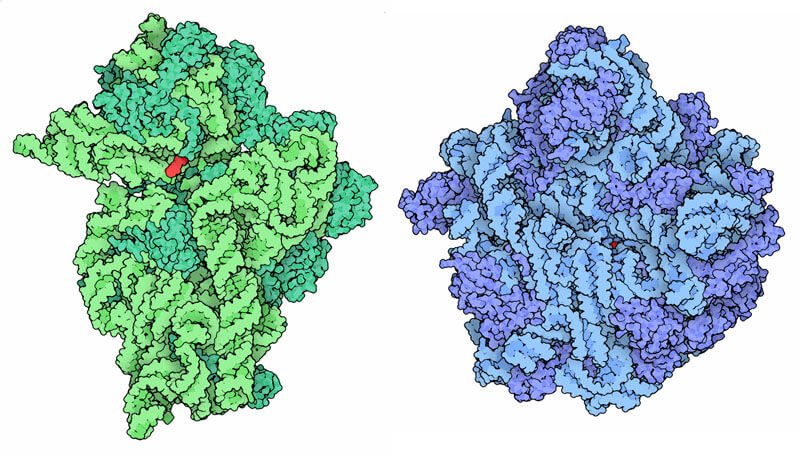
The two units of a ribosome. Image: Protein Data Bank

All living things on Earth are built from proteins created from the same 20 chemical units, called amino acids. Now, scientists at the Medical Research Council’s Laboratory of Molecular Biology, Cambridge, are getting closer to developing polymers composed of new amino acids.

While industrial methods assemble simple chemical units to make polymers, like stringing beads on a thread, the ribosome shuffles the 20 basic amino acids to sculpt elaborate 3D proteins such as enzymes, molecular machines, light sensors and more inside living things. [Jason] Chin’s work paves the way for an engineered ribosome that could assemble a much larger repertoire of amino acids into molecules that, with tens of thousands of amino acids and millions of atoms, could rival the size and complexity of anything in nature.

One potential application could be in a new kind of gene therapy, where an orthogonal ribosome is implanted in a patient to expand the repertoire of drugs to treat disease.

While conventional synthetic drugs are small molecules that are quickly cleared from the body, and GM versions of natural proteins can be chewed up by the body’s immune system, orthogonal ribosomes could mint polymers with precise and long-lasting effects. 

Read full, original post: Weird synthetic proteins could let us build new kinds of life

Related Articles

Infographic: Global regulatory and health research agencies on whether glyphosate causes cancer

Infographic: Global regulatory and health research agencies on whether glyphosate causes cancer

Does glyphosate—the world's most heavily-used herbicide—pose serious harm to humans? Is it carcinogenic? Those issues are of both legal and ...

Most Popular

ChatGPT-Image-Sep-17-2026-12_28_43-PM
Vitamin D, omega-3 fish oil and glucosamine supplements could cause brain damage 
ChatGPT-Image-Mar-10-2026-01_39_01-PM
Viewpoint—“Miracle molecule” debunked: Why acemannan supplements don’t work
ChatGPT-Image-Sep-17-2026-10_17_15-AM
Viewpoint: Why are the less intelligent more likely to be conservative—and smarter people more socially liberal?
Screenshot-2026-09-10-at-12.20.19-PM
'Jet fuel didn't melt the steel': 9/11 conspiracy theories debunked
Screenshot-2026-08-12-at-11.31.46-AM
AI is helping develop new vaccines
Screenshot-2026-09-16-at-12.07.47-PM
The heated debate over trans athletes in the WNBA
Screenshot-2026-09-17-at-10.24.54-AM
Viewpoint: Dubious environmental fears: Why the AI buildout is critical to America’s ecological future
Screenshot 2026-09-11 at 12.39
Child-monitoring apps: When the cure is worse than the harm—and how the technology could be tweaked
ChatGPT-Image-Sep-9-2026-02_48_24-PM
Viewpoint: Trump-RFK Jr. report on “Gender Ideology & Left-wing Ideology’ targets LGBTQ community—and science
ChatGPT-Image-Sep-15-2026-12_15_00-PM
Viewpoint: Women, depression and empathy: Explaining the gender gap in views about child-murderer Lindsay Clancy
Screenshot-2026-09-11-at-2.26.23-PM
Newly approved GMO chestnut trees planted across from the White House are stirring debate
Screenshot-2026-09-10-at-11.50.46-AM
Did COVID vaccines kill 2,500 service members? RFK Jr. hires an investigator who compares vaccine promoters to Nazi doctors
glp menu logo outlined

Get news on human & agricultural genetics and biotechnology delivered to your inbox.