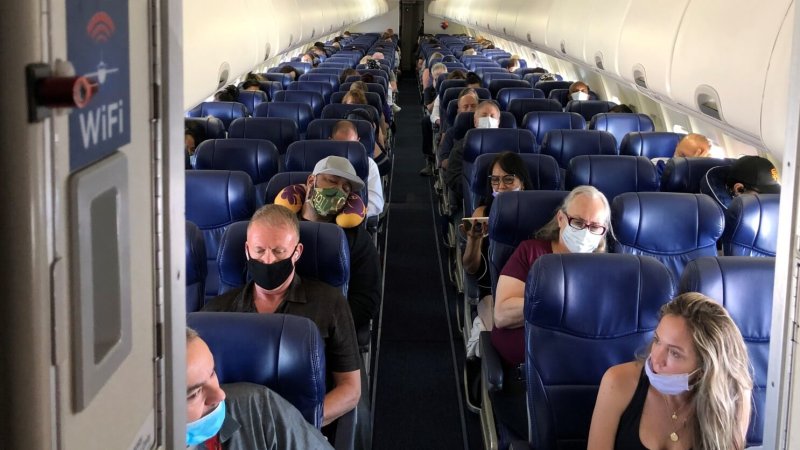
Flying? What are the real risks from COVID?

download
Credit: Christopher Reynolds/Los Angeles Times

In the absence of reliable data, we decided to ask the experts about the possibility of contracting the virus while on a flight. On the whole, airplanes on their own provide generally safe environments when it comes to air quality, but experts said the risk for infection depends largely on policies airlines may have in place.

According to experts, the risk of catching the coronavirus on a plane is relatively low if the airline is following the procedures laid out by public health experts: enforcing mask compliance, spacing out available seats and screening for sick passengers.

Follow the latest news and policy debates on sustainable agriculture, biomedicine, and other ‘disruptive’ innovations. Subscribe to our newsletter.

Airlines frequently note that commercial planes are equipped with HEPA filters, the Centers for Disease Control-recommended air filters used in hospital isolation rooms. HEPA filters capture 99.97% of airborne particles and substantially reduce the risk of viral spread. In addition, the air in plane cabins is completely changed over 10 to 12 times per hour, raising the air quality above that of a normal building.

Because of the high air exchange rate, it’s unlikely you’ll catch the coronavirus from someone several rows away. However, you could still catch the virus from someone close by.

“The greatest risk in flight would be if you happen to draw the short straw and sit next to or in front, behind or across the aisle from an infector,” said [indoor air pollution expert] Richard Corsi.


Read the original post

{{ reviewsTotal }}{{ options.labels.singularReviewCountLabel }}
{{ reviewsTotal }}{{ options.labels.pluralReviewCountLabel }}
{{ options.labels.newReviewButton }}
{{ userData.canReview.message }}

Related Articles

Infographic: Global regulatory and health research agencies on whether glyphosate causes cancer

Infographic: Global regulatory and health research agencies on whether glyphosate causes cancer

Does glyphosate—the world's most heavily-used herbicide—pose serious harm to humans? Is it carcinogenic? Those issues are of both legal and ...

Most Popular

Screenshot-2026-05-01-at-1.29.41-PM
Viewpoint: What happens when whole grains meet modern food manufacturing? Labels don’t tell the whole story.
S
As vaccine rejectionism spreads, measles may be taking a more dangerous turn
ChatGPT-Image-Apr-13-2026-02_20_22-PM
Viewpoint: Misinformation infodemic? Why assessing evidence is so challenging 
Screenshot-2026-04-20-at-2.26.27-PM
Viewpoint — Food-fear world: The latest activist scientists campaign: Cancer-causing additives
ChatGPT Image May 10, 2026, 08_16_59 PM 2
Overmedicalization? RFK Jr.’s antidepressant crackdown raises conflict questions over his fee stake in Wisner Baum, the tort firm built on suing drug makers
ChatGPT-Image-Mar-27-2026-11_47_30-AM-2
FDA’s expedited drug reviews are hailed in some quarters but other approval practices are problematic
Picture1-5
Science Disinformation Gap: The transatlantic battle over social media and censorship
Screenshot-2026-03-13-at-12.14.04-PM
The FDA wants to make many popular prescription drugs OTC—a great idea. Here’s why it’s unlikely to happen
bigstock opioids on chalkboard with rol
GLP podcast: 'Safe injection sites': enabling drug addiction or saving lives?
circular-bioeconomy-should-focus-on-sustainable-wellbeing
GLP podcast: What's wrong with 'doomsday' environmentalism? It's false.
Screenshot-2026-04-12-135256
Bixonimania: The fake disease scam that AI swallowed whole
glp menu logo outlined

Get news on human & agricultural genetics and biotechnology delivered to your inbox.