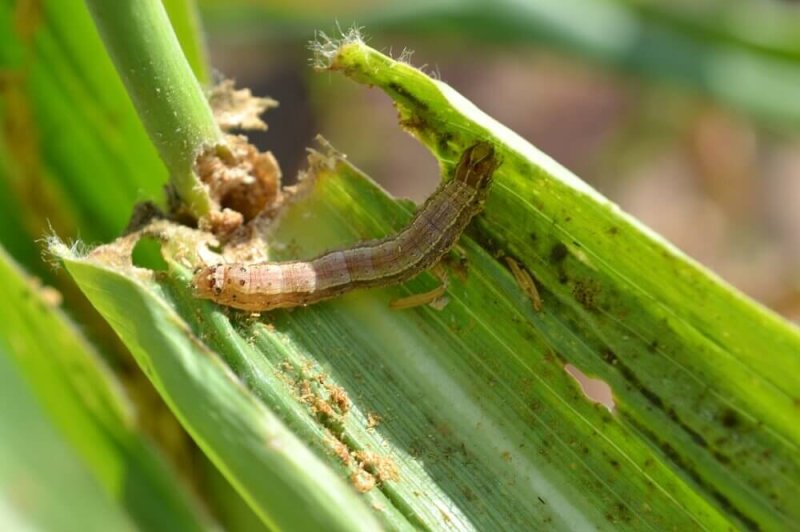
Severe levels of FAW infestation reduced per capita household income by 44 percent and increased a household’s likelihood of experiencing hunger by 17 percent, according to the study conducted by the Centre for Agricultural and Bioscience International (CABI) and published in Food and Energy Security.
It is the first study to explore the income and food security effects of the FAW invasion on a country, specifically, Zimbabwe.
“Our results suggest that while fall armyworm cannot be eradicated, taking actions to at least prevent severe level of infestation can significantly reduce welfare losses in terms of income and food security,” said lead author Dr. Justice Tambo, who is based at CABI’s Swiss Centre in Delémont. “Further studies are, however, needed to determine the threshold level of infestation that does not lead to significant welfare losses. More importantly, it would be useful to investigate which of the control measures can achieve the most positive outcomes that are cost-effective, safe and environmentally sustainable.”

The findings offer additional support for the adoption of genetically modified Bt maize, which has been found to successfully resist FAW in African field trials.
The CABI research looked at survey data obtained from 350 smallholder maize-growing households in six provinces across Zimbabwe. It showed that households affected by fall armyworm were 11 percent more likely to experience food shortages and family members had a 13 percent higher probability of going to bed hungry or going a whole day without eating because of household food insufficiency.
The scientists also discovered that the FAW-affected households who failed to implement a control strategy had a 50 percent lower per capita household income, while farmers who implemented a control strategy did not suffer a significant income loss. Around 30 percent of 185 households who reported a FAW infestation on their farms did not implement any intervention.

Those who did manage to control the pest typically used synthetic pesticides or picked off egg masses and larvae by hand. Other methods included pouring ash or sand into maize whorls, rogueing and burning infested plants and applying detergents.
Fall armyworm was reported for the first time in Zimbabwe during the 2016-17 cropping season and has continued to spread and damage crops there and elsewhere across the continent.
An earlier study found that the pest has the potential to reduce maize production in Zimbabwe by about 264,000 tonnes annually, translating into a revenue loss of US$83 million.
The study was conducted by Tambo and his CABI colleagues in Kenya and Zambia, in collaboration with Zimbabwe’s Ministry of Lands, Agriculture, Water and Rural Settlement.
A version of this article was originally posted at the Cornell Alliance for Science and has been reposted here with permission. The Cornell Alliance for Science can be found on Twitter @ScienceAlly