Viewpoint: The messy details of how lab-grown meat is made

Credit: Lisa Larson-Walker/Thinkstock/Reuters

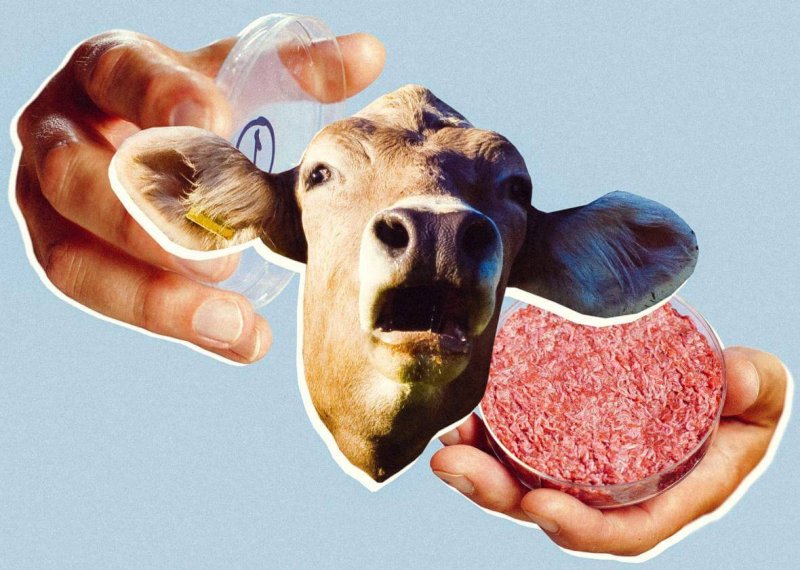
Lab meat—flesh grown in massive tanks instead of in the bodies of sentient animals—offers the promise of having our steak and eating it guilt-free, too.

No vast amounts of water-polluting chemicals to grow feed crops; no low-paid, oft-injured slaughterhouse workers; no climate-warming gases from cow burps or manure lagoons, and no billions of animals slaughtered each year to satisfy our carnivory.

Follow the latest news and policy debates on sustainable agriculture, biomedicine, and other ‘disruptive’ innovations. Subscribe to our newsletter.

Yet several obstacles hold back a new era of widely available animal-free burgers, nuggets, and carnitas. The biggest involves something much less appetizing than chicken dumplings: the blood of unborn cow fetuses, extracted from their mothers after slaughter, [called fetal bovine serum].

The first is expense. FBS sells for upward of $1,000 per liter—a major reason why, to break even on expenses, companies would have to sell their cultured meat for about $200,000 per pound.

The other big problem is optics: You can’t market your product as “slaughter-free,” let alone vegan, when you used a slaughterhouse byproduct to grow it… As a result, cultivated-meat companies are scrambling to find FSB substitutes. Such a “serum-free” growth medium exists, reports the Good Food Institute, a think tank that supports conventional-meat replacements. Trouble is, it currently costs nearly $400 per liter—still way too high to be commercially competitive.


This is an excerpt. Read the original post here.

Related Articles

Infographic: Global regulatory and health research agencies on whether glyphosate causes cancer

Infographic: Global regulatory and health research agencies on whether glyphosate causes cancer

Does glyphosate—the world's most heavily-used herbicide—pose serious harm to humans? Is it carcinogenic? Those issues are of both legal and ...

Most Popular

ChatGPT-Image-Sep-2-2026-10_30_14-PM
Zero: That is the official American measles death toll for 2026. Here is what RFK Jr.’s CDC leaves out.
ChatGPT-Image-Sep-14-2026-11_36_25-AM
How the reckless AI race among Anthropic, OpenAI and China spawned today’s safety crisis
Screenshot-2026-09-10-at-12.20.19-PM
'Jet fuel didn't melt the steel': 9/11 conspiracy theories debunked
ChatGPT-Image-Aug-28-2026-03_33_46-PM
Viewpoint: Bad science—Five bogus Trump administration claims about vaccines and autism
ChatGPT-Image-Mar-10-2026-01_39_01-PM
Viewpoint—“Miracle molecule” debunked: Why acemannan supplements don’t work
ChatGPT-Image-Sep-13-2026-10_24_17-AM
Bayer urges court to approve $7.25 billion Monsanto Roundup settlement that could limit its future liabilities
screenshot at  am
‘Glyphosate is not carcinogenic’: Independent EU chemical oversight agency reaffirms—for the 3rd time in 9 years—that the herbicide is safe-as-used
Screenshot-2026-09-14-at-10.52.30-AM
AI is being used in dangerous bioscience experiments
Screenshot-2026-09-14-at-3.07.56-PM
Trump EPA rolls back power-plant climate rules—and moves to block future carbon limits
ChatGPT-Image-Sep-14-2026-02_57_24-PM
Viewpoint: 6 Atlantic Council expert opinions on the U.S., China and the AI safety crisis
Screenshot-2026-08-04-at-11.36.16-AM
Viewpoint: Emotion-driven stories of doctors allegedly ignoring patient concerns are driving vaccine hesitancy
ChatGPT-Image-Sep-13-2026-10_46_11-AM
“Hit the brakes”: Anthropic warns the race to superintelligence could spawn internet-seizing AI swarms—and empower authoritarians. Here’s how to stop it.
ChatGPT-Image-Sep-14-2026-01_57_57-PM
Anthropic claims to thwart AI-based cyberattacks, surveillance, and biological weapons research
glp menu logo outlined

Get news on human & agricultural genetics and biotechnology delivered to your inbox.