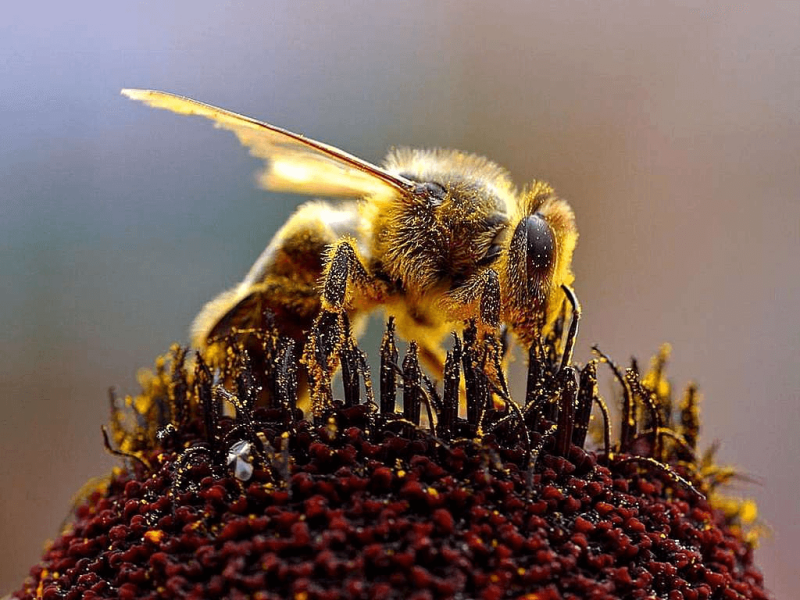

“The traditional methods of bee breeding have been around for nearly 100 years,” said Purdue University’s Brock Harpur, assistant professor of entomology. Although breeders have made progress, many of their methods remain unchanged even with the recent availability of affordable gene sequencing.
“The honeybee genome was sequenced in 2006. There really hasn’t been a lot of bee breeding in this country that’s been empowered by that resource,” he said. Harpur aims to change that with Purdue’s Luiz Brito, associate professor of animal sciences, and Gregor Gorjanc of the Roslin Institute at the University of Edinburgh in Scotland. They seek to validate genomic breeding tools while designing a system that bee breeders can implement themselves.
Their work is among the projects supported by $11.6 million in grants allocated from the U.S. Department of Agriculture National Institute of Food and Agriculture earlier this year to promote healthy pollinator populations. Agricultural pollination production from the beekeeping industry in the U.S. is valued at more than $19 billion annually.
“That excludes honey production, which is another huge industry,” Harpur said. “Bee breeding is central to that. Beekeepers historically have responded to industry threats with breeding. The goal here is to help them do that better with genomics resources.”
Five years ago, with genetic samples priced at $400 each, that prospect would have been costly. But the price has dropped to about $50 per sample. A 2017 economic case study of Canadian honeybee colonies assessed the value of an expensive sequencing technology.
“They were looking at one trait versus the many we’re hoping to predict,” Harpur said. “They showed that if a beekeeper used these more expensive genome-enabled breeding techniques, they could increase their profits by between 9% and 96%. Using genomic technology, we think we can increase the amount of money that beekeepers make.”
Harpur’s lab, which operates a gene sequencing service for beekeepers, has sequenced nearly 2,000 samples from across the country. “If you’re a beekeeper, you can send us a bee, and we’ll sequence it and tell you about it and where it’s from,” he said.
Harpur can use the genotypes from that same database to see how effectively they predict breeding values under ideal conditions. He also uses simulated datasets to explore the statistical validity of his approach on supercomputers at Purdue’s Rosen Center for Advanced Computing.
 Varroa mites central driver of uptick in overwinter honeybee colony losses according to 2018-2019 survey, worrying entomologists
 Pesticides don’t pose acute health risk to honeybees foraging on farmland, two-year study finds
 Deformed wing virus (DWV), one of the deadliest threats to bee health, seems to be evolving to be less harmful


The simulations allow the researchers to assess how many samples are enough to statistically validate their goals.
“If we have a thousand samples, is that enough?” Harpur said. “Do we need 10 times more? A hundred times more? And furthermore, if those thousand samples come from 10 different populations, does that matter?”
The computer simulations also enable the scientists to analyze thousands or millions of honeybee genomes with many different histories and from many different situations to see how well their genomic predictions fit reality. The simulations can even help identify which of the many available genome sequencing methods might work best, Harpur noted.
Harpur works closely with bee breeding organizations nationally, especially the Indiana Queen Breeders Association. Some trials and genomic data collection already have begun. “We’re going to start local, show that this works and then move to a more global scale,” he said.
As an evolutionary biologist, Harpur sees the project as a way to answer questions both for bee breeding and for basic science. How does the artificial selection of bee breeding affect bee colonies, which consist of tens of thousands of highly social individuals?
“They’re all genetically related, and they all collectively manifest these traits that we’re interested in,” he said. “When I talk about honey production, that’s not the action of one bee. That’s the action of thousands of related bees.
“So, when you make a prediction on a single genome for a trait that thousands of individuals contributed to, how exactly does that math work out? And how exactly does selection work in a case like that?”