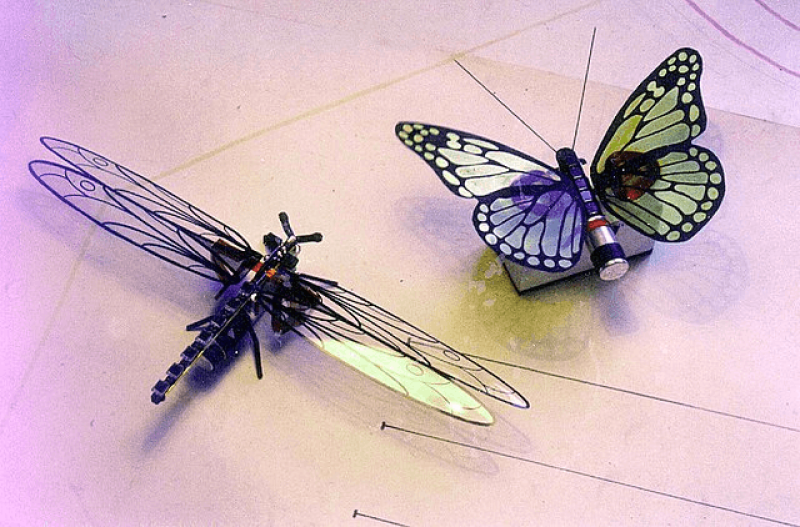
‘Insects are perfect machines’: Bug-mimicking tiny robots can pollinate crops, lift many times their weight

Insect-like robots have long been in development. Credit: U.S. Department of Energy

Insects are the “perfect machines,” faster and stronger than humans relative to size, [mechanical engineer Conor Trygstad] said. They are also tasty to the fish he’s trying to catch, so he has spent hours studying them to perfect his lure.

…

After mimicking the insect on his lure, Trygstad wondered if he could mimic them in his lab.

The two insect-like robots developed from his research are smaller, lighter and faster than micro-robots others have created in the past. They could someday be used for water safety testing, robotic-assisted surgery, artificial pollination, search and rescue, and other purposes.

“Looking at the mechanisms that these insects use, they can do exactly what we want to do. They can transmit forces much larger than their size and weight, and they work in teams collaboratively to build big structures,” Trygstad said.


Mis- and disinformation are distorting science and public policy. Subscribe to our Daily and Weekly Digests for incisive coverage of ‘disruptive’ innovations in AI, agricultural biotechnology, food, chemicals, nuclear energy, vaccines, and other disruptive innovations.

Because of its ability to operate on the surface of the water, a water strider could be used to monitor water for environmental toxins at a much more constant basis than currently possible.

“Our water strider could go around the surface of the water and take data about the water – like temperature, pH levels, different chemicals. And all that could then be constantly being transmitted back to the technician,” he said.


This is an excerpt. Read the original post here

Related Articles

Infographic: Global regulatory and health research agencies on whether glyphosate causes cancer

Infographic: Global regulatory and health research agencies on whether glyphosate causes cancer

Does glyphosate—the world's most heavily-used herbicide—pose serious harm to humans? Is it carcinogenic? Those issues are of both legal and ...

Most Popular

ChatGPT-Image-Mar-10-2026-01_39_01-PM
Viewpoint—“Miracle molecule” debunked: Why acemannan supplements don’t work
Screenshot-2026-09-17-at-1.07.08-PM
'We are dangerously addicted to antidepressants': Should we heed RFK Jr.’s sobering warning?
Screenshot-2026-09-03-at-10.51.20-AM
Viewpoint: Why do online health lies outlive the evidence that debunks them? Read "Everyone Else Is Lying to You"
ChatGPT-Image-Sep-23-2026-01_52_03-PM
Viewpoint: 4 very real AI doomsday scenarios
ChatGPT-Image-Sep-2-2026-02_03_32-PM
How much of a problem is AI’s water use?
Screenshot-2026-09-22-at-11.40.28-AM
After Idaho criminalized abortion providers in 2022, one-third of obstetricians fled. Health care advocates are making rural health the case for repealing the ban
Screenshot-2026-09-23-at-3.15.09-PM
Anti-GMO activists in Pakistan rev up their campaign of dire warnings
ChatGPT-Image-Aug-26-2026-12_46_16-PM
Viewpoint: The fake controversy over whether combining childhood vaccines is dangerous— a debate science resolved 25 years ago
ChatGPT-Image-Sep-22-2026-10_32_46-AM
There has been a slew of recent reports of food recalls and foodborne outbreaks. Do we face an escalating problem?
Screenshot-2026-09-23-at-11.55.01-AM
How can we know if social media bans actually help teens?
Screenshot-2026-09-17-at-12.00.30-PM
Investigative group ProPublica finds links between ectopic pregnancy deaths and abortion bans
Screenshot-2026-09-10-at-12.20.19-PM
'Jet fuel didn't melt the steel': 9/11 conspiracy theories debunked
glp menu logo outlined

Get news on human & agricultural genetics and biotechnology delivered to your inbox.