‘Gene editing is a more elegant way of tackling crop disease than spraying more pesticides’: CRISPR revolution opens door to ‘disaster-proof’ crops

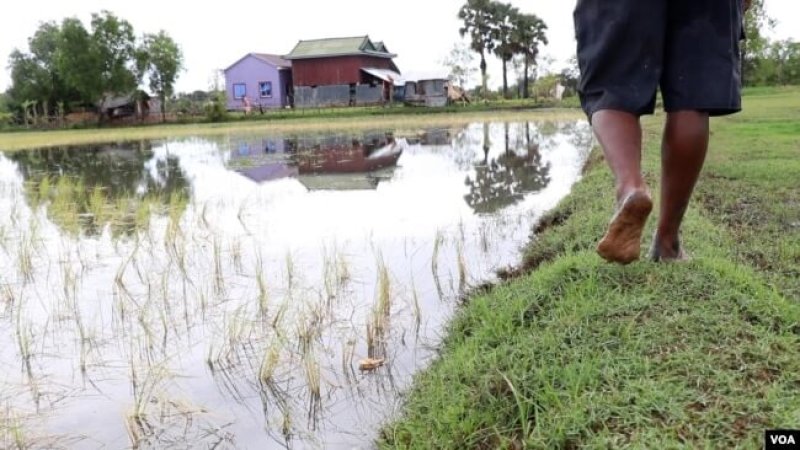
Cambodian rice farmer Prak Nhorn says storms, floods and salt water are ruining rice paddies in his village. A CRISPR edit could make these phenomena a non-issue. Credit: Sun Narin via VOA

Traditional crop breeding can be time-consuming and laborious. Brad Ringeisen, the executive director of the Innovative Genomics Institute (IGI) at the University of California (Berkeley and San Francisco), believes that gene editing using tools like Crispr-Cas9 is the most impactful way of ensuring that crops can withstand disasters.

“It speeds up the innovation cycles. It is a precise tool.”

Mr Ringeisen summarises the IGI’s work on disease resistance in crops: “There are a tremendous number of emerging diseases, and climate change is not helping this.”

He says gene editing is a more elegant way of tackling disease than spraying more pesticides.

Mis- and disinformation are distorting science and public policy. Subscribe to our Daily and Weekly Digests for incisive coverage of ‘disruptive’ innovations in AI, agricultural biotechnology, food, chemicals, nuclear energy, vaccines, and other disruptive innovations.

As well as disease resistance, the IGI is working on drought tolerance. A rice variety that has been gene edited to reduce the number of pores on leaves, reducing water loss, is now in field trials in Colombia. Such tests are necessary to make sure that gene edits don’t lead to unforeseen side effects in practice.

The IGI’s project is one of a number of scientific efforts to make rice less vulnerable to unpredictable water cycles. Scientists at the International Rice Research Institute in the Philippines, for example, have developed a “scuba rice” strain that can withstand weeks of submergence in water during floods.

This is an excerpt. Read the original post here

Related Articles

Infographic: Global regulatory and health research agencies on whether glyphosate causes cancer

Infographic: Global regulatory and health research agencies on whether glyphosate causes cancer

Does glyphosate—the world's most heavily-used herbicide—pose serious harm to humans? Is it carcinogenic? Those issues are of both legal and ...

Most Popular

ChatGPT-Image-Mar-10-2026-01_39_01-PM
Viewpoint—“Miracle molecule” debunked: Why acemannan supplements don’t work
Screenshot-2026-09-17-at-1.07.08-PM
'We are dangerously addicted to antidepressants': Should we heed RFK Jr.’s sobering warning?
ChatGPT-Image-Sep-2-2026-02_03_32-PM
How much of a problem is AI’s water use?
Screenshot-2026-09-03-at-10.51.20-AM
Viewpoint: Why do online health lies outlive the evidence that debunks them? Read "Everyone Else Is Lying to You"
Screenshot-2026-09-23-at-3.15.09-PM
Anti-GMO activists in Pakistan rev up their campaign of dire warnings
Screenshot-2026-09-10-at-12.20.19-PM
'Jet fuel didn't melt the steel': 9/11 conspiracy theories debunked
Screenshot-2026-09-22-at-11.40.28-AM
After Idaho criminalized abortion providers in 2022, one-third of obstetricians fled. Health care advocates are making rural health the case for repealing the ban
ChatGPT-Image-Sep-23-2026-01_52_03-PM
Viewpoint: 4 very real AI doomsday scenarios
glp menu logo outlined

Get news on human & agricultural genetics and biotechnology delivered to your inbox.