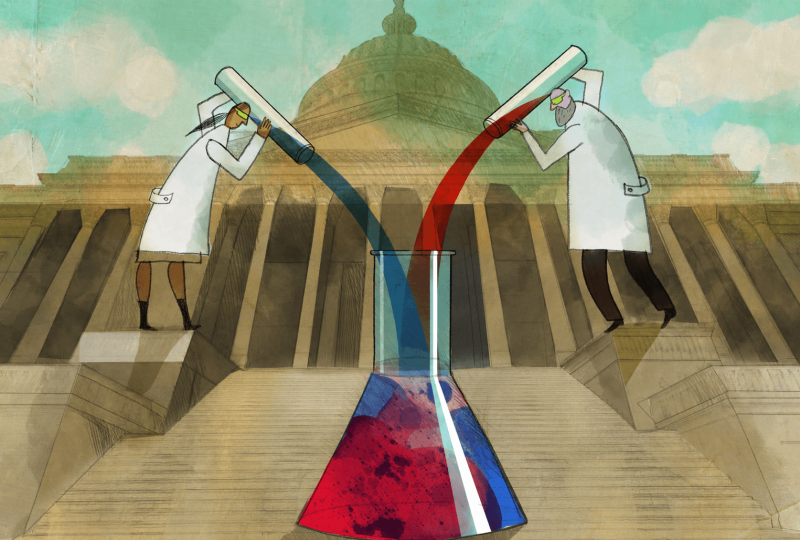
Political science is a social science that studies the workings of government. Lately it seems to have picked up a second definition: Belief in science advanced by a political party.
From nutrition to climate change, science is increasingly treated by media and political parties as a constituent of political parties. The result is science treated as a political belief and therefore bastardized science—which is not really science at all.
A real scientific hypothesis begins as something testable: it can be proven wrong by evidence.
But if you are only interested in politicized hypotheses, there’s no shortage of material—some three-million peer reviewed science publications are published each year, with many millions more already in existence.
In fact, the number of science papers has grown by half since 2016. Many are poorly done and should be retracted, and even when they are well done, they are often just links—many of which are never cited by anyone.
In fields like nutrition and obesity, most of the papers (three out of four) are links—also known as correlations or associations. Links are things that just happen to occur together; they do not mean causation. For example, the number of movies Nicolas Cage appears in each year is correlated with the number of pool drownings.
Every other week, I report some of these link studies, and try to remember to tell you that they are just links. They might be true causation, but most are not, or are causes for only some people. If you think they might help you, and don’t see any harm in trying, then try them, (but ask a professional first if you are concerned about harm).
Meanwhile, become aware of political, or politicized science, and do not let your beliefs be affected by people who have a vested interest in getting you to believe what they are selling.
One way to think about this is to avoid the extreme claims. Some of what each party says is likely to be true but, the more extreme the claim, the less faith you should place in it.
One party has made a point of trying to believe an extreme claim about global climate change. It rested on a model that assumed that the world would not make any further change in climate-related measures (like going back to coal) causing a global catastrophe. The IPCC was eventually forced to drop it—even though it had already been widely broadcast by a gullible media.

On the other side of the political ledger, the social science claim was made that imposing tariffs on foreign goods will make a country grow and become richer. Two top economists have completely debunked that notion. This side has also offered extreme nutrition advice to eat more meat and saturated fat.
Avoiding the science extremes on either side of the political ledger, or in most aspects of life, has support in multiple areas. Here are three examples:
- Goldilocks discovered the principle when she entered the house of the three bears while they were out. She tasted Papa Bear’s porridge but found that it was too hot. Mama Bear’s porridge was too cold, but Baby Bear’s porridge was “Just right.”
- Homeostasis is the biological principle for regulating internal systems like temperature and oxygen levels. It keeps them “just right” so your body keeps functioning, and it includes keeping your blood pressure right as well as your fluid balance.
When things get too far outside of what works, the hypothalamus sends either positive or negative feedback to return to the right levels. Inflammation is a perfect example. When you have an infection or an injury in your body your immune system will begin to repair the damage. This causes inflammation that directs the immune cells where to go to help—a good thing. But when your immune system does too much, inflammation attacks either the wrong parts of the body or overdoes it—causing excess inflammation. The result of excess inflammation is chronic diseases like cancer and heart disease. - Sidhartha Gautama (the Buddha) preached that, to create happiness for both you and others one should follow, the “Middle Way,” neither denying yourself everything (severe asceticism) or indulging in everything, (sensual indulgence).
Maybe people will begin to move away from believing politicized “truths” as they move away from the political parties.
- 1952: 22% of voters were independent, i.e., not aligned with either party.
- 2002: 33% of voters were independent and voters were split evenly with about one third (33%) registered to each of the other two parties.
- 2025: 45% of voters were independent with 28% going to each party.
As political parties move to more extreme positions, more voters are abandoning them, doubling the percentage of independents in the last 73 years.
Hopefully, abandoning them politically will also translate into abandoning politicized science and, at a minimum, having a more skeptical view of media’s championing extreme claims made by either side.
Richard Williams is a Senior Affiliated Scholar, the former Director of the Regulatory Studies Program, and the former Vice President of Policy Research at the Mercatus Center at George Mason University. He is also the author of Fixing Food: An FDA Insider Unravels the Myths and the Solutions. Follow Richard on Substack
A version of this article was originally posted at the Public Health Without Politics Blog and has been reposted here with permission. Any reposting should credit the original author and provide links to both the GLP and the original article.