

Heritable genome editing in human embryos is once again under intense scrutiny after the publication of an opinion piece in Trends in Genetics. In the paper, Cathy Tie, the founder and chief executive officer of the startup Origin Genomics, proposes that recent advances in genome editing technologies and an increase in public support might finally convince regulators to lift restrictions on the controversial field.
Scientists Claim They Have Overcome Technical Barriers
Tie said in an interview with NPR that she and her team at Origin are working with human embryos donated by couples who carry inherited genetic mutations that cause conditions such as Huntington’s disease, cystic fibrosis, Tay-Sachs, and hereditary cancers. By extracting stem cells from the embryos, the researchers can test different existing genome editing systems, such as CRISPR-Cas9, to see which will safely edit the disease-causing mutations. They are also using artificial intelligence to design new precision-editing systems and testing them in induced pluripotent stem cells that carry relevant mutations.

“My hope is that one day Origin Genomics can help couples and families with these hereditary diseases not pass them down to their children, and still have as many healthy children as they’d like,” Tie said, according to the Origin Genomics news page.
Human germline editing caused a stir in 2019 when, despite a moratorium, Chinese scientist He Jiankui edited human embryos and forged ethical review documents to have them implanted into human mothers. Subsequently found guilty of illegal medical practices in China, He was sentenced to three years in prison.
The United States has severely limited funding for any research that involves germline editing in human embryos, and the FDA is banned from even considering requests to approve clinical trials “in which a human embryo is intentionally created or modified to include a heritable genetic modification,” according to the bill.
However, Tie claims that with the severe unmet medical need and substantial improvements in editing technologies since the practice was made illegal, now is the time for regulators to reconsider the ban. “The technical barriers that halted earlier generations of embryo editing, including off-target editing, large deletions, chromosomal abnormalities, and mosaicism, are being overcome through advances in precision genome editing,” Tie remarked in the paper.
Ethical and Regulatory Obstacles to Germline Editing Remain
One of Tie’s arguments is that in vitro fertilization technology was once just as controversial among scientists and members of the public as germline editing is now, suggesting that it’s only a matter of time before it becomes the norm. And she’s not alone—another germline editing startup, Preventive, launched in 2025 with the tagline ‘Preventing Disease Before Birth.’
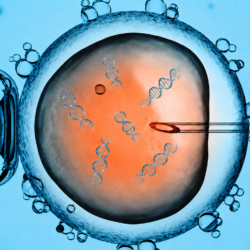




Despite burgeoning support from the public and funding from venture capitalists and entrepreneurs, many ethicists and genome editing experts fundamentally disagree with germline editing efforts, citing a range of concerns from basic safety to eugenics and ‘designer babies.’ “I just don’t think they’re being honest with us about why they’re really doing this,” said CRISPR pioneer Fyodor Urnov, of the University of California, Berkeley, in an interview with NPR. “They’re really in the business of embryo—and thus ultimately baby—improvement.”
Tie and her team at Origin hope to convince Congress to lift the current ban to allow the FDA to consider applications to test therapeutic germline editing in clinical trials. “I think that if you have a technology that can be proven to be safe, and it can help hundreds of millions of people that suffer from these diseases, it is unethical to not pursue this research,” Tie told NPR. “My hope is that humanity can capture the upside of this technology.”
Rebecca Roberts is a science writer and communicator. Find Rebecca on LinkedIn
A version of this article was originally posted at The Scientist and has been reposted here with permission. Any reposting should credit the original author and provide links to both the GLP and the original article. Find The Scientist on X @TheScientistLLC