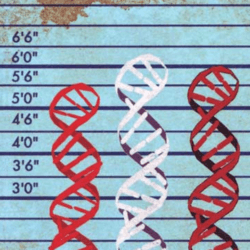
Do certain genes determine someone’s “criminal” nature?

The GLP aggregated and excerpted this blog/article to reflect the diversity of news, opinion and analysis.

[The year 1871 brought about] the theory of ‘the criminal man’, the idea that certain people are biological criminals. According to [talian criminologist Cesare Lombroso], these people represented an evolutionary throwback who…had inherited the brain structure of their primitive forbearers…At trials, Lombroso could identify a guilty person simply by observing his physical features.

…

The idea remained popular until an international team of scientists definitively debunked it with a much larger study in 1976.

You would think that after all these misbegotten studies scientists would have given up on their efforts to find a biological basis for crime. But no: in recent years there’s been a renewal of the science, most recently in the studies of an apparent ‘warrior gene’ that makes some men…inherently violent.

…

[I]t’s hard not to come to the conclusion that biology plays some role in criminal behaviour, impossible to quantify. The new science of epigenetics proposes an interaction between environment and heredity[.]

‘In this context,’ writes [Adrian] Raine, ‘how moral is it for us to punish many criminals as harshly as we do?’


Read full, original post: The inheritance of crime

Related Articles

Infographic: Global regulatory and health research agencies on whether glyphosate causes cancer

Infographic: Global regulatory and health research agencies on whether glyphosate causes cancer

Does glyphosate—the world's most heavily-used herbicide—pose serious harm to humans? Is it carcinogenic? Those issues are of both legal and ...

Most Popular

ChatGPT-Image-Mar-10-2026-01_39_01-PM
Viewpoint—“Miracle molecule” debunked: Why acemannan supplements don’t work
Wave Crest Over Red Cross
Viewpoint: Here are the election-inspired Trump administration healthcare policy reversals expected in the coming months
Aerial Sprayer Over Gradient Fields
Farming, food, and chemicals: Post-midterms, the MAHA alliance between Democrats and MAGA Republicans is bruised but not cowed. What comes next?
Microscopic IVF Egg Injection
With technical barriers to human embryo editing falling, ethical concerns escalate
Picture1
Viewpoint: How badly is the U.S. food-safety net fraying? FDA’s bungled handling of the tainted lettuce crisis deepens concerns over cuts to disease tracking and response
Screenshot 2026-10-27 at 10.32
“Do your own research”: What Medicare’s annual open enrollment circus teaches us about the seductive trap of DIY health and science
Prescription Capsules Scattered on Twenty-Dollar Bills
Facts & Fallacies podcast: America's health care system is broken. A doctor explains how to fix it, Part 2
Bayer Crop Circle in Golden Wheat
Making fertilizer from thin air: Bayer’s gene-editing innovation could dramatically cut chemical fertilizer use in growing food
Screenshot-2026-10-21-at-11.30.51-AM
Viewpoint: Yes, our food system stinks, but the attack of ultra-processed foods is often misplaced
glp menu logo outlined

Get news on human & agricultural genetics and biotechnology delivered to your inbox.