


Ancestry & Evolution
Was human brain growth driven by ecological challenges?
Most animals have brains in proportion to their body size – species with larger bodies often have larger brains. But ...

Water world: Does the evolution of intelligent life require land?
Exoplanets come in a variety of types, and so-called “water worlds”—planets with at least ten percent of their total mass ...

Cooperation in a time of chaos: Ancient Kenyan burial ground shows evidence of ‘social unity’
For millions of years, the Turkana Basin in northern Kenya has been a cradle of humanity. … Around 5,000 years ago, the ...

Was a gene mutation responsible for bigger human brains?
One of the major features that distinguish humans from other primates is the size of our brains, which underwent rapid ...
Video: Why gene editing could change the path of human evolution
Most people think the genetics revolution is primarily about healthcare. But what's really at play is the evolutionary trajectory of ...

Why evolution is more complicated than Darwin imagined
Darwinian evolution [is] the transmission of genes and traits down the family line. DNA, it turns out, can also be ...

Discovering a ‘third kingdom’: How this scientist upended Darwin’s ‘tree of life’
On Nov. 3, 1977, a new scientific revolution was heralded to the world — but it came cryptically, in slightly ...
From dinosaur to bird: How did the transformation take place?
[I]n Bavaria, the Jurassic-aged limestone deposits yielded a near-perfect fossil of Archaeopteryx. It had blade-like serrated teeth and many other features ...

98: That’s how many humans it would take to start over on another planet
Are we too vulnerable to asteroid strikes and other cataclysms to stick with our single planet? … Frédéric Marin is ...

‘Zombie gene’ could explain why elephants rarely get cancer
[B]igger animals, which have more cells, should have greater occurrences of cancer. By that reasoning, elephants, with hundreds of times ...
‘Remarkable’ love child: Here’s what happened when a Neanderthal met a Denisovan
In a remarkable twist in the story line of early human evolution, scientists have announced the discovery of “Denisova 11”—a ...
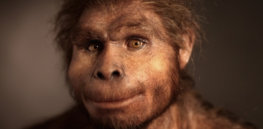
Viewpoint: Here’s why it’s ‘moronic’ to suggest that Homo erectus was lazy
[Y]ou’ve probably seen a headline or two (or twelve) touting a new discovery about our long extinct human relative, Homo erectus ...

Alpha: Examining Hollywood’s tale of dog domestication
Long ago, before your four-legged best friend learned to fetch tennis balls or watch football from the couch, his ancestors ...
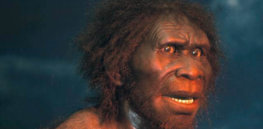
Did laziness drive early human relative, Homo erectus, to extinction?
Homo erectus may have gone extinct because they were lazy, according to research from the Australian National University. Scientists claim ...

Are mental disorders linked to the tweaking of genes in human evolution?
The same recent evolutionary changes that make humans prone to bad backs and impacted wisdom teeth may also tweak genes ...
Ancient genetic oddity makes whales and other aquatic mammals deadly susceptible to common pesticides
Over the past 50 million years, a group of small, hoofed mammals gradually evolved into today’s whales and dolphins. In ...

Were there two migration routes into North America? Genetics meets archaeology
Popular accounts of the peopling of North America paint a picture of a lone long-ago trek across the Bering Land ...
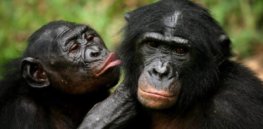
Why other primates can’t talk: It’s all in the brain
Compared to humans, most primates produce a limited range of vocalizations: At one end of the spectrum, there’s the Calabar angwantibo, ...
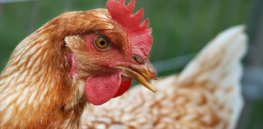
Talking Biotech: Chicken is the most widely grown animal in the world, but where did this popular bird come from?
Chicken is essential to modern agriculture, but where did it come from? Oxford University's Dr. Greger Larson explores this popular ...

What are the odds that aliens might actually look similar to us?
In his new book, Equations of Life: How Physics Shapes Evolution, Charles Cockell from the University of Edinburgh makes the argument ...
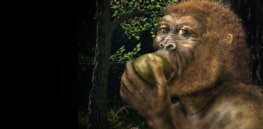
Delving into our 10 million-year relationship with booze
It was conventional wisdom that the human love affair with alcohol began 10,000 years ago, with the invention of agriculture ...

Tamed foxes could help unravel complex genetics behind social behavior
[D]omestication, based purely on behavioral traits, can result in other changes — like curlier tails and changes to fur color ...

Challenging our understanding of the genetics behind the evolution of human language
The evolution of human language was once thought to have hinged on changes to a single gene that were so ...

No link found between Flores Island pygmies and ancient ‘hobbits’ in study
Geneticist Serena Tucci sat in the small Indonesian village of Rampasasa on Flores Island, the only woman in a room full of ...
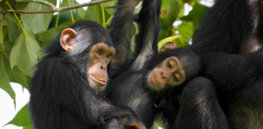
Can we learn about ourselves by studying chimpanzees? Not really.
Trying to go back to our animal roots sounds good in theory, but we can't truly find out what it ...
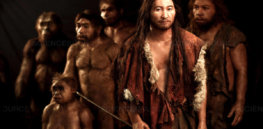
Jack of all environments: Is this why Homo sapiens survived and thrived?
When paleoanthropologists and archaeologists define what makes our species unique, they usually focus on our use of symbolism and language, ...
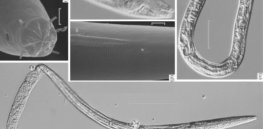
Ancient worms resurrected after spending more than 32,000 years on ice
A team of Russian scientists is lining themselves up to be the opening cast of a John Carpenter film. Earlier ...
