


Ancestry & Evolution
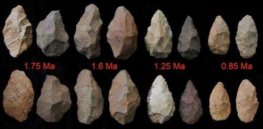
Did our ancestors’ development of complex tools spur the growth of language?
[A] new body of research [is] arguing that if not for our hominin ancestors’ hard-earned ability to produce complex tools, ...

We may owe our existence to plate tectonics
[T]here’s more to plate tectonics than earthquakes and eruptions. A wave of new research is increasingly hinting that Earth’s external ...

Are we closer to finding life on Mars?
Organic matter has been found on Mars in soil samples taken from 3 billion-year-old mudstone in the Gale crater by ...

Are age-related diseases the result of evolutionary tradeoffs favoring the young?
While granting human species some advantages over our primate cousins, recent genomic adaptations appear to have come at a cost ...
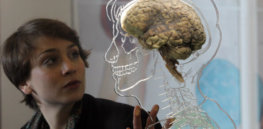
How did our brains get so big?
By studying [brain organoids, researcher Frank] Jacobs could look for genes that are switched on more strongly in the growing ...
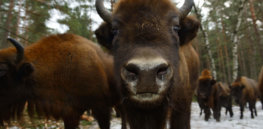
For all types of life, genetic diversity is ‘about the same’
Who would have suspected that a handheld genetic test used to unmask sushi bars pawning off tilapia for tuna could ...
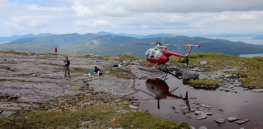
17,000-year-old route to North America could redefine human migration history
The first people to cross into North America from Eurasia did so by traveling through the Bering Strait, or so ...

Inca origins: DNA analysis supports a pair of foundational myths
Researchers from Peru, Brazil and Bolivia, who have been tracing the origins of the Inca civilization, have confirmed two of the ...

Humans have always been overwhelmingly right-handed. We still aren’t sure why.
Nine out of 10 humans are considered right-handed. “It doesn’t matter where you find them, humans have that ratio,” says ...

Are humans truly evolving or are we just genetically ‘drifting’?
Evolution may be responsible for a range of complex traits, including height and waist-to-hip ratio, and diseases such as schizophrenia, ...
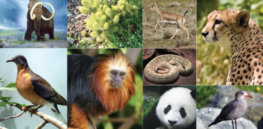
Big data meets taxonomy: Classifying animal species with ‘DNA barcoding’
[T]axonomy – the science of classifying organisms – would be so much easier if life forms came with barcodes… Interestingly enough, ...

Ancient human species with orange-sized brain could have possessed modern human intelligence
An ancient species of human with a brain no larger than an orange may have possessed intelligence to rival that ...

Astronomical cycles may have influenced animal evolution on Earth
A team of researchers from the United States and New Zealand took a look at how likely species were to ...
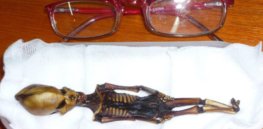
Who owns the DNA of ancient humans—and do they have rights?
The remains of a 6-inch long mummy from Chile are not those of a space alien, according to recently reported ...
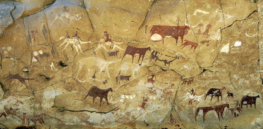
Ancient art may have been created by people with autistic traits, study suggests
Much of the world’s earliest great art is likely to have been created by gifted early humans on the autism ...
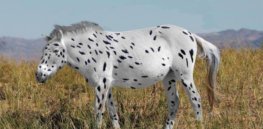
Ancient DNA analysis reveals Botai hunter-gatherers first domesticated horses
[W]ho first domesticated horses is a hotly debated question. One leading hypothesis suggests Bronze Age pastoralists called the Yamnaya were ...
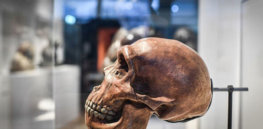
Neanderthal ‘mini brains’ created from ancient DNA could illuminate human brain biology
Scientists are preparing to create “miniature brains” that have been genetically engineered to contain Neanderthal DNA, in an unprecedented attempt ...
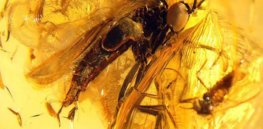
What caused the 60-million-year insect fossil gap?
Insects are everywhere—in the air, on the ground, in the ground, and sometimes in your house and food. Yet there ...
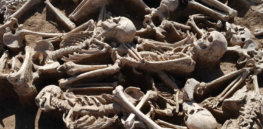
Extinct strain of hepatitis B found in human remains suggests virus had greater diversity
Despite its prevalence, little is known about the ancestral roots of the [hepatitis B] virus. New findings, published [May 9] in Nature, ...

How ‘human errors’ challenge intelligent design theory
When Charles Darwin first proposed natural selection as the mechanism of evolutionary change, he provided many different lines of reasoning ...

Sex in space? An awkward talk we will need to have
As the prospect of Mars colonization grows on the public radar screen, sex talk is not as much taboo that ...

Carnivorous waterwheel plant ten times faster than Venus flytrap
Scientists have characterised the movement of the Venus flytrap's aquatic cousin in detail for the first time. The carnivorous Aldrovanda vesiculosa, ...

What a headache: Genetic adaptation to cold weather also gave us migraines
A human genetic variant in a gene involved in sensing cold temperatures became more common when early humans migrated out of ...
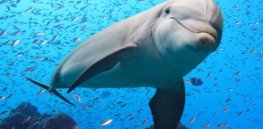
Searching for alien intelligence and how dolphins can help
The return to dolphins as a model for alien intelligence came in 1999, when SETI Institute astronomer Laurance Doyle proposed using information ...

King David’s United Monarchy: Is this 3,000-year-old Israeli house evidence of ‘lost’ biblical kingdom?
Archaeologists have discovered a sprawling, possibly 3,000-year-old house that suggests a biblical kingdom called the United Monarchy, ruled by King ...

Which of our hominid ancestors forged stone weapons used to kill rhino in the Philippines 700,000 years ago?
Stone tools found in the Philippines predate the arrival of modern humans to the islands by roughly 600,000 years—but researchers aren’t ...

The ‘Big O’: How and why evolution brought us the female orgasm
Female orgasms aren’t necessary for reproduction. A comparative evolution study suggests they once might have been ...
