



Ancestry & Evolution

Genetics may explain why elite divers of Southeast Asia can hold their breath so long
When a human is submerged in water, within seconds the body begins to reflexively adjust. The heart rate slows; blood ...
Viewpoint: Kevin MacDonald won’t accept evidence supporting alternative theories about Jewish influence
Kevin MacDonald now says that his “central goal has been to describe intellectual and political movements that were influential. The ...
Kevin MacDonald responds to criticism of his theory of Jewish ethnocentrism and influence
Nathan Cofnas’s GLP article summarizes some of his points from his previous two comments on my work, and, although he ...
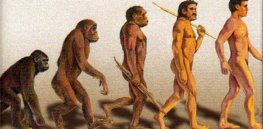
Walking upright emerged long before modern humans
The question of whether our early ancestors walked fully upright or in a crouched position, like apes, has long been ...

Life could have originated from ancient uranium-powered ‘nuclear geyser’
Life may not have originated in the primordial soup of an ancient pond, according to scientists, but rather in a ...
Persistence and perspiration: How sweating allowed humans to dominate other species
Millions of years ago, digestion consumed most of the calories we ate. These days, our brain takes 20 times more energy than ...

Why your startle reflex is like an ‘exploitable data breach’
[T]he startle reflex might be an evolutionary point of origin for many of our most common human emotional expressions. When ...
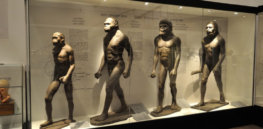
Stronger understanding of evolution may counter science denialism
Science denialism can seem intractable, and studies on the topic are seldom encouraging. For example, research out of Yale Law ...
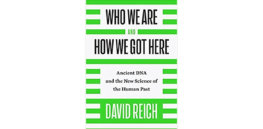
Review: David Reich’s ‘Who We Are and How We Got Here’ fails to examine ethical issues around DNA research
In Who We Are and How We Got Here, David Reich gracefully describes how recent advances in genomics have enabled ...
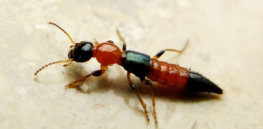
The rove beetle may help us ‘answer questions about evolution’ other insects can’t
It is rare that a new organism is introduced as a model for study in biology, but Dr. [Joseph] Parker ...

Early North American settlers brought dogs more than 10,000 year ago
A trio of dogs buried at two ancient human sites in Illinois lived around 10,000 years ago, making them the oldest ...

Could humans be Earth’s second civilization?
“How do you know we’re the only time there’s been a civilization on our own planet?” [said Goddard Institute for ...

Eating rare farm animal breeds could actually save them from extinction
When you think about Britain’s endangered animals, hedgehogs, small tortoiseshell butterflies and puffins may spring to mind. But rare breeds ...
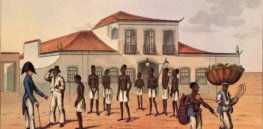
Uncovering ‘hidden stories of slavery’ in modern Latin American DNA
If you walked the cobblestone streets and bustling markets of 16th and 17th century Mexico City, you would see people ...

Without solar superstorms, Earth could have been an uninhabitable gaseous ‘mini-Neptune’
Gigantic solar storms may have helped strip unwanted gases from the Earth’s atmosphere, while helping to seed its surface with ...
Viewpoint: Universe started with a bang, will end with a frigid ‘slow, gradual death’
When will our universe reach the point of maximum entropy? And what other possibilities exist for our universe in the ...

Transhumanism could push human evolution into hyperdrive. Should we embrace it?
Some people believe that we can enhance human life through embracing biotechnology and genetic engineering, but should we? ...

What fossilized teeth tell us about human evolution
Examining the fossil record through the lens of evolutionary developmental biology may help scientists reassess the evolutionary history of humans ...
Can humans reproduce in space? NASA wants to know
If the thought of conceiving in space or the potential of one day giving birth there seem unimaginable and far-fetched ...

Traits of masculinity: What does it mean to ‘be a man’?
There are commonalities of human behavior that extend beyond any geographic or cultural boundary. Every known society has a sexual ...
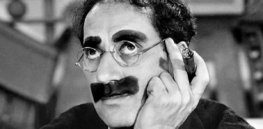
Evolution of the eyebrow and why it’s so important for communication
Modern humans might never have raised a quizzical eyebrow had Homo sapiens not lost the thick, bony brows of its ancient ...

Viewpoint: Precision medicine based on white populations could ‘reinforce existing societal and economic inequalities’
Sequencing the human genome has shown us that we are mostly all made up of the same stuff, but it’s ...
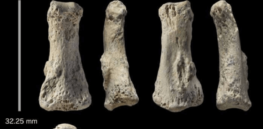
Discovery of ancient finger in Saudi Arabia suggests humans left Africa 20,000 years earlier than assumed
It’s just a lone, boney middle finger, but the scientists who found it say it’s the oldest directly dated fossil ...

Trellises not trees: Human populations have split, reformed and remixed over millennia
The ingrained notion – that there has only ever been one species of human being, Homo sapiens – is a latterday fiction ...

Analyzing Kevin MacDonald’s ‘Culture of Critique’ and the alt-right’s embrace of anti-Jewish ideology
The biblical commentator Rashi observes that in order for a falsehood to be successful, it has to contain at least ...
About phosphorous and why extraterrestrial life may be a long shot
Phosphorus is an essential element for life — but that there was enough of it for life to start on ...
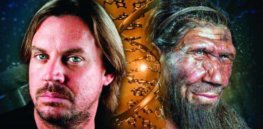
Why humans and Neanderthals look so different
Compared to modern humans, Neanderthals had heavy eyebrows, huge noses, and large, long faces that bulged forward. Using 3D computer ...
