Cancer cure? Patients’ blood reprogrammed to destroy diseased cells

Screen Shot at AM

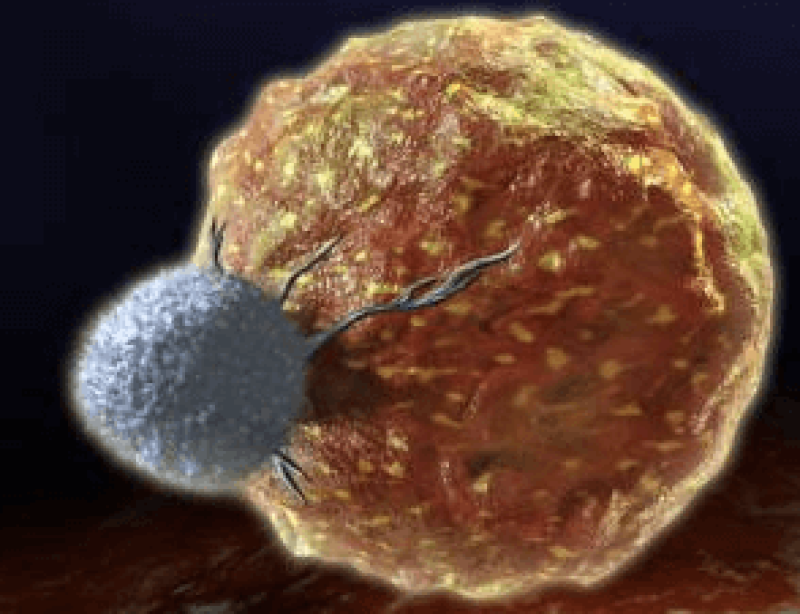
The blood cells of cancer patients, reprogrammed by doctors to attack their leukemia and re-infused back into the patients’ veins, led to complete remissions in 27 of 30 people. That’s especially exciting because those patients had failed all conventional treatments.

The report, published in the New England Journal of Medicine, is an extension of data presented  previously at the American Society of Hematology’s annual meeting. Not all of the remissions lasted, the report showed. Nineteen patients in the study remain in remission 2 to 24 months later, and 15 of them didn’t need any additional treatment. Seven patients relapsed between 6 months and 9 months after their infusion; those included three people whose cancers spread beyond the blood cells the new treatment targets. Five patients left the study for alternative therapy.

The numbers are remarkable because these patients had cancer return as many as four times before they joined the study, including some whose cancer had returned after stem cell transplants, said Carl June, the leader of the research team and an immunotherapist at the University of Pennsylvania. In other words, these people were the sickest of the sick.

Read full. original article: Lab-made blood cells hunt cancer, leading to remissions


{{ reviewsTotal }}{{ options.labels.singularReviewCountLabel }}
{{ reviewsTotal }}{{ options.labels.pluralReviewCountLabel }}
{{ options.labels.newReviewButton }}
{{ userData.canReview.message }}

Related Articles

Infographic: Global regulatory and health research agencies on whether glyphosate causes cancer

Infographic: Global regulatory and health research agencies on whether glyphosate causes cancer

Does glyphosate—the world's most heavily-used herbicide—pose serious harm to humans? Is it carcinogenic? Those issues are of both legal and ...

Most Popular

ChatGPT Image May 10, 2026, 08_16_59 PM 2
Overmedicalization? RFK Jr.’s antidepressant crackdown raises conflict questions over his fee stake in Wisner Baum, the tort firm built on suing drug makers
Picture1-5
Science Disinformation Gap: The transatlantic battle over social media and censorship
Screenshot-2026-05-08-at-3.40.33-PM
Seeds of power: China turns to genetic engineering to become global superpower
Picture1-14
When superbugs threaten vulnerable children: Can AI help solve antibiotic resistance?
S
As vaccine rejectionism spreads, measles may be taking a more dangerous turn
ChatGPT-Image-Apr-13-2026-02_20_22-PM
Viewpoint: Misinformation infodemic? Why assessing evidence is so challenging 
Screenshot 2026-05-08 at 3.01
Transforming farming and nutrition with AI and robotics? Larry Ellison’s half-billion-dollar Hawaii greenhouse dream goes bust
Screenshot-2026-05-01-at-1.29.41-PM
Viewpoint: What happens when whole grains meet modern food manufacturing? Labels don’t tell the whole story.
Farmers can talk to plants
Farmers are a major source of misinformation—about farming
Screenshot-2026-04-20-at-2.26.27-PM
Viewpoint — Food-fear world: The latest activist scientists campaign: Cancer-causing additives
ChatGPT-Image-May-8-2026-01_41_33-PM-3
Viewpoint: Surge of climate misinformation traced to right wing and anti-wind activists 
Screenshot-2026-03-13-at-12.14.04-PM
The FDA wants to make many popular prescription drugs OTC—a great idea. Here’s why it’s unlikely to happen
ChatGPT-Image-Mar-27-2026-11_47_30-AM-2
FDA’s expedited drug reviews are hailed in some quarters but other approval practices are problematic
glp menu logo outlined

Get news on human & agricultural genetics and biotechnology delivered to your inbox.