Could spinach gene save orange industry?

Orange juice has been an American breakfast staple for decades, adding a much-needed pop of color (and vitamin C) to the neutral hues of cereals and pancakes typically found at the morning table. Of the 170.9 million boxes of citrus harvested in Florida during the 2011-2012 growing season, 90 percent was processed into juice.

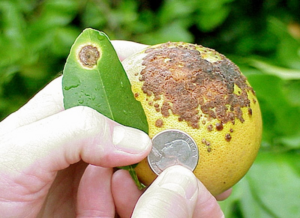
Oranges, and orange juice in particular, is big business – the on-tree value of the 2011-2013 Florida crop is estimated $1.35 billion – and extremely important to growers and consumers, alike. But, the industry is facing its biggest challenge yet as they fight a plant epidemic known as “citrus greening.”

How Is Citrus Greening Being Treated?

To date there is no cure. Since the disease is insect vectored, it is almost impossible to control the spread from infected groves. Many groves are just abandoned while some groves burn trees. Others implement an advanced nutrition program applying trace nutrients to the leaves or to the roots, which in some cases has helped infected trees maintain yields. 

How Do Genetic Solutions Fit In To All Of This?
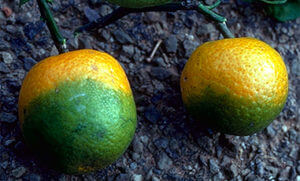
New genetics are helping breed trees that don’t get the disease or show symptoms at all. In “transgenic citrus,” trees have a gene added to confer resistance or tolerance to the disease. In fact, there is a gene from spinach that seems to help the tree grow fine with infection. 

“The genes from spinach should not have any effect on the normal growth of the citrus plants. The genes are just providing resistance/tolerance against citrus greening, so the trees can survive and be healthy. The field trials we have in place will confirm this,” says Dr. Erik Mirkov, a Professor with Texas A&M AgriLife Research, and a faculty member in the Department of Plant Pathology and Microbiology in Weslaco, Texas at the Texas A&M AgriLife Research and Extension Center. Mirkov discovered and developed the spinach gene therapy in his lab.

Read full, original article: The Fight to Save Our Oranges

Related Articles

Infographic: Global regulatory and health research agencies on whether glyphosate causes cancer

Infographic: Global regulatory and health research agencies on whether glyphosate causes cancer

Does glyphosate—the world's most heavily-used herbicide—pose serious harm to humans? Is it carcinogenic? Those issues are of both legal and ...

Most Popular

ChatGPT-Image-Mar-10-2026-01_39_01-PM
Viewpoint—“Miracle molecule” debunked: Why acemannan supplements don’t work
Screenshot-2026-09-10-at-11.50.46-AM
Did COVID vaccines kill 2,500 service members? RFK Jr. hires an investigator who compares vaccine promoters to Nazi doctors
Screenshot-2026-09-11-at-2.26.23-PM
Newly approved GMO chestnut trees planted across from the White House are stirring debate
ChatGPT-Image-Sep-13-2026-10_24_17-AM
Bayer urges court to approve $7.25 billion Monsanto Roundup settlement that could limit its future liabilities
Screenshot-2026-09-10-at-12.20.19-PM
'Jet fuel didn't melt the steel': 9/11 conspiracy theories debunked
ChatGPT-Image-Sep-15-2026-05_59_18-PM
RFK Jr. spent two years distancing himself from Children’s Health Defense. Now he’s keynoting its anti-vaccine DC conference.
Screenshot 2026-09-10 at 11.28
A meaty problem: How to make cell-grown protein taste like steak, chicken, and seafood
Screenshot-2026-09-15-at-11.04.54-AM
Viewpoint: Childhood deaths in dispute: Why the CDC vs Pennsylvania conflict over measles vaccines matters
ChatGPT-Image-Aug-28-2026-03_33_46-PM
Viewpoint: Bad science—Five bogus Trump administration claims about vaccines and autism
ChatGPT-Image-Sep-15-2026-06_05_13-PM
CRISPR fine-tuning unlocks vitamin C-rich potatoes without yield loss
Screenshot-2026-09-16-at-12.07.47-PM
The heated debate over trans athletes in the WNBA
ChatGPT-Image-Aug-14-2026-11_16_47-AM
Fibermaxxing: Latest Instagram diet craze raises hope that a fiber-rich diet can improve health
glp menu logo outlined

Get news on human & agricultural genetics and biotechnology delivered to your inbox.