Government approval next step in GM revival of American chestnut

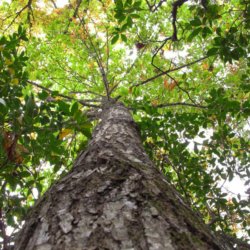
Until recently, the best strategy for saving the American chestnut has involved creating hybrids with the smaller and less impressive—but blight-resistant—Chinese chestnut (Castanea mollissima). Research from the State University of New York’s College of Environmental Science and Forestry (SUNY-ESF), however, using genetic engineering techniques to generate transgenic trees, suggests that we may at last be on the verge of bringing the American chestnut back.

The SUNY project, spearheaded by plant pathologist William Powell, has created an array of blight-resistant genetically modified chestnut trees. Powell and collaborators accomplished this by inserting a wheat gene into the American chestnut genome that codes for the enzyme oxalate oxidase, a compound that effectively zonks the invading C. parasitica fungus. The transgenic trees appear to be as resistant to chestnut blight as the impervious Chinese chestnuts, though otherwise their genetic makeup is almost entirely that of conventional American chestnut trees. (For more on Powell’s work, see Resurrecting a Forest.)

The next step, Powell and colleagues agree, is to obtain permission from the U.S. government before attempting to return the transgenic chestnuts to the environment.
The GLP aggregated and excerpted this blog/article to reflect the diversity of news, opinion and analysis. Read full, original post: Can We Engineer an American Chestnut Revival?

Related Articles

Infographic: Global regulatory and health research agencies on whether glyphosate causes cancer

Infographic: Global regulatory and health research agencies on whether glyphosate causes cancer

Does glyphosate—the world's most heavily-used herbicide—pose serious harm to humans? Is it carcinogenic? Those issues are of both legal and ...

Most Popular

ChatGPT-Image-Mar-10-2026-01_39_01-PM
Viewpoint—“Miracle molecule” debunked: Why acemannan supplements don’t work
ChatGPT-Image-Sep-10-2026-10_36_07-AM
Viewpoint: Even lousy scientific articles can shield authors when they hype dubious health claims and products
sorghum farmers in kenya FARMERS TREND
Here are all the ways CRISPR gene editing is transforming Africa’s staple crops—and there’s a lot more innovation to come
Screenshot-2026-10-01-at-11.21.27-AM
Vaccine hesitancy, like malaria, surges globally, topping 35% in some countries
ChatGPT-Image-Sep-30-2026-01_11_07-PM
How U.S. teamed with Russia to block global human AI weapons oversight
ChatGPT-Image-Sep-30-2026-01_25_34-PM
Blood tests for Alzheimer’s? The latest grifter, social media scam.
ChatGPT-Image-Sep-21-2026-03_15_09-PM
Viewpoint: Chipotle-inspired lesson: 10,000 sick customers suggest that processed foods can be safer than fresh ones
ChatGPT-Image-Sep-30-2026-01_38_36-PM
Viewpoint: Died “with measles” vs. died “from measles”: RFK, Jr.’s dangerously subversive word games
ChatGPT-Image-Sep-29-2026-12_16_42-PM
Social media influencers are driving food misinformation across Europe
Screenshot-2026-09-28-at-1.16.38-PM
Defying public perceptions, U.S. cancer deaths plunged 35% since 1991
glp menu logo outlined

Get news on human & agricultural genetics and biotechnology delivered to your inbox.