A short history of GMOs, from prehistoric times to today

Untitled x

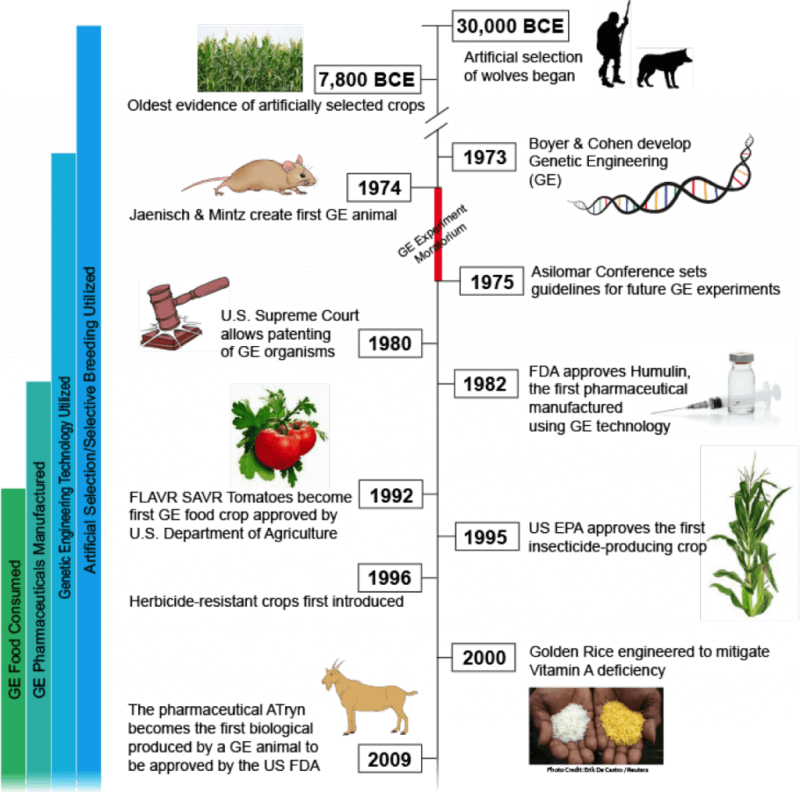
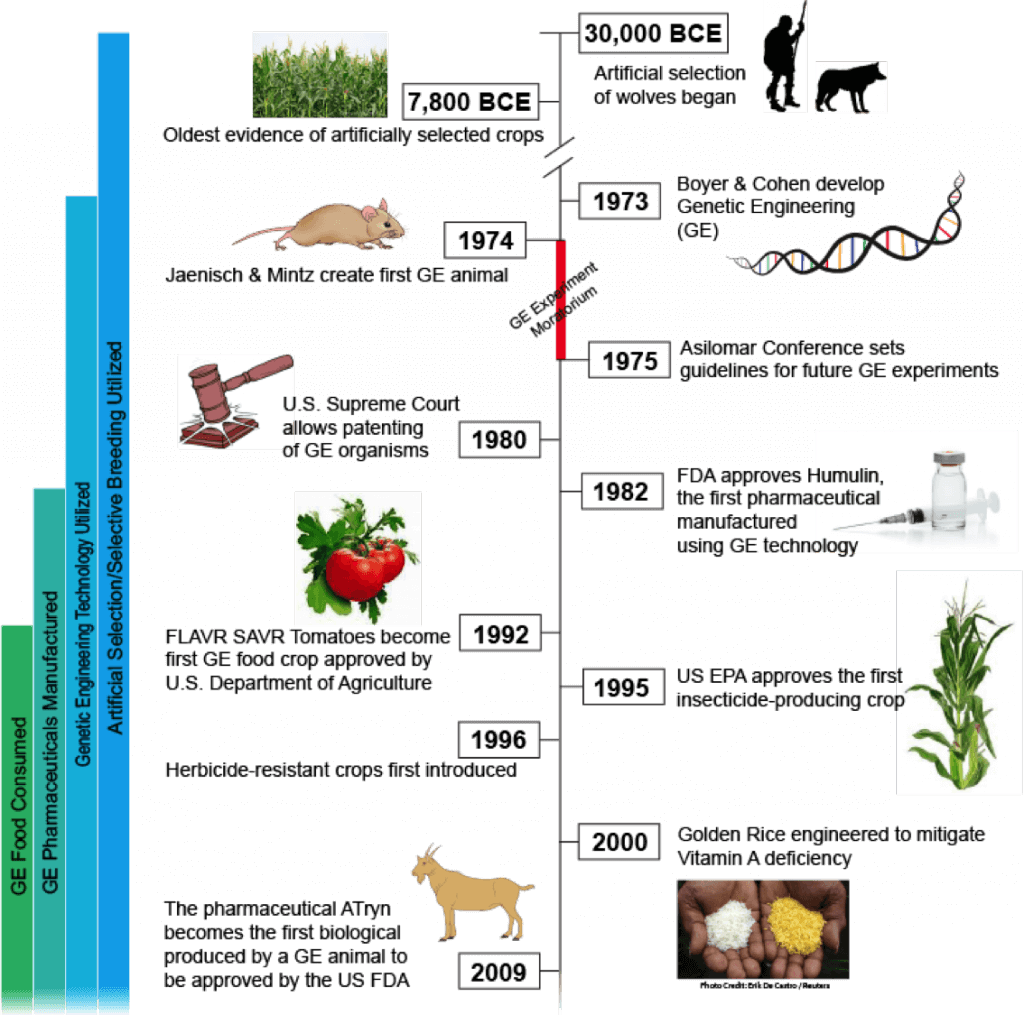
Humans have been altering the genetics of organisms for over 30,000 years, but how did the practice of selective breeding evolve into the GMOs, as we know them today?

Our ancestors had no concept of genetics, but they still influenced the DNA of other organisms by a process called “selective breeding” or “artificial selection”. The earliest evidence of artificial selection of plants dates back to 7800 BCE.

The GMO breakthrough came in 1973, with the creation of the first genetically engineered (GE) organism. Immediately the media, government officials, and scientists began to worry about the potential ramifications on human health and Earth’s ecosystems. At the Asilomar Conference of 1975, scientists, lawyers, and government officials debated the safety of GE experiments and concluded that the GE projects should be allowed to continue.
Untitled-1024x1015

GMO controversies abound, with the majority relating to GE food. While some critics object to the use of this technology based on religious or philosophical bases, most object on the basis of environmental or health concerns.

Though the GMO debate is ongoing, the scientific community has concluded that GE food is safe. This conclusion has not stopped businesses from capitalizing on the current fear of GE food.


There are countless potential uses of GE technology. These include disease and drought resistant plants. The United Nations predicts that by 2050, humans will need to produce 70% more food to feed the global population. Innovative approaches are required to solve this problem, and GMOs are a useful tool.

When our ancestors selectively bred wolves to develop Corgis, they could not foresee that we would be able to genetically engineer corn to withstand drought. What is the future of GMO technology that we ourselves can’t foresee now?

Editor’s Note: This post is part of a series on GMOs in a special edition of the online magazine “Signal to Noise”, produced by Science in the News. You can read the entire series here: Signal to Noise Special Edition: GMOs and Our Food

The GLP aggregated and excerpted this blog/article to reflect the diversity of news, opinion and analysis. Read full, original post: From Corgis to Corn: A Brief Look at the Long History of GMO Technology

{{ reviewsTotal }}{{ options.labels.singularReviewCountLabel }}
{{ reviewsTotal }}{{ options.labels.pluralReviewCountLabel }}
{{ options.labels.noReviewsLabel }}
{{ options.labels.newReviewButton }}
{{ userData.canReview.message }}

Related Articles

Infographic: Global regulatory and health research agencies on whether glyphosate causes cancer

Infographic: Global regulatory and health research agencies on whether glyphosate causes cancer

Does glyphosate—the world's most heavily-used herbicide—pose serious harm to humans? Is it carcinogenic? Those issues are of both legal and ...

Most Popular

ChatGPT-Image-Mar-10-2026-01_39_01-PM
Viewpoint—“Miracle molecule” debunked: Why acemannan supplements don’t work
ChatGPT-Image-Jul-6-2026-02_25_26-PM
40 million Americans take glucosamine. If you have memory loss, it could accelerate cognitive decline.
ChatGPT-Image-Jul-17-2026-12_42_10-PM
Viewpoint: RFK, Jr. is setting up a panel to compensate people who claim they were injured by a COVID vaccine–no proof needed 
file-f-d-d-
Facts & Fallacies Podcast: Europe's AC debacle underscores fatal flaw in green activism
px-Minced-beef-meat-cow-cattle
Can we trust Trump’s USDA to accurately report farm data? Beef export numbers suggest ‘no’.
Screenshot-2026-07-17-at-12.55.22-PM
Viewpoint: Is bagged salad a dangerous science experiment? Challenging an online misinformation campaign
ChatGPT-Image-Jul-8-2026-12_32_48-PM
Viewpoint: SCOTUS strikes a blow against junk science in Bayer glyphosate case. Will it deter mass tort litigators?
Screenshot 2026-07-11 094410
Growing animal muscle and fat cells inside rice grains and calling it beef: One of numerous genetically engineered products shaking up our ecosystem
ChatGPT-Image-Jul-9-2026-02_39_22-PM
Viewpoint: Polyphenols or NAD+ supplements to combat aging: No, Gwenyth Paltrow and followers, don’t waste your money.
afb-a-b
As the EU loosens restrictions on agricultural gene editing, it remains years behind the rest of the world on equally-safe GMO foods
ma art page image
‘It’s time to have a conversation’: Once adamantly opposed to human gene editing, UK’s The Guardian acknowledges likely benefits
ChatGPT-Image-Jun-17-2026-03_29_08-PM
Viewpoint: What’s the impact of the U.S. abandoning support for global health?
ChatGPT-Image-Jul-7-2026-01_57_55-PM
Viewpoint: Europe’s rejection of air conditioning is the poster child for misunderstanding how to mitigate the impact of climate change
ChatGPT-Image-Jun-25-2026-12_23_17-PM
No, Bill Gates did not secretly engineer ticks to promote veganism
glp menu logo outlined

Get news on human & agricultural genetics and biotechnology delivered to your inbox.