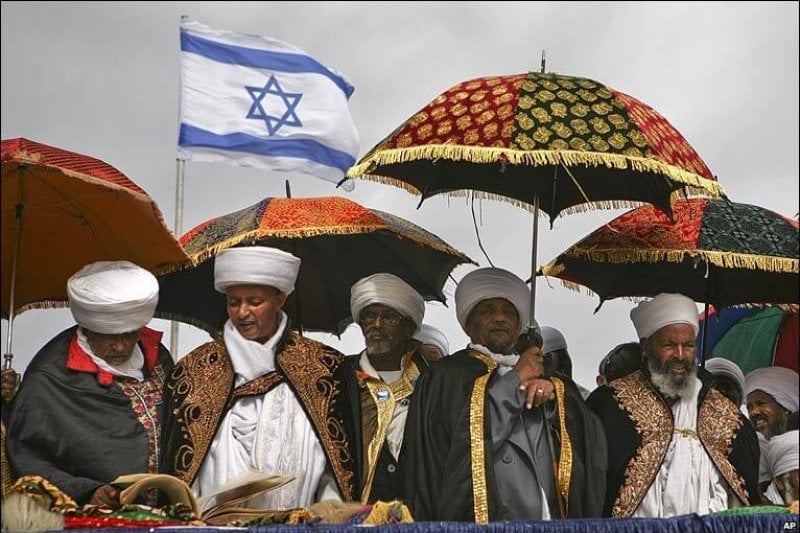
The Cohanim (singular: Cohen) are members of a priestly lineage maintained by the mainstream Ashkenazi and Sephardi Jewish communities. Traditionally, they are considered to be the descendents of Aaron, the brother of Moses, who served the Israelites as the first High Priest (Cohen Gadol). It is accepted in the mainstream biblical scholarship that the priesthood in ancient Israel has been hereditary (e.g. Exodus 28), passed paternally. Recent DNA studies, as reported in Jon Entine’s Abraham’s Children, confirmed the existence of a shared genetic lineage among those who maintain the Cohenic descent today. This lineage scientifically traces to about 3,300 years, which is the most commonly presumed time period of Aaron.
Although the Beta Israel — the Ethiopian Jews, a minority of today’s Israeli population, who mostly came to the country in two waves in the 1980s and early 1990s—maintain the priesthood tradition, they are unique in that they do not consider it to be hereditary. Instead, the Beta Israel priest, called as Kes or Kahin (Cohen), is elected by his community. Traditionally, Keses, as Ken Blady explains, “were for the most part drawn from the general population, and each was selected based on his own merits” (p. 363).
Genetic studies also find no Cohenic genetics among the Beta Israel, which is often considered by scholars as further proof to the theory that the group has no ancient Jewish descent. The problem with this suggestion is of course the false assumption that the genetics of Cohanim are exclusively determinative for the existence of an ancient Jewish lineage. In reality, this genetic trait reflects only a certain purported family lineage, that of Aaron.
And the fact that genetic studies have found the Cohenic lineage existent among the Lemba—black African group from Zimbabwe and South Africa — is cited by scholars in context of the Beta Israel as being exceptional among the presumably Jewish black-Africans for not having ancient Jewish genetics. Jessica Mozersky provides an expressive summary of this situation:
Thomas et al. (2000) discovered that some of the Lemba carried the Cohen model haplotype and this was used as evidence that they were likely descended from Jews in ancient Israel, as their oral history suggests. Another group of Jews in Ethiopia who claim also to be descended from Jews in ancient Israel were tested and did not carry the haplotype, and this was taken as proof that they were not Jewish.” (p. 46)
Yet, it is clearly unreasonable to define the Jewish roots of the Beta Israel–whose Jewishness spans all historical, religious, and ethnic ground—against the Lemba, with whom they share nothing in common other than broad continental African origins. The two populations are radically different in genetics, traditions, culture and history.
Traditions of the Abyssinian Christians (of what is today Ethiopia) and the Beta Israel, however, do essentially recognize the Cohenic priesthood, particularly as it relates to Zadok, the descendent of Aaron who was appointed by King David to be the first High Priest of the Jerusalem Temple. According to an Abyssinian tradition, Azaria the son of Zadok was sent by Solomon to become a priest in “Ethiopia”, or perhaps “Abyssinia”. (Note that Ethiopia in ancient sources referred to what is today Sudan, not to be confused with today’s Ethiopia).
Studies also report on Beta Israel priests who claimed descent from Zadok. A priest named Zadok is also a central character in a traditional Beta Israel narrative concerning the historical celebration of the group’s important religious holyday, Sigd. According to this narrative, which supposedly occurred in the tenth century, Zadok, along with another priest named Azarias, was responsible for instituting the Sigd. Hence, it is reasonable to speculate on whether a prestigious Cohenic priestly lineage had once existed among the Beta Israel. Yet, assimilation, depopulations and the diverse range of sufferings–including religious oppression, economic misery, and social discrimination–that the Beta Israel have experienced in Ethiopia might have caused such a lineage to be forgotten.
And although the lineage of Cohen is confirmed to be authentic, evidence suggests that the priesthood in ancient Israel was not limited to the Cohanim as commonly assumed. One of the first scholars to provide a strong and a reliable perspective on this subject is John Bartlett who observed that the Zadokites (the Cohenic descendents of Zadok) never gained full control of the priesthood in ancient Israel. He explains that the phrase House of Zadok was symbolic of a priesthood that was never strictly hereditary. One of Bartlett’s ground-breaking studies, as reviewed by Alice Hunt, concerns the issue of priestly succession as suggested in the biblical genealogical lists, which he describes as “artificial” (p. 87). He insists that “Apart from Zadok and his son Azariah… no priest is clearly said to have his sons as his successors”.
Although Bartlett’s argument did not gain recognition when he published it in 1968, it has increasingly been attracting the interest of scholars in the past few decades; as Hunt states:





I conclude, with Bartlett, that we cannot find evidence in Samuel—Kings for a Zadokite priestly dynasty. Neither can we find evidence in Samuel—Kings for a dominant Zadokite priesthood from the time of David. What can we say? According to the writers and redactors of Samuel—Kings, there was a priest named Zadok who served King David.” (p. 90)
Following the same line of thought, Pekka Pitkänen explains that “the Priestly tradition does not necessarily indicate a hereditary succession of priesthood, or that the high priest can only come from the line of Eleazer [the son of Aaron].” Other scholars, while not necessarily questioning the existence of a hereditary priesthood in ancient Israel, have doubted the uniformity of the appointment process.
“Where the anointing of Aaron suggests a natural origin in the Jerusalem Temple heritage of the Priestly Torah, the anointing of his sons may have roots in a more widespread practice from the old towns, villages, and shrines of the countryside,” Daniel Fleming states (as cited by Miller, p. 276).
Given the popularity of the priesthood in ancient Israel, it is easy to imagine how the kings would have found great interests in controlling the appointment of the priests. We are told in the bible (as suggested in 2 Samuel 8:17) that King David appointed his supporters Zadok and Abiathar as High Priests, thus, indicating a selective appointment process. Another example would be King Solomon’s decision to remove Abiathar from the priesthood due to the latter’s support of a foe (1 Kings 2:26).
In fact, it is also arguable that some biblical passages suggest that the priesthood system, as divinely revealed to Moses, was not intended to be eternally restricted to the descendents of Aaron. In Exodus, God is quoted telling Moses that the Israelites “shall be to Me a kingdom of priests and a holy nation” (19: 6). In such a context, the concept of the hereditary priesthood may not be considered as forever absolute.
In conclusion, the fact that the Beta Israel priesthood is non-hereditary does not necessarily contradict the priesthood appointment system in ancient Israel. While the Cohenic lineage is genuine, the ancient Israelite priesthood appears to have been more selective and informal than consistently hereditary. And in this context, the Beta Israel’s more democratic appointment system, in which the priest is appointed on basis of “merit,” may suggest a religiously justifiable process that is rooted in a pre-existing Israelite tradition.
On a different line of thought, the Beta Israel’s awareness of the Cohenic lineage, as manifested in their traditions on priests of Zadokite descent, makes it likely that a priestly family of Cohenic descent has existed at some point within the group, but is now forgotten.
Ibrahim M. Omer is a Research Assistant at California State University Monterey Bay, Visual & Public Arts Department, Museum Studies Program, and the author of the academic website AncientSudan.org.