Transplant breakthrough? Organs of one species grown inside an animal of another

hio
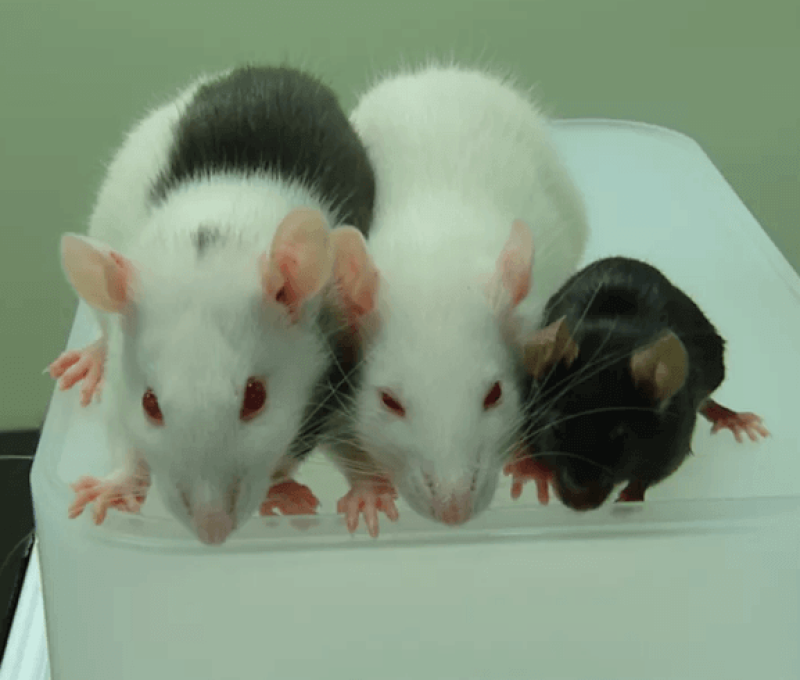
On the far left, the rat-mouse chimera created for the study. Credit: Tomoyuki Yamaguchi/Verge

Itโ€™s possible to grow organs of one species inside an animal of another species and then transplant that organ to cure disease…In this case, mouse pancreas cells were grown in rats, then transplanted into mice to reverse diabetes. The new research opens the possibility of one day creating human organs inside animals like pigs or sheep that could then be transplanted back into needy patients.

[Surprisingly,] the transplanted cells reversed the miceโ€™s diabetes and kept sugar levels down for one year. The mice didnโ€™t reject the cells, even if they were given anti-rejection medication for only five days after the transplant.

โ€œThere are not that many ways to generate a functional adult human organ for transplantation that can save many peopleโ€™s lives,โ€ says Qiao Zhou, an associate professor of stem cell and regenerative biology at the Harvard Stem Cell Institute. โ€œThis is one I think actually I can see work in the future.โ€

And then there are the ethical issues…[I]f human stem cells are injected into animal embryos, some of these cells will also go into organs like the brain. What are the ethical implications of having pigs with part human brains?

[The study can be found here.]

The GLP aggregated and excerpted this blog/article to reflect the diversity of news, opinion, and analysis. Read full, original post:ย Mice cured of diabetes by cells grown inside rats โ€” are humans next?

{{ reviewsTotal }}{{ options.labels.singularReviewCountLabel }}
{{ reviewsTotal }}{{ options.labels.pluralReviewCountLabel }}
{{ options.labels.newReviewButton }}
{{ userData.canReview.message }}

Related Articles

Infographic: Global regulatory and health research agencies on whether glyphosate causes cancer

Infographic: Global regulatory and health research agencies on whether glyphosate causes cancer

Does glyphosateโ€”the world's most heavily-used herbicideโ€”pose serious harm to humans? Is it carcinogenic? Those issues are of both legal and ...

Most Popular

Screenshot-2026-04-22-at-12.21.32-PM
Viewpoint: Why the retracted Monsanto glyphosate study doesnโ€™t change the scienceโ€”the worldโ€™s most popular herbicide is safeย 
Picture1
The FDA couldnโ€™t find a vaccine safety crisis, so it buried its own research
ChatGPT-Image-May-1-2026-11_42_59-AM-2
Viewpoint: NAD is the wellness grifters latest evidence-lite longevity fad. At least the mice are impressed.
ChatGPT-Image-Apr-16-2026-02_56_53-PM
Financial incentives, over diagnosis, and weak oversight: Autism claims are driving up Medicare costs
global warming
โ€˜Implausibleโ€™: Top climate scientists reject worst-case scenarioโ€”soaring temperatures and fast-rising sea levels
ChatGPT-Image-May-12-2026-11_27_01-AM-2
AI likely to improve health care, research showsโ€”but not for blacks and ethnic minorities
ChatGPT-Image-May-7-2026-01_23_27-PM-2
Viewpoint: Will AI democratize personalized cancer treatment or fuel medical misinformation?

Sorry. No data so far.

glp menu logo outlined

Get news on human & agricultural genetics and biotechnology delivered to your inbox.