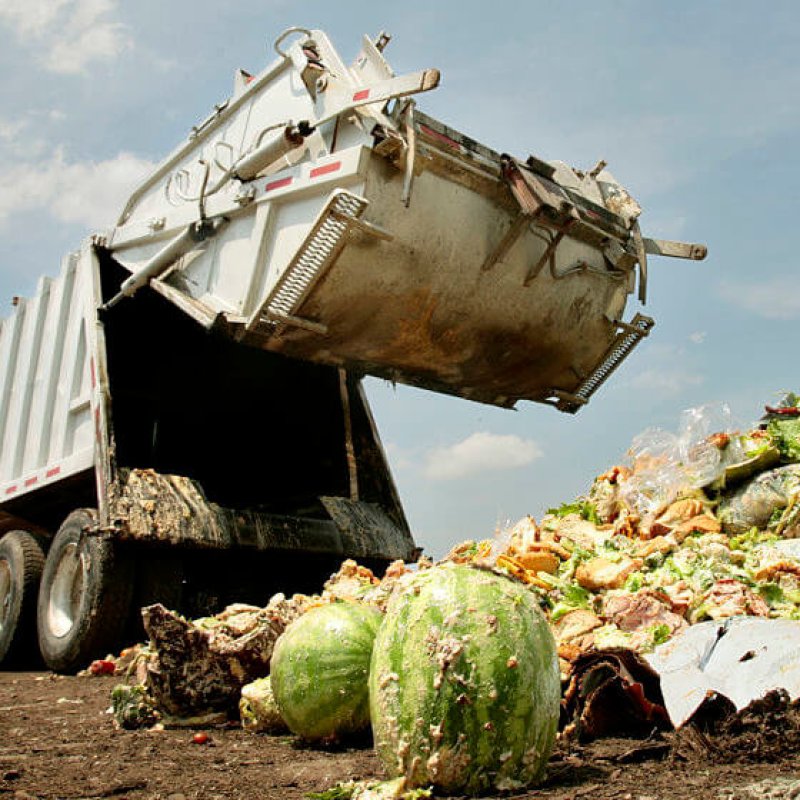
Garbage? Study challenges claim that Americans waste $165 billion of food each year

waste e

Say you’re a journalist, and you’ve been assigned a story about food waste. You’re on a deadline, and you need some handy numbers to put a sprawling, overwhelming issue into context. Whether you’re writing about the relationship between hunger and wasted food, the latest scrappy startupsfreegans, or the trash generated by social media-induced body shame, odds are good that two factoids will find their way into your work: First, Americans waste about $165 billion worth of food each year. Second, 40 percent of all food in the United States goes uneaten.

Over the past five years, journalists have repeatedly, almost reflexively reached for both stats.

But how do we know they’re true?

A new study by researchers from the University of Minnesota’s Department of Applied Economics, and published in The American Journal of Agricultural Economics, argues that commonly cited food waste estimates are likely to be inaccurate, incomplete, overstated, or contradictory. The biggest issue the authors point out? No one knows exactly what we mean when we use the term “food waste.” It turns out that definitions differ significantly from study to study, resulting in “wildly different estimates” and, ultimately, different policy conclusions.

The GLP aggregated and excerpted this blog/article to reflect the diversity of news, opinion, and analysis. Read full, original post: We’ve all heard the staggering statistics about food waste. A new study says they’re wrong.

{{ reviewsTotal }}{{ options.labels.singularReviewCountLabel }}
{{ reviewsTotal }}{{ options.labels.pluralReviewCountLabel }}
{{ options.labels.newReviewButton }}
{{ userData.canReview.message }}

Related Articles

Infographic: Global regulatory and health research agencies on whether glyphosate causes cancer

Infographic: Global regulatory and health research agencies on whether glyphosate causes cancer

Does glyphosate—the world's most heavily-used herbicide—pose serious harm to humans? Is it carcinogenic? Those issues are of both legal and ...

Most Popular

Screenshot-2026-05-01-at-1.29.41-PM
Viewpoint: What happens when whole grains meet modern food manufacturing? Labels don’t tell the whole story.
S
As vaccine rejectionism spreads, measles may be taking a more dangerous turn
Screenshot 2026-05-06 at 2.56
Singularity crisis ahead? Can super babies save us from rogue AI geniuses?
Screenshot-2026-05-06-at-2.07.43-PM
Manufacturing a conspiracy: The timeline of how  the White House embraced the fringe claim that scientists are being mysteriously murdered
Screenshot-2026-04-20-at-2.26.27-PM
Viewpoint — Food-fear world: The latest activist scientists campaign: Cancer-causing additives
Screenshot-2026-04-30-at-2.19.37-PM
5 myths about summer dehydration that could damage your health — or even kill you
Screenshot-2026-03-13-at-12.14.04-PM
The FDA wants to make many popular prescription drugs OTC—a great idea. Here’s why it’s unlikely to happen
Screenshot-2026-04-12-135256
Bixonimania: The fake disease scam that AI swallowed whole
ChatGPT-Image-May-6-2026-03_41_05-PM
‘Protecting the integrity of science’: Kennedy’s FDA blocks release of taxpayer-funded studies finding COVID and shingles vaccines safe
glp menu logo outlined

Get news on human & agricultural genetics and biotechnology delivered to your inbox.