Cerebral organoids: How can we know if cells collected as ‘mini-brains’ are conscious?

organoidx
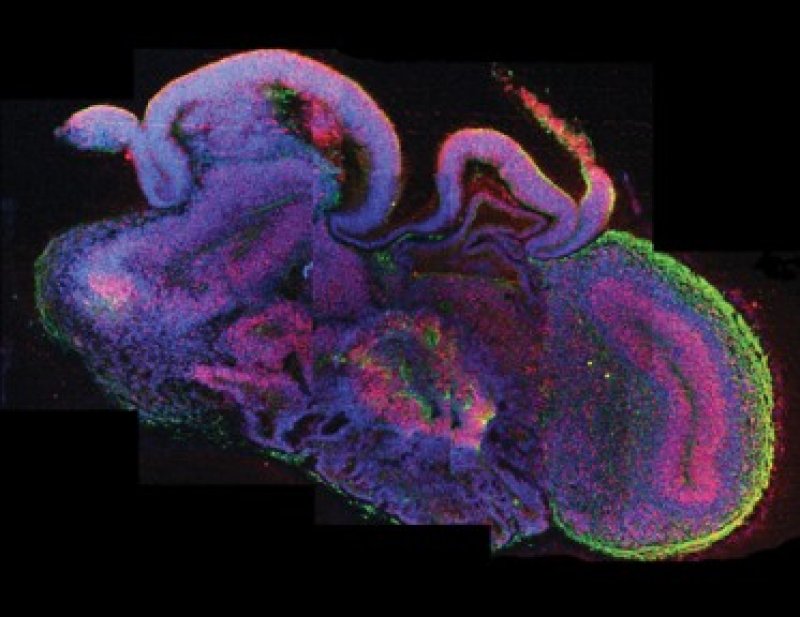
A stained section of an organoid is seen in close-up.

[Editor’s note: Mike Klymkowsky is a Professor of Molecular, Cellular & Developmental Biology at the University of Colorado Boulder.]

The fact that experiments on people are severely constrained is a major obstacle in understanding human development and disease. Some of these constraints are moral and ethical and clearly appropriate and necessary given the depressing history of medical atrocities. Others are technical, associated with the slow pace of human development.

Madeline Lancaster, Jurgen Knōblich, and colleagues devised an approach by which [differentiated human cells] could be induced to form what they termed “cerebral organoids”…

The production of cerebral organoids from reprogrammed human somatic cells has […] attracted the attention of the media.  While “mini-brain” is certainly a catchier name, it is a less accurate description of a cerebral organoid, itself possibly a bit of an overstatement, since it is not clear exactly how “cerebral” such organoids are.

The reasonable question, then, must be whether a  cerebral organoid, which is a relatively simple system of cells (although itself complex), is conscious. It becomes more reasonable as increasingly complex systems are developed, and such work is proceeding apace.

While a future concern, in a world full of more immediate and pressing issues, it will be interesting to listen to the academic, social, and political debate on what to do with mini-brains as they grow in complexity and perhaps inevitably, towards consciousness.

The GLP aggregated and excerpted this blog/article to reflect the diversity of news, opinion, and analysis. Read full, original post: Is it time to start worrying about conscious human ‘mini-brains’?

{{ reviewsTotal }}{{ options.labels.singularReviewCountLabel }}
{{ reviewsTotal }}{{ options.labels.pluralReviewCountLabel }}
{{ options.labels.noReviewsLabel }}
{{ options.labels.newReviewButton }}
{{ userData.canReview.message }}

Related Articles

Infographic: Global regulatory and health research agencies on whether glyphosate causes cancer

Infographic: Global regulatory and health research agencies on whether glyphosate causes cancer

Does glyphosate—the world's most heavily-used herbicide—pose serious harm to humans? Is it carcinogenic? Those issues are of both legal and ...

Most Popular

ChatGPT-Image-Mar-10-2026-01_39_01-PM
Viewpoint—“Miracle molecule” debunked: Why acemannan supplements don’t work
organic scaled
Facts & Fallacies podcast: Organic food cuts pesticide exposure? A response to Dr. Rhonda Patrick
close up arabica coffee farmer s hands picking beans plant his farm colombia
Viewpoint: Why do so many ‘mainstream’ and ‘respected’ media outlets exaggerate climate change threats?
ChatGPT-Image-Jul-22-2026-09_13_07-AM
Viewpoint—The Strategic Litigation boom: Understanding the tightening coalition among NGOs, foundations, journalists, and tort lawyers
How to Include More Strawberries in Your Diet
Strawberries are berries—and 35 other surprising food and drink myths
kratom
Viewpoint: Kratom ‘supplement’ crisis: DEA sits on its hands while patient addictions to this ineffective drug  rise
diversity
We are entering a new era of personalized medicine—if you’re white
Screenshot 2026-07-22 at 10.25
Science brain drain escalates as Trump purge extends to USDA
Screenshot-2026-07-07-at-12.55.44-PM
Viewpoint: Yes, we can adapt to a changing climate without devastating the environment and the economy
ChatGPT-Image-May-22-2026-10_26_09-AM
Trump-RFK, Jr. National Science Board firings: Accountability vs. partisan meddling
Screenshot-2026-07-01-at-2.49.48-PM
Dr. TikTok and male fertility: Viral claims tout GLP-1 drugs as fertility boosters. What does the science say?
using genetics to reverse aging
Is the longevity obsession a new form of ageism?
ChatGPT-Image-Jun-25-2026-02_53_56-PM
Embryo gene editing is on the horizon, stirring mixed emotions
glp menu logo outlined

Get news on human & agricultural genetics and biotechnology delivered to your inbox.