FDA approves first product claiming to reduce infant peanut allergies

A x

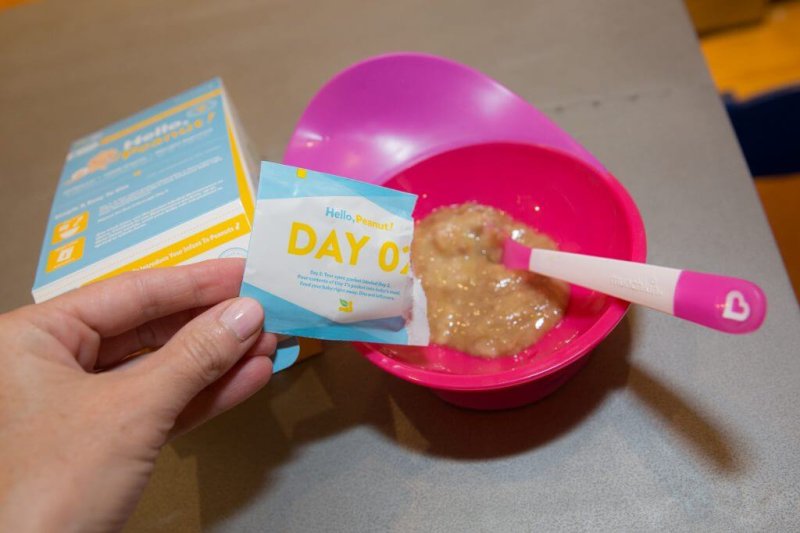
A new powdered peanut product is the first food item allowed to claim it may reduce peanut allergies in infants, though parents of susceptible babies are urged to consult a doctor before trying it. The product, called Hello, Peanut, can be mixed into puréed baby food to expose infants to peanuts starting around five months old.

The Food and Drug Administration allowed the new item, developed by a physician, to make the claim just months after the nation’s top allergy experts reversed longstanding advice on preventing peanut allergies….

The product consists of packets of organic peanut and sprouted oat blends in powdered form that can be mixed into baby food starting at five months, or soon after an infant starts eating solids. It is meant to be phased in with an introduction kit of seven packets that increases the amount of peanut content every day for a week, starting with a packet for day one that contains 200 milligrams of peanut powder, which is less than a single peanut, and gradually increasing by day seven to 2 grams of peanut, the equivalent of three to seven peanuts.

The powder is certified organic, dairy-free, kosher and free of genetically modified organisms. The introductory kit is $25 and the maintenance kit costs $20 for about three weeks.

The GLP aggregated and excerpted this article to reflect the diversity of news, opinion and analysis. Read full, original post: New Product Is First to Claim It May Reduce Peanut Allergies


{{ reviewsTotal }}{{ options.labels.singularReviewCountLabel }}
{{ reviewsTotal }}{{ options.labels.pluralReviewCountLabel }}
{{ options.labels.newReviewButton }}
{{ userData.canReview.message }}

Related Articles

Infographic: Global regulatory and health research agencies on whether glyphosate causes cancer

Infographic: Global regulatory and health research agencies on whether glyphosate causes cancer

Does glyphosate—the world's most heavily-used herbicide—pose serious harm to humans? Is it carcinogenic? Those issues are of both legal and ...

Most Popular

Screenshot-2026-03-13-at-12.14.04-PM
The FDA wants to make many popular prescription drugs OTC—a great idea. Here’s why it’s unlikely to happen
Screenshot-2026-04-20-at-2.26.27-PM
Viewpoint — Food-fear world: The latest activist scientists campaign: Cancer-causing additives
Screenshot-2026-05-04-at-12.54.32-PM
How Utah became the country’s supplement capital  — and a haven for unregulated, ineffective and fake products
Screenshot-PM-24
Viewpoint: The herbicide glyphosate isn’t perfect. Banning it would be far worse.
images
The never-ending GMO debate: Pros and cons
Screenshot-2026-05-01-at-11.56.24-AM
‘Science moves forward when people are willing to think differently’: Memories of DNA maverick Craig Venter
Screenshot-2026-04-30-at-2.19.37-PM
5 myths about summer dehydration that could damage your health — or even kill you
Screenshot-2026-04-03-at-11.15.51-AM
Paraben panic: How a flawed study, media hype, and chemophobia convinced the public of the danger of one of the safest classes of preservatives
bigstock opioids on chalkboard with rol
GLP podcast: 'Safe injection sites': enabling drug addiction or saving lives?
79d03212-2508-45d0-b427-8e9743ff6432
Viewpoint: The Casey Means hustle—Wellness woo opportunism dressed up as medical wisdom
glp menu logo outlined

Get news on human & agricultural genetics and biotechnology delivered to your inbox.