‘Kelp highway’–not a land bridge–likely brought first humans to the Americas

The Stone Age

For decades, students were taught that the first people in the Americas were a group called the Clovis who walked over the Bering land bridge about 13,500 years ago.

Now scholars are supporting the “kelp highway hypothesis,” which holds that people reached the Americas when glaciers withdrew from the coasts of the Pacific Northwest 17,000 years ago, creating “a possible dispersal corridor rich in aquatic and terrestrial resources.” Humans were able to boat and hike into the Americas along the coast due to the food-rich ecosystem provided by coastal kelp forests, which attracted fish, crustaceans, and more.

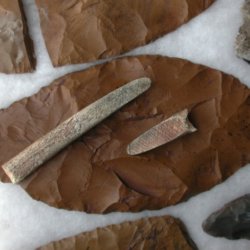
[T]he big question now is when pre-Clovis people actually arrived in the Americas. They suggest the arrival could be as early as 20,000 years ago on the verdant kelp highway. Other researchers, however, say people could have arrived during a temperate period about 130,000 years ago. A recent paper in Nature describes what appear to be the 130,000-year-old butchered remains of mastodons in California, along with sharp stones used to deflesh the animals. There is plenty of skepticism in the scientific community about this discovery, but the evidence can’t be ignored.

[The original study can be found here]

The GLP aggregated and excerpted this blog/article to reflect the diversity of news, opinion, and analysis. Read full, original post: Most scientists now reject the idea that the first Americans came by land

{{ reviewsTotal }}{{ options.labels.singularReviewCountLabel }}
{{ reviewsTotal }}{{ options.labels.pluralReviewCountLabel }}
{{ options.labels.noReviewsLabel }}
{{ options.labels.newReviewButton }}
{{ userData.canReview.message }}

Related Articles

Infographic: Global regulatory and health research agencies on whether glyphosate causes cancer

Infographic: Global regulatory and health research agencies on whether glyphosate causes cancer

Does glyphosate—the world's most heavily-used herbicide—pose serious harm to humans? Is it carcinogenic? Those issues are of both legal and ...

Most Popular

Screenshot-2026-07-09-at-1.09.25-PM
Anti-vaccine myths rattle health care
ChatGPT-Image-Mar-10-2026-01_39_01-PM
Viewpoint—“Miracle molecule” debunked: Why acemannan supplements don’t work
ChatGPT-Image-Jul-10-2026-12_21_03-PM
Viewpoint: Is there new evidence that the animal deworming drug ivermectin decreases the risk of Covid and cancer? Don’t waste your money.
Picture1
Hiroshima at 81: America’s new nuclear bomb, a buried Iranian target, and a question no one wants to ask
ChatGPT-Image-Jun-25-2026-12_23_17-PM
No, Bill Gates did not secretly engineer ticks to promote veganism
leeteam
How Kennedy and his family could pocket millions from Merck’s $50 million vaccine injury settlement that he oversaw
Screenshot-2026-07-30-at-3.07.42-PM
Controversy over WNBA star Sophie Cunningham’s comment opposing trans females in women’s sports reinvigorates the culture wars
Screenshot-2026-07-30-at-2.30.35-PM
Climate scientists claim conservative activists are promoting ‘lies’ that Europe’s summer heatwaves are far from unusual

Sorry. No data so far.

glp menu logo outlined

Get news on human & agricultural genetics and biotechnology delivered to your inbox.