Healthy bacon? Headlines mislead on Chinese CRISPR gene-edited low-fat pigs

On October 23, Chinese scientists published a paper heralding a truly remarkable feat: Using the genome-editing technique CRISPR, they created 12 healthy pigs with about 24 percent less body fat than usual. The implications of their research is potentially huge. The pigs have a gene that allows them to better regulate body temperature by burning up fat, which could save farmers millions in heating and feeding costs and prevent little piggies from suffering and dying in the cold.

Then came the headlines.

“Healthy bacon? Scientists engineer skinny pigs with low body fat,” wrote Newsweek, amping up the claim even more on social media to proclaim that “diet bacon might now be a thing.”

Here’s the thing, though: Scientists have not created a diet bacon product. Bacon is not and will never be healthy.

The Chinese scientists did engineer a pig that will have more lean meat than typical pigs, which may be better for farmers looking to sell to conscious consumers. But there are already leaner cuts of bacon available in any grocery store. … Short of engineering less fatty fat, it’s unlikely the diet bacon will be a thing, well, ever.

The GLP aggregated and excerpted this article to reflect the diversity of news, opinion and analysis. Read full, original post: Sorry, Genetically Engineered ‘Diet Bacon’ Is Still Not a Thing

IVF ethics: What if your only viable embryo has a genetic disease?

bigstock sperm injection
[A]n emerging ethical morass in the field of reproductive medicine: what to do when patients seeking to get pregnant select embryos with DNA that could lead to a disease or disability. Should clinicians’ desire to help their patients have children override concerns about possibly doing harm to those children?

A test can tell prospective parents that their embryo has an abnormal number of chromosomes in its cells, for example, but it cannot tell them what kind of developmental delays their child might have, or whether transferring that embryo into a womb will lead to a pregnancy at all. Families and physicians are gazing into five-day-old cells like crystal balls, seeking enlightenment about what might happen over a lifetime. Plus, the tests can be wrong.

[P]atients will want to select an embryo with a certain genetic trait. Most frequently, experts say, this happens in the cases of patients who are deaf or have dwarfism and want to have children with the same traits.

The GLP aggregated and excerpted this blog/article to reflect the diversity of news, opinion, and analysis. Read full, original post: A baby with a disease gene or no baby at all: Genetic testing of embryos creates an ethical morass

Protecting against cancer: What can we learn from animals who live for centuries

Screen Shot at AM

We live in a promising age, when science has begun unraveling the double helix of DNA, and with secrets that could allow significant extension of the human lifespan, and arguably more importantly extension of the “healthspan” — the length of time that a human can be not just alive but also healthy and productive.

In the last 125 years, life expectancy for the average person in industrialized countries has risen from under 40 years to well into the 80s. The increase was rapid during the first half of the 20th century as researchers learned to be proactive against infectious disease with antibiotics and an increasing number of vaccines. Today, the usual causes of death are very different from what they were a century ago and life expectancy continues to increase slowly, because of incremental medical advances.

Alongside incremental advance, there also are an increasing number of clues from watching other animal species that possess higher longevity than humans, or a lack of cancer, or both, that we could use to boost lifespan and healthspan dramatically. Careful study of the molecular biology of such animals might lead to new therapies for cancer and aging and diseases with associated genetic links to aging like Alzheimer disease, macular degeneration, as well as progeria, a rare condition in which children age rapidly and die of many of the same conditions that kill people in old age.

On the other hand, the interest that most people have in staying young and healthy can make them vulnerable to marketers of extracts from high longevity animals, despite lack of a rational basis of how the product might produce the desired effect. Such marketers are the literal snake oil salesmen (and snake oil saleswomen) of modern times who may be pushing the longevity of animals as a solution too far.

Telomeres, clams, and tortoises

australia-zoo-harriet-the-aldabran-tortoise-brisbane
Harriet the tortoise

In 2006, a clam nicknamed Ming died at the age of 507 years. It belonged to the species Arctica islandica and was called Ming, because analysis of the shell showed it had come to life during the Ming dynasty. It died because it was pulled out of the water off the coast of Iceland and killed, otherwise it might still be alive today. Of course, a clam has no brain. It’s just a bunch of cells sitting at the bottom of the ocean. So, while interesting, the longevity of such a creature may not strike us as something that could be applied to human beings.

But that same year, a tortoise named Harriet died at the age of 176 in an Australian zoo. She was a celebrity, particularly because she had been a pet of Charles Darwin. Some less famous tortoises have been recorded actually living longer than Harriet. In both tortoises and clams, accumulating evidence suggests that the longevity could be due to genetic up-regulation of telomerase, an enzyme that helps keep chromosomes from wearing out by keeping nucleotide sequences called telomeres long.

Before people start posting comments that the data are not so clear on the connection between telomere length and aging, the point is that we are delving into the molecular basis of aging for humans and other animals, not to suggest that we understand enough yet to intervene with human lifespan today. When it comes to telomere length, things are very complicated and science does still have numerous questions, many more in fact than answers. For instance, there are inconsistencies between various methods for measuring telomere length in different body tissues, telomeres shorten at different rates in different cells and tissues, and we don’t know in which chromosomes having longer telomeres is more important. Also, while emerging gene therapies may be able to lengthen telomeres by increasing telomerase activity, how this might relate to the interplay between aging and diseases like cancer is uncertain.

On one hand, there are studies showing correlations between long telomeres, longevity, and lack of cancers in certain shellfish. But on the other hand, many types of cancer are able to grow, while overpowering the body’s immune system, because the cancer cells gain a kind of immortality by increasing lengths of their telomeres. If you have precancerous or cancerous cells in your body that normally may not develop into an actual malignancy, you certainly do not want to help them along with a gene therapy that could increase telomerase in all cells, because it is not precisely targeted. In fact, there are some effective anti-cancer drugs that work by inhibiting telomerase, thus causing telomeres to shorten quickly in the rapidly dividing cancer cells so that they die out. This is not to put a damper on the idea for telomerase-related anti-aging therapies that are being studies. Rather, the point is that it’s a potentially powerhouse clinical approach that could be a double edged sword, so it requires a lot more study.

Similarly, there’s an anti-oncogene called P53. Research on it was featured in a recent PBS  story on the New Hour, because elephants have about 40 copies of the gene and hardly ever get cancer. It made a wonderful story, because scientists are doing research to see whether we might eventually use the elephant P53 gene to fight cancer in humans. While humans also have P53 and it’s similar to elephant P53, the typical human has only two or three copies of the gene, while people and families having just one copy or lacking the gene all together have a high incidence of cancer. In addition to the genetics, it works particularly well on television, because everybody loves a story about that shows elephants. At the same time, it’s also responsible reporting, because, while the genetics and human biology may turn out to be as complex as the telomere issue with many years of laboratory research needed before it produces anything clinical, the science is sound.

Beware of ‘shark’ oil salesmen

In contrast with the science stories, because people do have a fascination with our non-human counterparts, phenomena in certain species, such as longevity and lack of cancer, or even the ability to strike fast or outrun a car, also present opportunists in the unregulated supplement industry to make a quick buck. The practice goes back to the snake oil peddlers of the 19th century, but for years people have been able to purchase bottles of shark liver oil. That’s sold because sharks don’t get cancer and today you can even buy it for your dog. Since it’s considered a supplement, not a pharmaceutical, you can’t be sure of the concentration of shark liver oil in the product, but that really doesn’t matter, since there’s no more basis for thinking that products extracted from a cancer-less shark should be helpful in a human to prevent cancer. In addition to a two-century long life span, tortoises also don’t get cancer, but that doesn’t mean that you should start dining on tortoise soup.

Why do consumers fall for such schemes? Maybe, there’s a lingering superstition in society, the same superstition that made people in centuries passed think that drinking, or being transfused with, the blood from particular animals would give people characteristics of that animal. Maybe, it’s predatory marketing, or maybe it’s a combination of both. Whatever the reason, however, as scientists proceed through the hard, nitty gritty work of testing, repeating experiments, and verifying, gradually genetic based therapies will come into clinical practice and society will learn to tell the difference by observing the results.

David Warmflash is an astrobiologist, physician and science writer. Follow @CosmicEvolution to read what he is saying on Twitter.

How epigenetics is linked to drug resistance

images

Scientists at Vanderbilt University say they have discovered a nongenetic cause of resistance to cetuximab, a therapeutic that is used to treat advanced colorectal cancer. The team’s study (“lncRNA MIR100HG-Derived miR-100 and miR-125b Mediate Cetuximab Resistance via Wnt/β-Catenin Signaling”), which is published in Nature Medicine, suggests a novel strategy for overcoming this resistance.

As noted in their paper, the researchers found increased expression of a long noncoding RNA called MIR100HG, which houses two microRNAs, miR-100 and miR-125b, that also had increased expression. Long noncoding RNAs and microRNAs are transcribed from the genome just like genes, but they do not encode proteins. Instead, these pieces of RNA coordinate complex epigenetic processes to regulate gene expression.

Dr. Coffey and his colleagues discovered that miR-100 and miR-125b collectively suppressed the expression of five different genes that are negative regulators of the Wnt signaling pathway. Removing these miRNAs led to increased Wnt signaling, which is known to promote cell proliferation.

When the investigators blocked Wnt signaling using both genetic and pharmacologic inhibitors, they were able to restore responsiveness to cetuximab in cultured colon cancer cells and in colorectal tumors in mice.

The findings suggest that epigenetic regulation to increase Wnt signaling may be a general mechanism cancer cells use to overcome therapeutic blockade of epidermal growth factor receptor (EGFR) signaling, say the scientists.

The GLP aggregated and excerpted this blog/article to reflect the diversity of news, opinion, and analysis. Read full, original post: Epigenetics Linked to Resistance for Anti-Cancer Drug

How will the EU regulate new crop breeding techniques like CRISPR?

dae o e

Developments in genetic coding techniques open the doorway to crops that produce higher yields or have positive characteristics, such as drought or pest resistance. The EU regulates the cultivation and use of genetically modified organisms (GMOs) in food but debate rages over whether new biotechnologies such as CRISPR-Cas gene editing should be treated differently.

The European Union has a low adoption rate for modified foods….

While research has not currently indicated any heightened risk from GMOs, restrictions reflect the strong anti-GM public opinion among European consumers.

Many in the scientific community are frustrated by Europe’s resistance to GMOs, arguing that they could be an important tool in boosting food security and improving sustainability.

[Louise Frisco, president of research at Wageningen University] stressed that a different approach is required with the development of new gene-editing technologies, such as CRISPR-Cas, have come to be referred to as new plant breeding techniques (NPBTs).

The Dutch government has suggested that it wants to begin authorising NBTs outside the GMO framework.

The GLP aggregated and excerpted this article to reflect the diversity of news, opinion and analysis. Read full, original post: Should ‘precision breeding’ biotech be included in GMO regulation? 

Is the universe really 13.8 billion years old?

p xsw e

[Editor’s note: Ethan Siegel is an astrophysicist and author.]

You’ve no doubt heard that the Universe itself has been around for 13.8 billion years since the Big Bang, and that scientists are extremely confident of that figure. In fact, the uncertainty on that figure is under 100 million years: less than 1% of the estimated age. But science has been wrong in the past. Could it be wrong again, about this?

By measuring what’s in the Universe today, how distant objects appear to move, and how the light from them behaves nearby, at intermediate distances, and for the greatest distances observable, we can reconstruct the expansion history of the Universe.

[We] know how these components evolve in time, and that the Universe obeys the laws of General Relativity. Combine those pieces of information, and a single, compelling picture of our cosmic origins emerge.

[It is unlikely] that there’s going to be a major revision of this 13.8 billion year figure. Even if there is more fundamental physics than the forces, particles, and interactions that we know of, they are unlikely to change the physics of how stars work, how gravity works over time, how the Universe expands, or how radiation/matter/dark energy make up our Universe.

The GLP aggregated and excerpted this blog/article to reflect the diversity of news, opinion, and analysis. Read full, original post: Ask Ethan: How Sure Are We That The Universe Is 13.8 Billion Years Old?

Is organic farming sustainable? 5 carbon footprint challenges

organic

For some farmers, “organic” looks like an attractive deal. The switch from conventional farming may mean lower yields and greater labor needs, but the extra costs are incurred are often made up for through higher profit margins that come from charging premiums to consumers. At least that’s the conclusion in a recent study by two Washington State University professors, who found that premiums paid to organic farmers ranged up to 32 percent more than for conventional crops.

Most customers who are willing to spend more for the “certified organic” seal or a “non GMO” label do so because of their belief that their food will be “safer,” “healthier” or more “environmentally friendly.” In the absence of convincing evidence that organic foods are truly healthier or safer in comparison to conventionally grown crops, the claim “environmentally friendly” has garnered special attention in recent years as the rallying justification for eating organic foods.

Growing concerns about climate change—and estimates that one-third of greenhouse gas emissions come from agriculture—have helped fuel the organic industry and environmental groups’ marketing of organic foods as reducing environmental impacts. Even mainstream media outlets like The Wall Street Journal have pushed the idea forward in their reporting last year: “Organic practices could counteract the world’s yearly carbon dioxide output while producing the same amount of food as conventional farming, that organic foods.”

The Organic Trade Association (OTA), the leading mainstream lobbying group for the organic industry in the U.S., goes as far as to boast that eating more organic foods could mitigate or even reverse factors that contribute to human-induced climate change. “Organic agriculture is based on practices that not only protect environmental health, but also improve it,” the organization advertises on its website. Those farming practices include manure composting, cover crops, and crop rotation, each of which put carbon into the soil.

To back up its claims, the OTA cites a white paper by organic nonprofit lobbying group Rodale Institute. The paper concludes that if all cropland, as well as pastures, on the Earth were converted to the what the institute calls “regenerative” organic farming model, then it would appropriate all if not more carbon emissions annually and, as a result, solve the problem of global warming. The white paper reads:

“Simply put, recent data from farming systems and pasture trials around the globe show that we could sequester more than 100 percent of current annual CO2 emissions with a switch to widely available and inexpensive organic management practices, which we term ‘regenerative organic agriculture.’ These practices work to maximize carbon fixation while minimizing the loss of that carbon once returned to the soil, reversing the greenhouse effect.”

It should be noted that the paper is not a peer-reviewed article or event a real study. Far from it. It’s an opinion piece and what amounts to a public relations document by an advocacy group. But it’s widely cited by other organic promoters as if it’s fact and science.

But not everyone is buying into the OTA’s assurances that organic farming results in a lower carbon footprint (and greater profits). Farmers, soil scientists, and agricultural scientists are especially skeptical because the organic industry’s utopic assertions just don’t hold up to scientific scrutiny.

Comparing claims

Comparing the carbon footprints of organic and conventional agriculture is complex. For an accurate life-cycle assessment, total carbon equivalency based on all activities related to farming must be evaluated and measured all year round. Carbon equivalency means that assessments must also include those of other greenhouse gases such as methane and nitrous oxide, which are about 24 times more potent or about 295 to 320 times more potent, respectively, as compared to carbon dioxide.

Assessments by the organic industry and environmental groups too often overlook greenhouse gases emitted during the process of manure composting along with carbon releases from tillage, which are most commonly associated with organic systems, according to agriculture scientist Steve Savage. Combined with the need to use more land to produce equivalent crop yields and the need for more cows to produce manure to fertilize those crops, the evidence suggests that, despite all of the hyperbole surrounding organic farming community’s ideals, claims of a reduced environmental impact are just not grounded in reality.

For a true comparison of carbon footprint (based on carbon equivalency) from organic farming and conventional farming, the following five challenges should be considered:

  • Large-scale commercial manure composting as compared to synthesizing nitrogen for farming.
  • Machinery to haul around manure compost.
  • Yields of organic farming versus conventional farming.
  • Tillage of land of organic farming versus “no till” conventional farming.
  • Cows needed for producing manure for organic and carbon equivalency of cow burping and flatulence.

Manure composting’s “leaky pipe”

Let’s start with manure composting. Organic advocates often credit manure composting as the solution for returning lost carbon back into soil. Additionally, they say it reduces the need for the use of synthetic nitrogen fertilizer that is generated through a process that depends on burning fossil fuels. It’s estimated, in fact, that the amount of energy it takes to synthesize nitrogen to grow an acre of corn is about 30 gallons of gasoline. So, the use of manure compost is chalked up as the answer to avoiding the use of fossil fuels. Because manure compost holds more of the nitrogen inside the soil, preventing pooling or runoff, the manure compost also helps build up soil carbon while reducing emissions of nitrous oxide and methane.

For all of fanfare about large-scale manure composting, however, Savage said it’s like having a “leaky pipe” releasing greenhouse gases into the environment long before it ever reaches the soil. The process of creating compost, for instance, is going to emit not only carbon dioxide, but also large amounts of methane and nitrous oxide that are far more concerning for the environment.

“When you actually do the math on those emissions, it can be pretty substantial and that adds up over time. It becomes a lot greater number than what it takes to make synthetic nitrogen,” said Savage in a phone interview.

Savage has calculated that organic use of manure composts releases about 12 to 14 times more in the equivalence of carbon emissions compared to conventional agriculture using synthetic nitrogen from fossil fuels. These are greenhouse gas emissions that are largely ignored in the Rodale Institute’s life-cycle assessments, he said. In fact, one global meta-analysis from the Research Institute of Organic Agriculture of Switzerland determined that organic farming led to greater nitrous oxide emissions, while having only a relatively small methane uptake, as compared to conventional farming from the soil.

Still, there are other emissions released indirectly due to large-scale composting that are also not necessarily considered. These include emissions released during the act of hauling the manure from feedlots, food waste from recycling plants for compost, and the compost around itself to farms. It includes emissions released during the use of a tractor to turn the compost to maintain aerobic conditions. And it includes emissions released when tilling manure compost into the soil.

More tillage of forests and pastures

That brings us to tillage itself. Tillage is the act of overturning the soil mechanically through ploughing or digging and hoeing. By itself, historically, it’s been the practice with the largest initial releases of carbon into the atmosphere. The reason is that when soils are tilled, it also destroys large networks of microorganisms and fungi that act like the glue that holds soil together. And advocates of organic farming often ignore the issue of land use, a key factor driving carbon emissions. So for organic farming to match production of conventional farming, it means cutting down more forest or using up more pasture to create farmland. Tillage is also one of the largest uses of fuel on nearly every organic farm.

Lower yields from organic agriculture in the face of a growing global population means more tillage of land. Overall the yield gap for organic and conventional corn and soybean crops could average out to as much as 30 percent, according to a 2011 policy brief by the Center for Agricultural and Rural Development. There are no honest studies that don’t show yield gap including those performed by organic proponents, such as one published by researchers at the University of California, Berkeley, which evaluated 115 studies with more than 1,000 comparisons of more than 50 crop species across approximately 36 countries. The paper found a near 20 percent lower yield for organic crops compared to conventional and recommended more investment in crop rotations and diversification to help close the gap.

False promise of “no-till” or “reduced till” organic production

Yet tillage is needed as a step for controlling weeds on most organic farms because of prohibition of synthetic herbicides, which are used for “no-till” agriculture in conventional farming. The Rodale Institute’s white paper recognizes the problem of “marginal” practices of no-till or reduced-tillage on organic farms. For these reasons, the organization has been working on a roller-crimper technique intended to squash cover crops or weeds as a method of organic “no-till” agriculture. But the fact is that the technology is unlikely to be available as a large-scale approach anytime soon.

The scientific research evaluating “reduced-tillage” organic farming hasn’t been promising either. One study by soil scientist Jane Johnson and her colleagues from the USDA-Agriculture Research Service evaluated reduced-tillage farming in both the organic and conventional methods during a four-year rotation of corn, wheat, soybean, and alfalfa in Minnesota. The researchers used closed-vented chambers to monitor greenhouse gas emissions for three years during early spring thaws until late fall.

During those four years, they found that yields varied, but averaged much lower for organic farming. In 2007 and 2008, for example, organic and conventional yields for soybean were found to be similar, but 2006 organic soybean was 90 percent lower than conventional yields. Organic and conventional corn yields were similar for 2007, but then organic was 60 percent lower than conventional in 2006, and 40 percent lower during 2008. In 2006, organic wheat also was 50 percent lower than conventional wheat yields.

The researchers also found that while both conventional and reduced-tillage organic systems emit nitrous oxide emissions, the amount cumulatively represented 4.74 percent of nitrogen of the synthetic nitrogen added into the conventional system compared to 9.26 percent of the nitrogen from manure added to the organic system. Essentially, the organic farming system had nearly twice the nitrous oxide emissions for the same amount of nitrogen applied compared to the conventional system—for a smaller yield!

More land use means more cows and methane gas

Still the smaller yields requiring more acres of land for tillage doesn’t yet highlight what would likely be the single greatest threat on the environment were more conventional farmers to turn to organic farming—it’s the need for all the extra cattle to produce manure to fertilize those organic crops. The extra cattle would not just take up additional land; they’d lead to huge releases in greenhouse gas emissions resulting from manure production itself and from burping and farting. One estimate is that every individual cow lets out between 30 and fifty gallons of methane per day, from both its behind and mouth.

Currently, cattle livestock is already blamed for generating nearly 20 percent more greenhouse gases in terms of carbon equivalency as compared to driving automobiles. The problem could grow far worse as summarized quite succinctly by Ramez Naam, author of Infinite Resource: The Power of Ideas on a Finite Planet:

If we wanted to reduce pesticide use and nitrogen runoff by turning all of the world’s farmland to organic farming, we’d need around 50% more farmland than we have today.  Nobel Prize winner Norman Borlaug, whose work helped triple crop yields over the last 50 years and arguably saved billions from starvation, estimated before his death that the world would need an additional 5 to 6 billion head of cattle to produce enough manure to fertilize that farmland.  There are only an estimated 1.3 billion cattle on the planet today.

Combined, we’d need to chop down roughly half of the world’s remaining forest to grow crops and to graze cattle that produce enough manure to fertilize those crops.   Clearing that much land would produce around 500 billion tons of CO2, or almost as much as the total cumulative CO2 emissions of the world thus far.  And the cattle needed to fertilize that land would produce far more greenhouse gasses, in the form of methane, than all of agriculture does today, possibly enough to equal all human greenhouse gases emitted from all sources today.

That’s not a viable path.

A sustainable way forward for agriculture

Comparatively it’s a lot cleaner to skip the manure production and composting altogether. Instead, Savage suggests putting manure and organic waste into an anaerobic digester. An anaerobic digester collects methane and burns it as a carbon. The result is a carbon neutral effect since it started in the air, ends up in the plant, and then ends up in food before it’s released back into the atmosphere. Some water treatment plants and dairies have already invested in anaerobic digesters. So have some farms such as Gills Onions, the big onion processor, which uses its anaerobic digester to take its stinky pile of skins and use it to generate electricity to run its plant.

Nevertheless, most would agree that other organic-type practices to improve soil quality are useful for lowering agriculture’s carbon footprint overall. A good combination, according to Savage, is actually a mixture of typical organic farming practices like cover crops and crop rotations along with conventional farming practices that include no-till agriculture, genetically engineered crops, and the use of synthetic nitrogen fertilizer.

That synthetic nitrogen fertilizer, after all, adds one other twist that is not often acknowledged by organic farming proponents. Organic farming is just as dependent if not more dependent on synthetic fertilizer—because cows don’t actually create nitrogen; they extract it from whatever foods they eat, which often is from conventional crops.

That’s cow manure that would be better off left in the pasture, or placed in an anaerobic digester if sourced from a feedlot, Savage said. It’s better than being piled up and left to get hot, resulting in the production of even more potent greenhouse gases.

David Despain, M.Sc., is a science and health journalist based in Gilbert, Ariz. Follow @daviddespain on Twitter.

CRISPR gene editing of the brain could open research floodgates

Neuron Doctrine Featured Image LARGE e
[Researchers] at the Max Planck Florida Institute for Neuroscience (MPFI) have developed a new tool that, for the first time, allows precise genome editing in mature neurons, opening up vast new possibilities in neuroscience research.

The CRISPR-Cas9 system acts to damage DNA in a specifically targeted place. The cell then subsequently repairs this damage using predominantly two opposing methods; one being non-homologous end joining (NHEJ), which tends to be error prone, and homology directed repair (HDR), which is very precise and capable of undergoing specified gene insertions. HDR is the more desired method, allowing researchers flexibility to add, modify, or delete genes depending on the intended purpose.

When precursor brain cells mature into neurons, they are referred to as post-mitotic or nondividing cells, making the mature brain largely inaccessible to HDR – or so researchers previously thought. The team has now shown that it is possible for post-mitotic neurons of the brain to actively undergo HDR, terming the strategy “vSLENDR (viral mediated single-cell labeling of endogenous proteins by CRISPR-Cas9-mediated homology-directed repair).”

[Editor’s note: Read the full study (behind paywall)]

The GLP aggregated and excerpted this blog/article to reflect the diversity of news, opinion, and analysis. Read full, original post: Gene editing in the brain gets a major upgrade

Illegal spraying of off-label dicamba herbicide main cause of crop damage, BASF says

Screen Shot at AM

Illegal spraying of a volatile weedkiller may be the cause of unprecedented damage to crops earlier this year, especially for soybean farmers in Arkansas.

Complaints arose this summer from U.S. farmers after an herbicide suited only for genetically modified crops was “drifting” across neighboring fields and leaving a trail of damage. A new version of dicamba, the offending herbicide, that’s supposed to be less mobile is produced by seed and crop-chemical giants Monsanto Co., DowDuPont Inc. and BASF SE. It’s fine for use on acres planted with the modified seeds, but can leave non-resistant plants stunted with wrinkled leaves.

BASF only sold enough of its product to cover about 52 percent of the dicamba-tolerant acres planted in the state, the company said in an email.

The numbers imply that a large quantity of off-label dicamba could have been used to fill the gap, said Chris Perrella, a Bloomberg Intelligence analyst. Such versions of the herbicide can be highly volatile, meaning the chemical vaporizes and can easily move to neighboring fields.

The GLP aggregated and excerpted this article to reflect the diversity of news, opinion and analysis. Read full, original post: BASF Data Signals Illegal Dicamba Spray as Source of Crop Damage

Why Alzheimer’s patients have abnormal gut bacteria

dementia

People suffering from Alzheimer’s disease have altered gut bacteria, a new study published in Scientific Reports shows.

A team of researchers primarily based out of the University of Wisconsin-Madison examined the gut microbiota of twenty-five Alzheimer’s patients at the Wisconsin Alzheimer’s Disease Research Center and compared their samples with those of twenty-five control subjects matched for age, gender, and health.

Overall, Alzheimer’s patients had reduced microbial diversity, as well as a few noteworthy differences in bacterial abundance. “Alzheimer’s disease participants had decreased abundance of Firmicutes and Actinobacteria, and increased abundance of Bacteroidetes compared to control participants,” the researchers reported.

It’s becoming very clear that the gut and brain are intimately linked. As many as 500 million neurons dwell in the gastrointestinal system and are connected to the brain via the vagus nerve. Thus, gut bacteria have access to the brain via a veritable a super-highway, and can influence it in both good and bad ways.

The GLP aggregated and excerpted this blog/article to reflect the diversity of news, opinion, and analysis. Read full, original post: Alzheimer’s Patients Have Altered Gut Bacteria

Body/brain connection: Two genes linked to seizures, obesity, autism

Cannabidiol for Seizures Shows Promise in New Study

Identifying relevant genetic interactions contributing to neurodevelopmental disorders is a huge challenge facing the field.  Now, a study from researchers at the Whitehead Institute identifies a direct link between deletions in two genes, namely fam57ba and doc2a, and brain-body traits, such as seizures, hyperactivity, enlarged head size, and obesity.  The team state their findings point to future analyses addressing the molecular pathways by which these genes control synaptic activity and their cellular targets. The opensource study is published in the journal Human Molecular Genetics.

Previous studies show that both the fam57ba and doc2a genes reside in the 16p11.2 region of human chromosome 16. Around 4 million people worldwide, have deletions in this region which are associated with autism spectrum disorders, developmental delay, intellectual disability, seizures, and obesity.  The current study demonstrates that one pair of 16p11.2 homologs can regulate both brain and body phenotypes which are reflective of those in people with 16p11.2 deletion.

For the future, the researchers state their data suggest that there may be metabolic genes involved in human neurodevelopmental disorders.

The GLP aggregated and excerpted this blog/article to reflect the diversity of news, opinion, and analysis. Read full, original post: Genetic Body/Brain Connection Identified in Genomic Region Linked to Autism

Neonicotinoid insecticides may hurt honey bee colony health by reducing genetic diversity

queen honey bee wallpaper e

[Editor’s note: The following is from a study published in the open-access mega-journal PLOS ONE.]

Neonicotinoid insecticides can cause a variety of adverse sub-lethal effects in bees. In social species such as the honeybee, Apis mellifera, queens are essential for reproduction and colony functioning. Therefore, any negative effect of these agricultural chemicals on the mating success of queens may have serious consequences for the fitness of the entire colony. … [Q]ueens reared in colonies exposed to both neonicotinoids experienced fewer matings. This resulted in a reduction of the genetic diversity in their colonies (i.e. higher intracolonial relatedness). As decreased genetic diversity among worker bees is known to negatively affect colony vitality, neonicotinoids may have a cryptic effect on colony health by reducing the mating frequency of queens.

Successful mating of the honeybee queen is paramount to colony health and fitness. Our results demonstrate that queens exposed to neonicotinoids during development mated with significantly fewer drones at the same DCAs [Drone Congregation Areas].

Our data suggest that combined exposure to the neonicotinoids thiamethoxam and clothianidin can have a negative long term effect on colony health by reducing intracolonial genetic diversity resulting from few matings. The data highlight an important sublethal effect of neonicotinoids for eusocial species relying on one or few primary reproductives.

The GLP aggregated and excerpted this article to reflect the diversity of news, opinion and analysis. Read full, original post: Neonicotinoid pesticides can reduce honeybee colony genetic diversity

Video: Why organic and non-GMO labels don’t matter when it comes to eating healthy

Screen Shot at AM e

[N]on-GMO labels do more than placate people concerned about scientists secretly tinkering with their food. They might persuade people to make a poor food choice. That’s because genetically modifying food can actually make it safer, by limiting the need for, say, pesticides. According to Pam Ronald, who studies genetics at the University of California, Davis and whose husband is an organic farmer, farms going non-GMO to meet consumer demand are causing major damage.

“These non-GMO labels have proliferated, and they’re really a problem,” Ronald told Quartz. “Because there’s no regulation, they can just spray anything they want. So what’s happening is… they’re going back to using [far] more toxic compounds. And I think that’s really a disservice to the consumer to market it as somehow being more healthy—when of course, it’s not, and it’s also more harmful to the environment.”

The GLP aggregated and excerpted this article to reflect the diversity of news, opinion and analysis. Read full, original post: Non-GMO food labels are incredibly misleading—and could be harming you and the environment

Genetics brought to bear in fight against modern cholera outbreaks

waterpolluted e

Cholera is an infectious disease of the small intestine caused by strains of the bacterium Vibrio cholerae. The classic symptoms of the disease include extensive bouts of acute diarrhea that can last several days and consequently lead to severe dehydration. This can lead to death if left untreated. Symptoms may start as little as two hours after ingestion of water contaminated with this bacterium. This short ‘incubation time’ is thought to be the reason for cholera being able to spread so rapidly through populations.

Researchers have estimated that there are up to 4 million cases of cholera every year and up to 140,000 deaths worldwide, so it is still very much a global health issue.

John Snow and the Broad Street water pump

The first cases of cholera in England were reported in 1831, around the same time an 18-year-old man called John Snow was completing his medical studies in London (he’d begun training as a medic at just 14 years old!). Over the next 20 years cholera caused a series of serious epidemics, killing tens of thousands of people in England alone.

Back then very little was known about how infectious diseases spread or even what infectious diseases were. At that time people believed that diseases like cholera and the Black Death were caused by breathing in miasma or ‘bad air’ coming from decomposing matter. However, the investigations of John Snow were about to challenge these ideas.

A magazine illustration from 1852 showing the unsanitary and crowded conditions of London slums. Image credit: Wellcome Library via Wellcome Images

Although he specialised in women’s health and pregnancy, Snow was interested in many areas of medical science. He was particularly fascinated with how infectious diseases, like cholera, were spread. Since beginning his medical training, he was always keen to investigate water as a vehicle for transmitting infectious disease. In the mid-1800s, people didn’t have running water or clean ways to dispose of or treat sewage. London was particularly bad, with sewage often being dumped into open pits called ‘cesspools’ or even directly into the River Thames. In addition to this, water from the Thames was commonly bottled and delivered to pubs and other businesses for consumption!

Snow recognized this and suspected that sewage could be contaminating the water supply and spreading cholera, and probably many other diseases, around the city.

In September 1854 a particularly severe outbreak of cholera hit the Soho area of London, close to where he lived. He took the opportunity to find the source of the outbreak, once and for all. He worked around the clock to track the infection by examining hospital and public records.

Snow constructed a map (below) showing the location of various water pumps around the city and where deaths from cholera were clustered. He showed the number of deaths at each address as a series of horizontal lines, stacked up like a pile of bodies in the street.

x
John Snow’s cholera map of Soho. Image credit: Wellcome Library via Wellcome Images
He reported that the map showed clearly that the outbreak was linked to the “much-frequented street-pump in Broad Street”. At that time the pump not only provided water to many households in the surrounding streets, but also supplied a number of businesses in the area.

Some groups of people in the area had managed to avoid cholera despite living and working near the pump so he investigated why this was. He found one group of men working in a brewery on Broad Street who had remained healthy by avoiding drinking water from the pump and instead sticking to their own beer. Although unbeknown to them at the time, the fermentation process kills the cholera bacteria so drinking beer and gin was actually much safer than drinking water back then!

John Snow’s cholera map focused on the broad street water pump. Image credit: Wellcome Library via Wellcome Images

John Snow’s cholera map is an important early example of data visualisation and represents a significant milestone in the birth of the field of epidemiology – the branch of medicine that investigates the incidence, distribution and control of diseases.

On 7th September 1854 Snow took his findings to the town officials and convinced them to take the handle off the Broad Street water pump. Although they initially refused his request, after removing the handle the outbreak of cholera almost immediately dissipated.

A few decades later, the German physician Robert Koch identified the cause of cholera, the bacterium Vibrio cholerae. Koch confirmed that the bacterium was indeed spread via unclean water or food, providing concrete support for John Snow’s theory. Snow is now widely credited with establishing the field of epidemiology. To mark the importance of his discovery, the Broad Street pump is on permanent display in the London School of Hygiene and Tropical Medicine.

A microscope image of Vibrio cholerae bacteria, the cause of cholera.

Still a disease in the modern era

Many people think that the cholera story ends there, but it is a still very much a major public health issue. Today, cholera causes millions of cases of diarrhea and hundreds of thousands of deaths every year. Even in the UK there are about 12 cases of cholera reported every year, although these are generally associated with overseas travel to developing countries. Since the 1880s, developed countries like the UK have built up a solid infrastructure for the distribution of clean water, as well as the disposal and treatment of sewage. This has prevented the transmission of water borne diseases such as cholera. But there are still many resource-poor areas of the world where sanitation remains a major problem.

Cholera is still relatively common in areas of the world where there are no clean water and sewage disposal systems such as in parts of Africa, Asia and South America. However, outbreaks of cholera can still occur in other parts of the world. For example, there was an outbreak of cholera in Haiti in 2010. This was after a devastating earthquake that struck the island of Hispaniola, which is made up of the Dominican Republic in the east and Haiti in the west. The earthquake killed more than 160,000 people and caused a loss of infrastructure to Haiti that led to political and social unrest. This loss of infrastructure contributed to a devastating cholera outbreak.

x
A little boy kneeling at the edge of a muddy pond in rural eastern Sudan, about to drink from this unsafe water source. Image credit: Theresa Roebuck, Centers for Disease Control and Prevention

Tracking cholera through genomics

In the past, scientists have used fairly blunt tools to investigate cholera, but with DNA sequencing? we can now gain a much deeper understanding of the bacterium by looking at its genome?.

There are many different types of cholera, but only a few that cause “pandemic” disease. This refers to the types of cholera that have spread rapidly across countries and continents. Six cholera pandemics have been recorded since 1816. The current, seventh pandemic is caused by a type of cholera bacteria named after the village where it was originally found, El Tor in Egypt. Pandemic types of cholera are of primary interest for DNA sequencing because they cause the most widespread and devastating disease.

cholera pandemic timeline yourgenome
A timeline showing the seven cholera pandemics throughout history. Image credit: Genome Research Limited

To track the spread of cholera across the globe, scientists can sequence the genomes of thousands of samples of cholera bacteria taken from different people from different regions of the world. These are called ‘isolates’. By comparing the genomes of these isolates, scientists can now say with confidence that different cholera bacteria from different countries are related to each other. They can also work out how closely related different isolates are and how recently they separated from each other. They can tell whether they separated from each other just a few days or weeks ago or whether they are more distantly related and separated by a few years or even decades.

This is useful information to know. If two people are found to be infected with cholera bacteria that are closely related, then it may suggest that they have both recently visited the same country or community and may even have drunk from the same contaminated water source. If that’s the case then it is clear where the origin of the cholera infection is and attention can be focused on eliminating that source of the disease.

Identifying outbreak origins

Sequencing a genome enables us to find out the exact order of DNA bases in a genome. If we sequence lots of genomes then we can then compare them side by side to find the similarities and differences. This is what scientists have done with cholera. Primarily they have been looking for single base differences in the genomes from different isolates. The fewer single base differences there are between two genomes, the more closely related those isolates are to each other.

By comparing lots of genomes in this way, scientists can draw a phylogenetic tree. Like a family tree, a phylogenetic tree shows how different individuals are related to each other. For example, comparing the genomes from isolates of cholera enables scientists to establish a tree of how these isolates are related to each other.

An illustration of a phylogenetic tree based on DNA sequences. The DNA sequence from closely related individuals is more similar than that from distantly related individuals. Image credit: Genome Research Limited

Scientists analysed the DNA from cholera isolates from 1930 up to the present day. From this they created a phylogenetic tree for cholera showing the relationships between the isolates causing the current pandemic. By analyzing the tree, they identified a single, evolving population of Vibrio cholerae that acts as the source of all cholera. All cholera outbreaks around the world can be traced directly back to this source population, but each local outbreak eventually dies out and isn’t seen again.  However whilst these individual outbreaks die out, the source population persists and continues to evolve. So is this source population found in one place or is it moving around?

To answer this question, scientists at the Wellcome Trust Sanger Institute looked at where each isolate came from. What they saw was that the cases of cholera from South Asia all branch off directly from the main source population. In contrast, the outbreaks in other parts of the world like Africa and South America were linked to this source population but were slightly more distantly related to it. This suggests that the South Asian isolates are more closely related to the source population, pointing to the location of the source also being in South Asia. Further investigation identified this source location as being in the Bay of Bengal, positioned in the middle of India and Sri Lanka, Bangladesh and Myanmar (Burma). This stretch of water may well be the world’s equivalent of the Broad Street Pump identified by John Snow, from which the world’s cholera pandemics stem.

A map showing the spread of cholera in three waves out of the Bay of Bengal, based on genome sequence information (Data source: Mutreja et al. 2011; doi:10.1038/nature10392). Image Credit: Genome Research Limited

What next?

With this evidence scientists now know they need to focus their efforts on tackling cholera in the Bay of Bengal and essentially, take the handle off the theoretical water pump. By doing this they can hopefully prevent any further spread of cholera to the rest of the world and grasp a much stronger understanding of the current cholera pandemic.

However, this will require resources, funding, and lots of cholera samples. It will also take time to fully understand how the cholera is spreading and the nature of the water sources that are involved. This will ensure that any vaccination or drug campaign is carried out effectively, efficiently and gives cholera the knock-out punch.

Building on the foundation of John Snow’s work all those decades ago, we now have an extremely powerful tool using genomics to make high resolution maps to show how a whole host of infectious diseases spread. These maps can be used to understand outbreaks across regions, countries and continents but also in specific local communities and hospitals. Hopefully they will enable scientists and doctors to gain the upper hand when tackling infectious diseases like cholera in the future.

A version of this article was originally published on Your Genome’s website as “Science in the time of cholera” and has been republished here with permission.

Viewpoint: Former US journalist Carey Gillam should stay out of Europe’s glyphosate debate

As the glyphosate lobbying process intensifies, American carpetbaggers are showing up and showing off quite frequently in Brussels. Carey Gillam is one of many environmental activists and lobbyists coming to the EU to capitalise on the softer hazard-based, precaution-primed policy process to get quick regulatory wins in Brussels they can then export to Washington.

Twice in two weeks, Green Party Members of the European Parliament flew this American anti-Monsanto lobbyist to Brussels to advise them about how to attack Monsanto and ban glyphosate. Given that European taxpayers are funding the costs for this activist to come to Brussels to lobby the European Union, perhaps we should look closely and ask: Who is Carey Gillam?

Journalist or lobbyist?

Gillam says on her website she is an investigative journalist. During a revealing presentation last week at a press conference in Brussels organised by several Green Party members, Bart Staes and Michèle Rivasi, Carey again introduced herself as a journalist first and then as a “researcher” for US Right to Know (USRTK is an activist pressure group funded by the organic food industry lobby).

Gillam was indeed a journalist from 1998 until 2015 for Reuters, who, after repeatedly attacking Monsanto in her articles, was pushed out from the news organisation. As any good conspiracy theorist would maintain, Gillam believes that Monsanto got to Reuters and was responsible for the sudden end to her journalism career. See an article that looks into this period.

Now losing one’s job is an emotional event, and from my own experience I can understand if Gillam were to feel a bit of obsessive scorn (especially if she believes she was victimised by a company she felt had no moral authority). But does that justify her compulsive rage against Monsanto that the US, and now Brussels, is witnessing?

The USRTK spotted the opportunity and directly employed Gillam to lead their Monsanto witch-hunt. As she channels her hatred into research on anything negative about glyphosate; as she tirelessly pours over and cherry picks from thousands of pages of Monsanto documents leaked from the courts; as she ruthlessly attacks the reputations of respected plant biologists who disagree with her dogma; as she churns out an endless array of pro-organic, anti-GMO articles and blogs (some quite remarkably biased and manipulative) … Gillam’s relentless energy and anger has infected and rallied the anti-Monsanto zealots looking for a champion to exploit.

But this is not journalism nor research. USRTK is an activist non-profit lobbying group attempting to influence the food debate. Like our very own Corporate Europe Observatory, USRTK lobbies to stop industry lobbying, but has a hard time admitting that they are lobbying for the organic industry and its chief Sugar Daddy, the Organic Consumer Association. Gillam’s work is to advance the interest of the organic lobby – by any standard definition, she is thus a lobbyist (although I’m sure she finds that word almost as offensive as the word “Monsanto”).

An influential influencer?

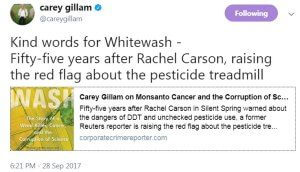
carey as rachel
Really now. We’ve been looking for a new Rachel Carson.

Gillam has been likened to a modern-day Rachel Carson, which she coyly promoted on her twitter page. She does keep very good company. For example:

  • Gillam can be seen moving freely among the anti-glyphosate activist scientists. The chair of the IARC glyphosate monograph working group, Aaron Blair, noted in his deposition (page 219-220) that Carey would often consult him and Christopher Portier (architect of the “Great IARC Scientific Swindle”).
  • Gillam is working directly with the legal pack of wolves suing Monsanto, and when they sequester documents, Carey quickly rifles through them for gotcha lines she can publish, and then releases them on a near daily basis (sometimes in breach of court discretionary rules) on the USRTK website.
  • She is obviously close to the IARC communications machine, helping to push the agency forward in its battle to maintain some shred of credibility against the criticisms and howls from the scientific community. See in the image below how Carey was able to tweet about an IARC press release four hours before the agency published their communication. A special relationship?
    clear food
    Courtesy of Clear-Food on twitter. Carey tweets on IARC reaction four hours too soon. Collusion?
    Clearly Gillam is seen by the range of actors in the organic food industry lobby as a key player. For that reason, the European Green Party is again using taxpayer money to fly this carpetbagger from the US to Brussels to help people like MEP Bart Staes put a few more nails in the coffin of the glyphosate renewal dossier and further trash industry’s reputation.

    Breaking the law?

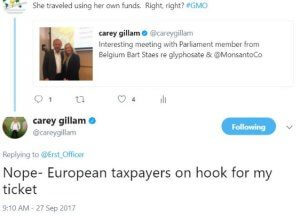
    As a Belgian citizen (and a European taxpayer), I asked my MEP, Bart Staes, about details of the public funding of Gillam’s repeated trips to Brussels (Gillam was crowing on twitter that the “European taxpayers on the hook for my ticket”). The way I saw it, this was an American activist paid by US organic lobbying organisations, being funded to come to Brussels to lobby a foreign government. I believe there are protocols in the European Parliament about if and how lobbyists should be paid.

    carey on hook
    Wait, I’m an EU taxpayer! … Shit!

    We should also not forget that the European Green Party has its own voluntary initiative of full disclosure of any lobbyist contacts. I couldn’t find this disclosure report for her first visit (she came with one of the lawyers suing Monsanto). I have written MEP Staes for more details, but two weeks on, he has declined to reply – I suspect he is scrambling to cover his tracks.

    More curious is the question of whether Gillam’s lobbying trips to Brussels are not breaking the laws in the US governing how non-profits are allowed to act. American 501c3 tax exempt organisations like USRTK are not normally allowed to lobby foreign governments (USRTK could risk losing their tax exempt status). Carey would have to have reported this before her trips, explaining the nature of her activities abroad as a representative of an American non-profit. Now I am not an American lawyer (perhaps one should follow this up), but under the FARA law, it seems indeed that a foreign government is paying Gillam with the expectation that she will influence public policy. Consequences of violating the reporting requirements could be severe. As Gillam is a stickler for transparency and proper conduct, I’m sure all of the proper requirements have been fulfilled. But wouldn’t it be a howler if she had forgotten and USRTK loses its tax exempt status. I for one will be shedding tears of joy!

    If Gillam attempts to promote her anti-Monsanto book while here, she will likely be breaking more laws. Damn, I was hoping to get a signed copy!

    All this just to bash a company?

    Why are my tax-euros paying for this nonsense (twice for Christ’s sake!)?

    The claims Gillam is making about glyphosate and Monsanto are outrageous, cherry-picked and obsessively amplified given the reality. For example, on ghost writing, the BfR produced a 4000+ page report on glyphosate. Often there are texts pasted in to serve as “placemats” for the scientists to rework and reference at a later time. That the authors forgot to manage four paragraphs (over 4000 bloody pages) is not a reason to scrap the entire EU risk assessment process (unless that was their motive all along and this whole glyphosate melodrama is just a tool in the process of undermining EU regulatory science).

    At the end of the day, relentless obsession from characters like Carey Gillam is blowing the entire glyphosate regulatory process into the realm of the absurd. I really can’t bear to share my observations with farmers any more when they contact me for news on whether they can use the herbicide of the century next year.

    Despite all of the torches and pitchforks, as I wrote in my last blog, I keep trying to remind myself that Monsanto is just a mid-sized research-based company, glyphosate is a useful substance with low toxicity that farmers in the EU can use to control weeds and improve soil health. There is no Roundup-Ready GE seeds in Europe (although that is precisely why American carpetbaggers like Carey keep coming over). The activities of this company have not always been appropriate, but compared to other company mis-steps in the past, I think the manufactured outrage is just a tad too excessive.  This is not the end of the world, the destruction of science and media nor the demise of public health.

    Gillam needs to get over her rage from 2015 … but she has surrounded herself with a band of opportunistic zealots happy enough to exploit that.

    David Zarukthe Risk-Mongerhas been an EU risk and science communications specialist since 2000, active in EU policy events from REACH and SCALE to the Pesticides Directive. Follow him on twitter @zaruk

    This article was originally published on The Risk-Monger as Carey Gillam: A Rachel Carson for our Time? and has been republished here with permission.

GMO nutrition-enhanced corn in development could cut cost of animal feed

image x

Researchers in the United States say they have discovered how to genetically engineer corn to produce a kind of amino acid usually found in meat.

The result is a food with increased nutrition that could feed animals and people around the world. The new corn, also called maize, could reduce the cost of animal food.

The researchers say the process involves putting genetic material from a bacterium into corn.

Methionine is very important for humans and animals. It is one of nine necessary amino acids that humans get from food, according to the National Center for Biotechnology Information. It supports growth, helps repair skin injuries, improves hair quality and strengthens fingers and toenails. It also helps protect cells from pollution and slows the aging process.

Thomas Leustek is a professor of Plant Biology at Rutgers University in New Jersey and one of the writers of the study. He told VOA, “We improved the nutritional value of corn, the largest commodity crop grown on Earth.” He added, “Most corn is used for animal feed, but it lacks methionine — a key amino acid — and we found an effective way to add it.”

[Editor’s note: Read the full study (behind paywall)]

The GLP aggregated and excerpted this article to reflect the diversity of news, opinion and analysis. Read full, original post: Researchers Genetically Modify Corn to Increase Nutrition

EU delays vote on glyphosate herbicide reauthorization; France ‘ready to accept’ 4-year extension

eu and glyphosate

EU countries failed on Wednesday [October 25] to vote on a license extension for weedkiller glyphosate, delaying again a decision on the widely used herbicide that critics say could cause cancer.

The European Commission said in a statement the relevant committee did not hold a vote at a meeting and that it would announce the date of the next meeting shortly.

It also failed to vote at a meeting earlier this month. The current license expires at the end of the year.

In anticipation of a vote, the European Parliament called on October 24 for the weedkiller to be phased out in the next five years, prompting the Commission to drop its proposal for a 10-year license extension.

The Commission then said it would seek to find a consensus around an extension of between five and seven years.

[Separate Reuters story:] France is prepared to accept a four-year license extension for controversial weedkiller glyphosate in order to reach a consensus among European Union countries, the government’s spokesman said on Wednesday.

The GLP aggregated and excerpted this article to reflect the diversity of news, opinion and analysis. Read full, original post: EU delays decision on herbicide glyphosate

Unapproved stem cell therapy leaves elderly women blind

lead
[E]ye doctors based primarily at the Bascom Palmer Eye Institute in Miami had published a widely covered report describing three eerily similar cases: Three elderly women with macular degeneration got stem cells derived from their own fat injected into their eyes at a different stem-cell clinic in Florida. The same thing happened: Their retinas became detached, and they went blind.

[T]he clinic should have known better. “It’s just not a professional thing to take an unproven intervention and inject it in both eyes,” says Leigh Turner, a bioethicist at the University of Minnesota, who tracks stem-cell clinics. Kuriyan says that injecting both eyes and asking patients to pay out of pocket for their treatment are both highly unusual for clinical trials. “Those are all big red flags,” he says. A better approach, he says, would have been to test the injections in animals for safety first.

It’s unclear exactly why the stem-cell injections caused such a bad reaction in these women. Perhaps the stem cells had differentiated into cells that formed a membrane and then contracted, peeling the retina away from the rest of the eye. Or perhaps there was scarring caused by immune cells, which are part of the mix of cells in fat that can be injected along with stem cells into the eye.

The GLP aggregated and excerpted this blog/article to reflect the diversity of news, opinion, and analysis. Read full, original post: A Woman Went Blind After Stem Cells Were Injected in Her Eyes

Gulf War veterans show signs of permanently damaged DNA

Screen Shot at PM

Researchers say they have found the “first direct biological evidence” of damage in Veterans with Gulf War illness to DNA within cellular structures that produce energy in the body.”

In blood tests, researchers observed more lesions and more mitochondrial DNA—that is, extra copies of genes—in Veterans with Gulf War illness, relative to controls without the illness, suggesting excess DNA damage. Lesion frequency gives a direct measure of DNA damage, while the increased number of mtDNA copies reflects a response to the damage. Both lesion frequency and the number of mtDNA copies vary in response to environmental toxins and together provide a reading of overall mitochondrial health.

[Dr. Mike Falvo] notes that everyone experiences some level of mtDNA damage, perhaps due to aging and environmental exposures, such as air pollution. In the study, the mtDNA damage was 20 percent greater in the Veteran group, compared with a control group that included three Veterans without GWI and four non-Veterans.

“Mitochondrial dysfunction among Veterans with GWI may help explain, in part, the persistence of this illness for over 25 years,” the researchers on Falvo’s study write. “For example, chemical and environmental exposures during deployment may have provided the initial [harm] to mtDNA and accumulation of damage.”

[Editor’s note: Read the full study]

The GLP aggregated and excerpted this blog/article to reflect the diversity of news, opinion, and analysis. Read full, original post: Evidence of DNA damage in Vets with Gulf War Illness