Leukemia defense: Y-chromosome offers ‘extra layer of protection’

leukemia
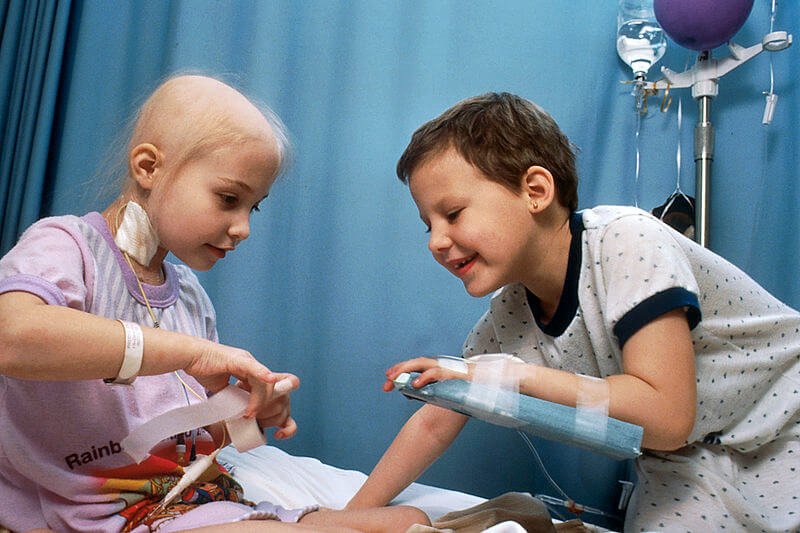
Two young girls with acute lymphocytic leukemia receiving chemotherapy. Image credit: National Cancer Institute

Scientists have discovered the first example of a gene that is only found in one sex and provides protection against cancers including an aggressive form of leukaemia.

The gene is only found on the Y chromosome which, until today, was thought to only carry genetic information that leads to an embryo developing as a male, rather than a female, foetus.

It appears to offer an extra layer of protection against acute myeloid leukaemia (AML), a development researchers at the Wellcome Sanger Institute and the University of Cambridge said changed the way the Y chromosome was viewed and could lead to new treatments.

The team studied the X-chromosome gene UTX in human cells and in mice to try to understand its role in AML. They found the loss of the UTX, which is known to be mutated in many tumours, hastens the development of AML.

The researchers also found that UTY, a related gene on the Y chromosome, protected male mice that were lacking UTX against developing AML, because it can stand in and perform the role of UTX in preventing the unchecked growth of cells.

“Our study strengthens the argument that loss of the Y chromosome can increase the risk of cancer and describes a mechanism for how this may happen,” [says Professor Brian Huntly].

Editor’s note: Read full study (behind paywall)

Read full, original post: Scientists discover male-only gene that protects against leukaemia

{{ reviewsTotal }}{{ options.labels.singularReviewCountLabel }}
{{ reviewsTotal }}{{ options.labels.pluralReviewCountLabel }}
{{ options.labels.newReviewButton }}
{{ userData.canReview.message }}

Related Articles

Infographic: Global regulatory and health research agencies on whether glyphosate causes cancer

Infographic: Global regulatory and health research agencies on whether glyphosate causes cancer

Does glyphosate—the world's most heavily-used herbicide—pose serious harm to humans? Is it carcinogenic? Those issues are of both legal and ...

Most Popular

Picture1-5
Science Disinformation Gap: The transatlantic battle over social media and censorship
Screenshot-2026-04-23-at-11.00.36-AM
Regulators' dilemma: Thalidomide, Metformin, and the cost of getting drug approvals wrong
ChatGPT-Image-May-12-2026-08_39_41-PM
GLP podcast: Big Pharma, Big Ag, Big Food—health harming industries or life-saving innovators?
Screenshot-2026-05-12-at-9.58.31-PM
'He seems fine': Marty Makary out as FDA commissioner
ChatGPT Image May 10, 2026, 08_16_59 PM 2
Overmedicalization? RFK Jr.’s antidepressant crackdown raises conflict questions over his fee stake in Wisner Baum, the tort firm built on suing drug makers
Screenshot-2026-05-12-at-10.05.11-AM
Pro-vaccine “hero” vs. an anti-vax “villain”: ‘Bad Vaxx’ video stirs MAHA backlash
Picture1-1
Cooling the planet with balloons: Could a geoengineering gamble slow global warming?
ChatGPT-Image-Apr-13-2026-02_20_22-PM
Viewpoint: Misinformation infodemic? Why assessing evidence is so challenging 
Screenshot-2026-05-01-at-1.29.41-PM
Viewpoint: What happens when whole grains meet modern food manufacturing? Labels don’t tell the whole story.
images
The never-ending GMO debate: Pros and cons
ChatGPT Image May 12, 2026, 10_19_00 AM 2
Viewpoint— 'Muscular governance': How authoritarianism is surging corporate-linked energy misinformation
Screenshot-2026-05-11-104424
Hantavirus outbreak research: Trump administration shut down study last year on rodent-to-human transmission
glp menu logo outlined

Get news on human & agricultural genetics and biotechnology delivered to your inbox.