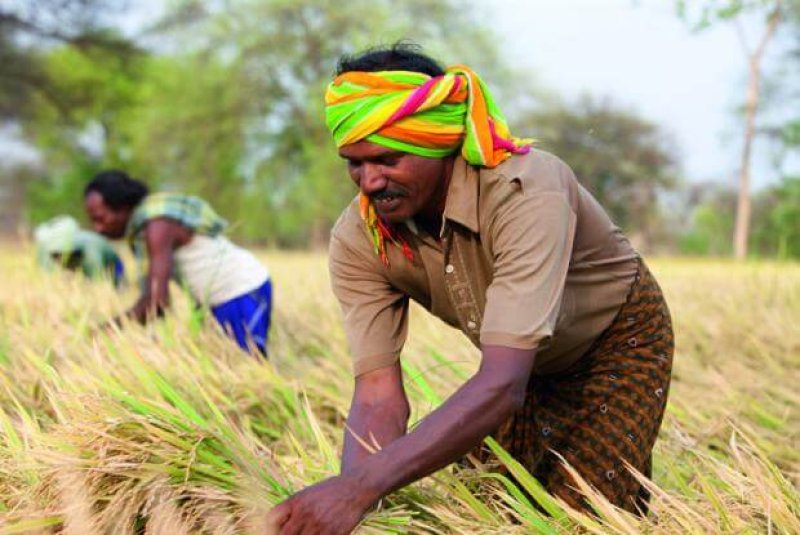
Indian rice farmers increasingly opt for buying high-yielding hybrids instead of saving seeds

Credit: Bayer CropScience

The poorer a state, the less are the chances of its farmers adopting high-yielding seed technology, right? Well, not when it comes to hybrid rice at least.

Out of the country’s total estimated area of 65.8 lakh acres (26.6 lakh hectares) under hybrid paddy — the un-milled grain containing roughly two-thirds rice and one-third husk and bran — nearly 83% is accounted for by Uttar Pradesh, Bihar, Jharkhand, Chhattisgarh, Madhya Pradesh and Odisha. These are states, whose farmers aren’t as well-off as their counterparts in Northwestern and Southern India, and crop yields well below even that of West Bengal (India’s No. 1 rice producer).

What accounts for this seeming paradox — of relatively poorer farmers taking to planting of hybrids, as opposed to conventional open-pollinated varieties (OPV)?

Hybrids are produced by crossing genetically diverse plants even within the same species. The first-generation or F1 offspring from such crosses tend to have yields higher than what either of the parents (both OPVs) individually can give. Unlike OPVs, though, the grains from hybrids aren’t suited for saving and re-use as seed by farmers. The resultant plants will not have the same hybrid vigour as the F1 offspring. Farmers will, hence, plant hybrid seeds — which, have to be purchased each time — only if the grain yields from them are substantially higher over OPVs.

Read full, original post: Breeding challenges: Hybrid rice clicks better in poor than agriculturally prosperous states

{{ reviewsTotal }}{{ options.labels.singularReviewCountLabel }}
{{ reviewsTotal }}{{ options.labels.pluralReviewCountLabel }}
{{ options.labels.noReviewsLabel }}
{{ options.labels.newReviewButton }}
{{ userData.canReview.message }}

Related Articles

Infographic: Global regulatory and health research agencies on whether glyphosate causes cancer

Infographic: Global regulatory and health research agencies on whether glyphosate causes cancer

Does glyphosate—the world's most heavily-used herbicide—pose serious harm to humans? Is it carcinogenic? Those issues are of both legal and ...

Most Popular

ChatGPT-Image-Mar-10-2026-01_39_01-PM
Viewpoint—“Miracle molecule” debunked: Why acemannan supplements don’t work
ChatGPT-Image-Jun-25-2026-02_53_56-PM
Embryo gene editing is on the horizon, stirring mixed emotions
Screenshot-2026-07-01-at-2.49.48-PM
Dr. TikTok and male fertility: Viral claims tout GLP-1 drugs as fertility boosters. What does the science say?
ChatGPT-Image-Jul-6-2026-02_25_26-PM
40 million Americans take glucosamine. If you have memory loss, it could accelerate cognitive decline.
a-mature-farmer-working-in-the-field-at-sunrise-harvesting-crops-generated-by-ai-photo
What’s the prospect of developing gene-altered crops that are more nutritious and resist climate disruption
png-upside-food-syn-bio-cultured-meat
Regulating cultured meat around the world
Screenshot-2026-07-21-at-6.22.06-PM
The Indian physician’s one-woman battle against health disinformation on Wikipedia
reverse-aging
Rapamycin: Here’s the skinny on the anti-aging pill that increases the lifespan—of mice by 10%
YearReview Grift
Viewpoint: A practical guide to evaluating social media wellness hype
ChatGPT-Image-Jun-17-2026-03_29_08-PM
Viewpoint: What’s the impact of the U.S. abandoning support for global health?
ChatGPT-Image-Jun-25-2026-12_23_17-PM
No, Bill Gates did not secretly engineer ticks to promote veganism
file-f-d-d-
Facts & Fallacies Podcast: Europe's AC debacle underscores fatal flaw in green activism
glp menu logo outlined

Get news on human & agricultural genetics and biotechnology delivered to your inbox.