Some wild bee populations are declining. What can we do about it?

bumblee
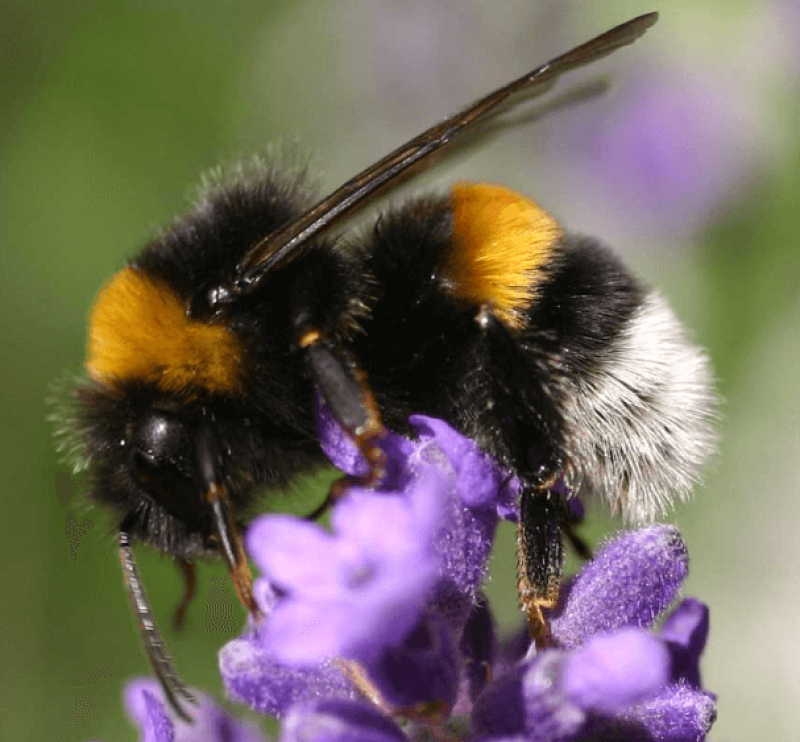
Bombus terrestris, a species of bumblebee

In recent years, a significant amount of attention has been paid to the numerous threats that are facing the honeybee. But contrary to what many people believe …. numbers of the Western honeybee …. in the United States have actually been rising slowly in recent years (there around 2.9 million colonies today …. and the species is not at risk of extinction.

This is not to say that the situation is good. Huge numbers of hives are being lost every winter and spring, with some beekeepers reporting losses exceeding 40 percent ….

A number of policy and conservation initiatives have been put in place to address these kinds of issues. But according to a 2016 paper in Conservation Biology, while such efforts may sound beneficial, they may actually be exacerbating …. the decline of native bee species, such as bumblebees …. Unlike the honeybee, a small portion of these native species are classified at risk of extinction.

“We argue that North American honeybee losses are not a conservation problem,” the authors wrote. “Rather, they are a domesticated‐animal‐management problem. By focusing attention on honeybees, policies and funding priorities may undermine native bee conservation and have negative impacts, ecologically and socially.”

To find out more about why native bees have been overlooked …. Newsweek spoke to Robert Gegear a professor with Worcester Polytechnic Institute’s Department of Biology and Biotechnology, in Massachusetts ….

Read full, original article: Wild Bees Are Dying and Ecosystem Collapse Will Follow—But Nobody’s Taking Notice


{{ reviewsTotal }}{{ options.labels.singularReviewCountLabel }}
{{ reviewsTotal }}{{ options.labels.pluralReviewCountLabel }}
{{ options.labels.newReviewButton }}
{{ userData.canReview.message }}

Related Articles

Infographic: Global regulatory and health research agencies on whether glyphosate causes cancer

Infographic: Global regulatory and health research agencies on whether glyphosate causes cancer

Does glyphosate—the world's most heavily-used herbicide—pose serious harm to humans? Is it carcinogenic? Those issues are of both legal and ...

Most Popular

Screenshot-2026-04-13-at-1.39.26-PM
Viewpoint: ‘Safer for children?’ Stonyfield yogurt under fire for deceptive organic marketing
ChatGPT-Image-May-7-2026-12_16_37-PM-2
Viewpoint: Are cancer rates ‘skyrocketing’ as RFK, Jr. and MAHA claim? The evidence says mostly the opposite
Screenshot-2026-04-22-at-10.46.29-AM
Viewpoint: How to counter science disinformation? Science journalist offers 12 practical tips
Picture1-14
When superbugs threaten vulnerable children: Can AI help solve antibiotic resistance?
Screenshot-2026-04-23-at-11.00.36-AM
Regulators' dilemma: Thalidomide, Metformin, and the cost of getting drug approvals wrong
Picture1-1
Cooling the planet with balloons: Could a geoengineering gamble slow global warming?
ChatGPT-Image-May-12-2026-08_39_41-PM
GLP podcast: Big Pharma, Big Ag, Big Food—health harming industries or life-saving innovators?
png-pill-omega-Supp-fish-oil
Millions take omega-3 fish oil for brain health. New research suggests it may do the opposite.

Sorry. No data so far.

glp menu logo outlined

Get news on human & agricultural genetics and biotechnology delivered to your inbox.