Viewpoint: Why we need a 3-year moratorium on gene-edited babies

hi
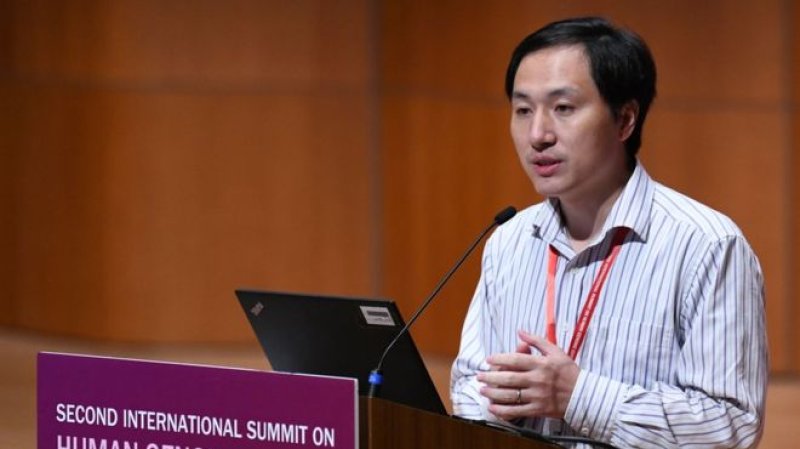
Chinese scientist He Jiankui speaks at the Second International Summit on Human Genome Editing in Hong. Image credit: AFP

Chinese researcher He [Jiankui] dropped the bomb with his claim that he produced twin CRISPR’d babies. He cited a 2017 National Academies of Sciences, Engineering, and Medicine consensus report as one reason he felt it was alright for him to proceed with his efforts to do this.

I question He’s interpretation of that report, but in my view the experts issuing various reports left the door too open to this kind of work.

He’s announcement was likely timed to coincide with last week’s Second International Summit on Human Genome Editing in Hong Kong.

As the Hong Kong meeting wrapped up, the organizers released a statement that did not explicitly call for a moratorium on making gene-edited babies.

Unlike the meeting organizers, I favor a low-risk, temporary, three-year moratorium on implantation of gene-edited human embryos to make genetically modified babies. A moratorium won’t stop the most driven rogue, and one can reasonably ask how it would be enforced. … Three years is enough time for both the science and societal discussions to advance without being a burden.

The scientific community needs to take a firmer and clearer stance that making genetically modified babies is prohibited for the time being. A temporary moratorium specifically on implantation of gene-edited human embryos would achieve that with minimal risk of over-regulating research and no impact on in vitro research.

Read full, original post: We need a temporary moratorium on using gene editing to create babies

{{ reviewsTotal }}{{ options.labels.singularReviewCountLabel }}
{{ reviewsTotal }}{{ options.labels.pluralReviewCountLabel }}
{{ options.labels.newReviewButton }}
{{ userData.canReview.message }}

Related Articles

Infographic: Global regulatory and health research agencies on whether glyphosate causes cancer

Infographic: Global regulatory and health research agencies on whether glyphosate causes cancer

Does glyphosate—the world's most heavily-used herbicide—pose serious harm to humans? Is it carcinogenic? Those issues are of both legal and ...

Most Popular

Picture1-5
Science Disinformation Gap: The transatlantic battle over social media and censorship
Picture1-1
Cooling the planet with balloons: Could a geoengineering gamble slow global warming?
ChatGPT Image May 10, 2026, 08_16_59 PM 2
Overmedicalization? RFK Jr.’s antidepressant crackdown raises conflict questions over his fee stake in Wisner Baum, the tort firm built on suing drug makers
Screenshot-2026-05-11-104424
Hantavirus outbreak research: Trump administration shut down study last year on rodent-to-human transmission
Picture1-14
When superbugs threaten vulnerable children: Can AI help solve antibiotic resistance?
Screenshot 2026-05-11 at 11.30
Despite politicized disinformation, Midwest AI data centers are fueling a solar energy boom
Screenshot-2026-05-08-at-3.40.33-PM
Seeds of power: China turns to genetic engineering to become global superpower
ChatGPT-Image-Apr-13-2026-02_20_22-PM
Viewpoint: Misinformation infodemic? Why assessing evidence is so challenging 
S
As vaccine rejectionism spreads, measles may be taking a more dangerous turn
images
The never-ending GMO debate: Pros and cons
Screenshot-2026-05-08-at-11.55.47-AM
Anti-vax activists falsely blame COVID vaccines for the rising U.S. cancer rate among younger people.
glp menu logo outlined

Get news on human & agricultural genetics and biotechnology delivered to your inbox.