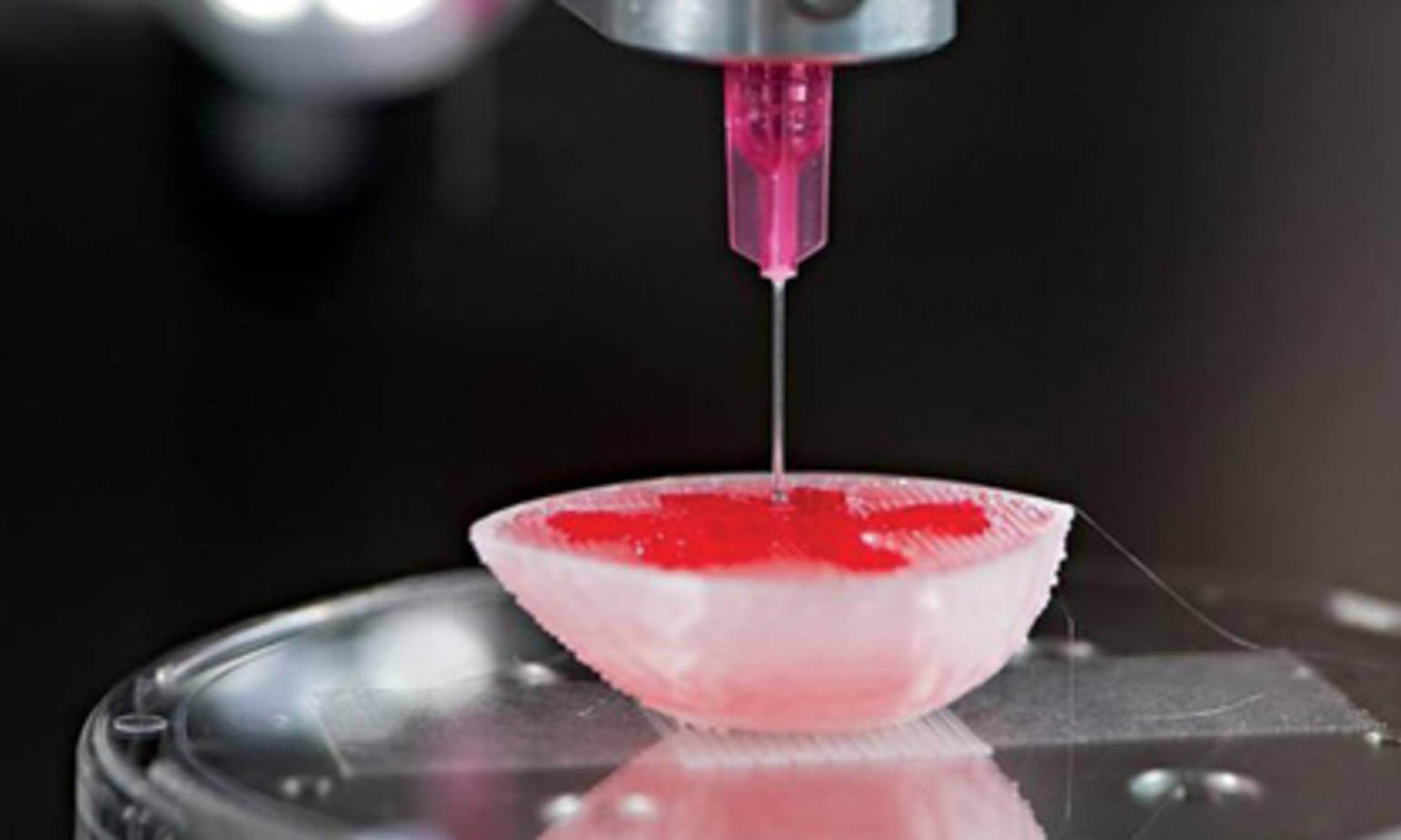
Printed replacement human body parts might seem like science fiction, but this technology is rapidly becoming a reality with the potential to greatly contribute to regenerative medicine. Before any real applications, “bioprinting” still faces many technical challenges. Processing the bio-ink and making it stick to itself and hold the desired printed gel structure have been proving particularly difficult especially in inkjet printing. Few methods currently exist for gluing bio-ink droplets together and these do not work for every kind of cell, motivating new alternative approaches.
Building on their previous work, researchers at Osaka University have now refined an enzyme-driven approach to sticking biological ink droplets together, enabling complex biological structures to be printed.
…
Currently, sodium alginate is the main gelling agent used for inkjet bioprinting, but has some compatibility problems with certain cell types. The researchers’ new approach is based on hydrogelation mediated by an enzyme, horseradish peroxidase, which can create cross-links between phenyl groups of an added polymer in the presence of the oxidant hydrogen peroxide.
Although hydrogen peroxide itself can also damage cells, the researchers carefully tuned the delivery of cells and hydrogen peroxide in separate droplets to limit their contact and keep the cells alive. More than 90% of the cells were viable in biological test gels prepared in this way.
[Editor’s note: Read the full study (behind paywall)]
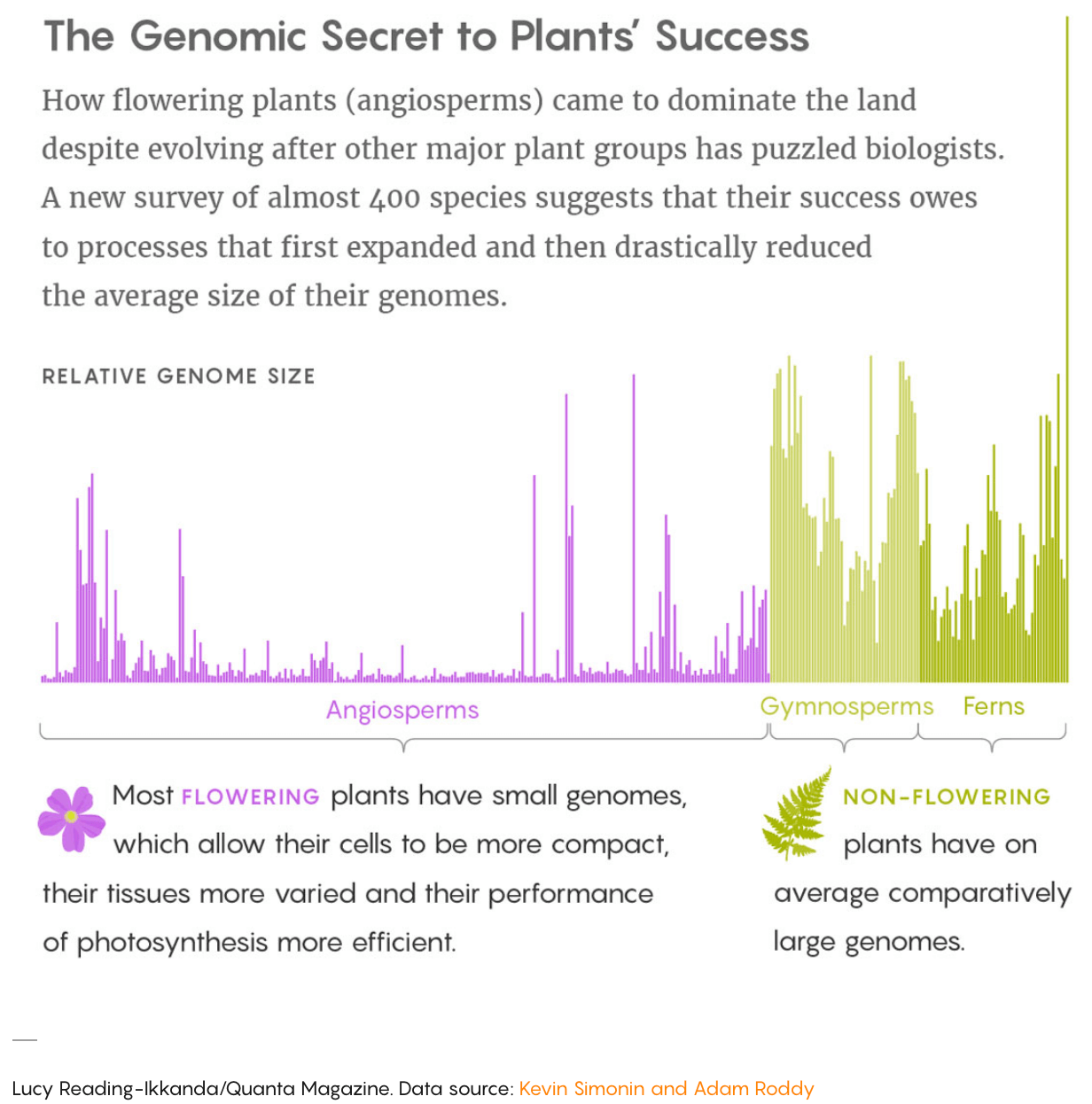
When people consider evolutionary events related to the origin and diversification of new species and groups, they tend to emphasize novel adaptations — specific genes giving rise to new, beneficial traits. But a growing body of research suggests that in some cases, that deciding factor may be something much more fundamental: size. In a [new] paper published … in PLOS Biology, a pair of researchers studying the angiosperms, or flowering plants, has named genome size as the limiting constraint in their evolution.
…
Today, the 350,000 flowering-plant species, which have flourished in the vast majority of environments on Earth, constitute 90 percent of all plants on land. Since Darwin’s time, biologists pursuing the answer to that abominable mystery have sought to explain how the flowering plants could possibly have achieved this level of dominance in such a relatively short time.
Perhaps the answer has been so elusive because those scientists have usually focused on the physiological traits that set the angiosperms apart from their relatives. In the PLOS Biology paper, however, Kevin Simonin, a plant biologist at San Francisco State University, and Adam Roddy, a postdoctoral fellow at Yale University, argue that it’s the genome sizes underlying those individual adaptations that really matter.
A controversial pesticide allegedly linked to bee deaths will be pulled from [Australian, New Zealand, and UK hardware store chain] Bunnings’ shelves by the end of this year, a spokesman has confirmed.
The canned product Yates Confidor is a class of pesticide which some studies suggest affects bees’ navigation and immune systems, resulting in colony death.
Bunnings made the decision in November last year to remove the product from its UK and Australian stores amid declining British bee populations, however, admitted their decision was based on precautions rather than scientific evidence.
“There’s a lot of conflicting science out there,” a spokeswoman said, “we decided to err on the side of caution.”
The company received several calls from concerned customers requesting the product be removed, but have not released a statement on its decision.
Yates Confidor is a neonicotinoid, a class of pesticides which is absorbed by the plant rather than coating its surface. The chemicals spread to all parts of the plants, and are exposed to bees through pollen.
The European Food Safety Authority (EFSA) scientists identified a number of risks to bees from neonicotinoids in 2013, however were unable to finalise risk assessment due to a data gaps.
A spokesman for the Australian Pesticides and Veterinary Medicines Authority (APVMA) said neonicotinoids registered for use in Australia are safe and effective.
In recent decades, prompted by concerns that men’s sperm quality is declining, researchers have looked at things they suspect of potentially disrupting the body’s endocrine system.
…
In a study published…in the Proceedings of the National Academy of Sciences, researchers found that a concentrated dose of the over-the-counter painkiller taken by young, healthy men appears to be linked to a testicular condition that typically only appears at middle age and has been linked to infertility.
The experiment involved 31 men under 35 in Denmark and France who were split into two groups, with the first taking 1,200 milligrams of ibuprofen each day for six weeks and the other a placebo. While 1,200 milligrams of ibuprofen is considered on the high side for general aches, pains and fever, it’s not unusual for doctors to prescribe twice that much for athletes.
In two weeks, the concentration of testosterone hormone dropped as ibuprofen concentrations grew in the blood of those taking ibuprofen — resulting in the men having a condition known as hypogonadism.
…
“I do not think the message should be to stop taking ibuprofen. Rather this is an important but small study. Larger studies with more follow up are needed to understand the implications of ibuprofen use,” [Michael Eisenberg] said.
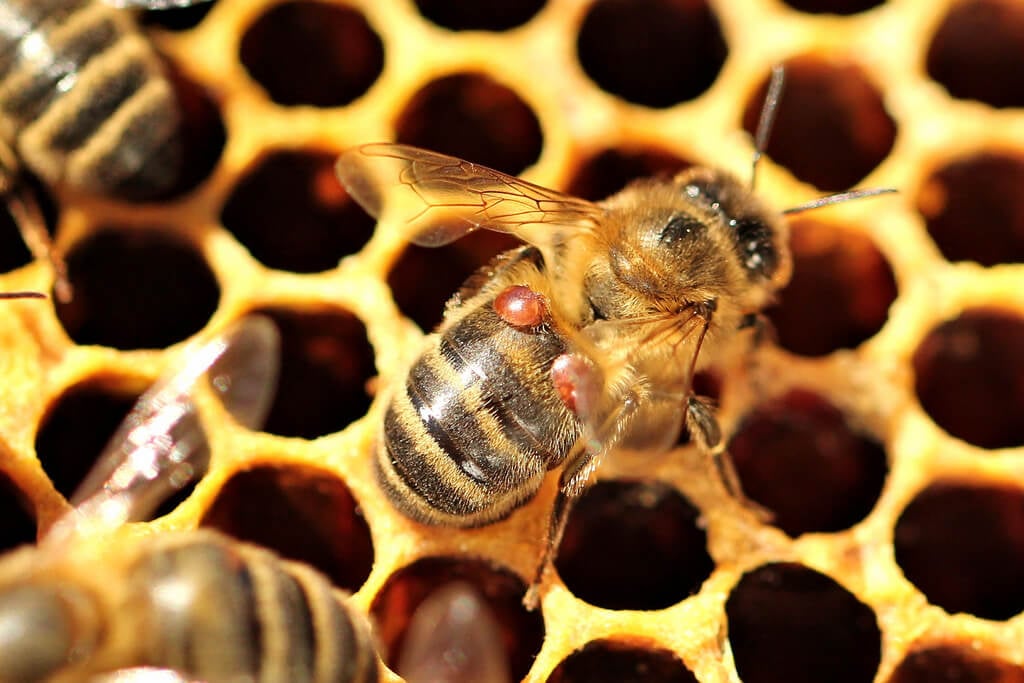
German scientists primarily based out of the University of Hohenheim have stumbled upon a simple solution that could deal a blow to honeybees’ greatest threat. They’ve found that a tiny dose of the compound lithium chloride kills Varroa destructor mites without harming bees.
The scientists detailed their incredible findings in the January 12th publication of Scientific Reports.
V. destructor, more commonly known as the Varroa mite, is a scourge of honeybees across the globe. Upon infiltrating a colony, the mites latch on to bees, sucking their hemolymph (essentially blood) and spreading the diseases they carry. According to the USDA, 42 percent of commercial hives in the U.S. were infested in summer 2017, and 40 percent of beekeepers said the parasite seriously harmed their colonies. By comparison, only 13 percent reported harm from pesticides.
Chemical compounds exist to combat the parasites but they are outdated and growing increasingly ineffective, the researchers write, adding that no new active compounds have been registered in the last 25 years.
The dearth of options prompted scientists at The Hebrew University of Jerusalem to experiment with a technique called RNA interference. In their study, they fed bees double-stranded RNA via a sugar solution to knockout vital genes in Varroa mites. The mites ingested the lethal RNA via bees’ hemolymph and subsequently died.
Inspired by those results, the German researchers sought to replicate them by repeating the experiment with slightly tweaked methods. Indeed, mites infesting bees that were fed sugar water with the designed RNA rapidly died, but so did mites in a control group given another RNA that should have been ineffective. The astonishing results prompted the researchers to suspect that the lithium chloride used to produce the RNA – and thus present in the sugar water – was actually killing the parasites. A battery of subsequent examinations confirmed their hypothesis.
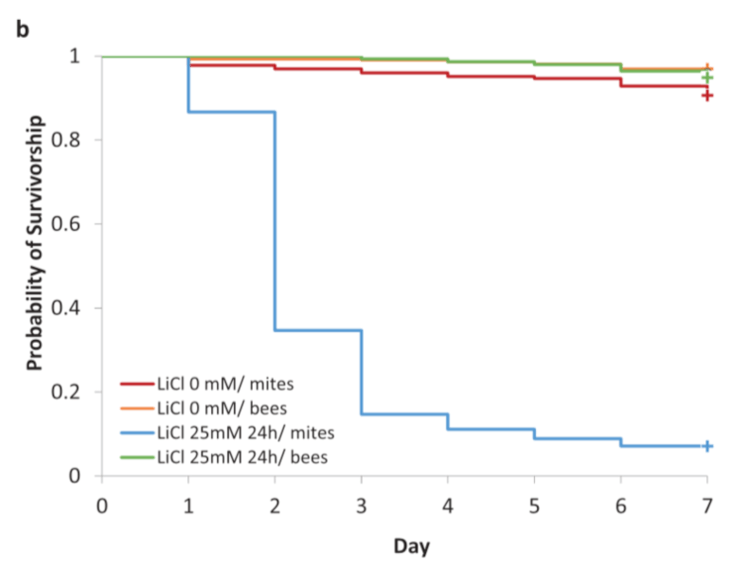
The scientists then carried out numerous experiments testing lithium chloride against Varroa mites, including ones that approximated field studies. They found that feeding honeybees minuscule amounts of lithium chloride (at a concentration of no more than 25 millimolar) over 24 to 72 hours wiped out 90 to 100 percent of Varroa mites without significantly increasing bee mortality. (Below: The figure shows the surviving proportion of bees and mites fed lithium chloride compared to those not fed lithium chloride.)
Ziegelmann et al. / Scientific Reports
According to the researchers, lithium chloride could be put to use very quickly as it is easily applied via feeding, will not accumulate in beeswax, has a low toxicity for mammals, and is reasonably priced. However, wider studies on free-flying colonies testing long-term side effects are required first, as well as analyses of possible residues in honey.
Francis Ratnieks, a Professor of Apiculture at the University of Sussex, expressed skepticism about the new finding.
“We can kill 97% of the Varroa in a brood less hive with a single application of oxalic acid, which takes five minutes to apply and is already registered and being used by beekeepers,” he told RCScience via email. “I think it will be difficult in practice to apply lithium salts to colonies to kill varroa and get the same level of control… There are also the wider issues of registration and potential contamination of the honey with a product that would not normally be there.”
Still, the Hohenheim researchers are hopeful.
“Lithium chloride has potential as an effective and easy-to-apply treatment for artificial and natural swarms and particularly for the huge number of package bees used for pollination in the United States,” they conclude.
Ross Pomeroy is Chief Editor of RealClearScience and a zoologist and conservation biologist by training. Follow him on Twitter @SteRoPo
This article was originally published at Real Clear Science as “Accidental Discovery Could Save Bees From Their Greatest Threat” and has been republished here with permission.
One of the longest-running debates in the realm of child development is the question of whether we are the result of our environment or our genetics. Reality, however, is more complex and more intriguing.
The oversimplification of this matter, which has been a major topic of debate and scientific inquiry among psychologists, physicians, and scientists of all stripes since the term nature vs. nurture was coined by Francis Galton in 1869, does not give due consideration to that time when the two are inextricably intertwined: that crucial forty weeks, give or take, during which a human grows from fertilized egg to embryo to fetus. And there is now research suggesting a third manner of passing on genetics to offspring: the control of genetic expression and hormonal imprinting set in motion by exposure to hormones during gestation.
The research in this arena is ongoing, but it is clear that hormones released during gestation appear to affect the development of the fetal brain in a number of ways.
It is common knowledge that deficiencies of nutrients in a pregnant person’s diet, pathogens, medications, and other outside influences can have a teratogenic effect. For example, a medication used to treat severe cases of cystic acne, Acutane (retinoic acid), is known to cause birth defects through mutation of the SSH Gene(Sonic Hedgehog Gene).
What is not well known outside the scientific community is that factors within the gestational partnership between fetus and parent, in particular the balance of hormones released into the mother’s bloodstream, also have a profound effect on the expression of genes within the placenta and the fetal brain, affecting intelligence, mental health, social and developmental disorder manifestation, brain size and structure, susceptibility to stress and sensitivity of the fight or flight response, and hormonal imprinting, to name a few.
The mother’s hormones appear to have a programming effect on the fetal brain through the phenomenon of hormonal imprinting. The exposure of the developing brain to varying levels of particular hormones will permanently set how responsive the fetus’s hormone receptors are for the rest of their lives. Two such examples of hormonal imprinting involve oxytocin and cortisol.
Exposure to cortisol while in utero appears to affect the formation of the stress-response axis, responsible for how the offspring reacts when exposed to stressful stimuli. But it isn’t as simple as a dose-response system or the negative effect of teratogens(an element that causing malformations of an embryo or fetus by way of exposure).
When examining cortisol exposure during pregnancy, it appears that timing of exposure, amount of exposure, and the slope of increase in exposure(cortisol exposure naturally increases over the course of a pregnancy) all contribute to the final outcome. What we find is a U-shaped curve where the lowest and highest levels of cortisol exposure in pregnancy are associated with negative outcomes, including exaggerated stress response in childhood and impaired brain development.
As evidenced by a study published in 2010 involving 125 full term infants whose mothers were tested for cortisol levels and surveyed for psychological states five times during pregnancy, early exposure to elevated cortisol levels negatively impact offspring while late exposure to high cortisol has a salutary effect. The infants in the study exposed to elevated cortisol early in gestation showed slower growth and lower scores in mental development when tested at 12 months with the Bayley Scale of Infant Development(BSID) whereas infants exposed to higher cortisol during late gestation showed faster development and higher mental development scores on the BSID.
It also appears that a steeper increase in cortisol across the course of a pregnancy, starting with a lower level in the first trimester and ending with a higher level in the last few weeks, improves outcomes evidenced by faster mental development over the first year and resulting in higher intelligence scores at a year. Only infants with a moderate average exposure (lack of either high exposure in the first 18 weeks, no abnormally high exposure at any recorded time and a moderate level recorded overall) to cortisol do not exhibit an exaggerated stress response in infancy. A study conducted in India, in which 133 pregnant women were evaluated for depression before and after birth using the Kessler scale and the Edinburgh Postnatal Depression Scale and then following up with 58 of their infants, looking for a connection between cortisol secretion during pregnancy and exaggerated stress responses in childhood found that two-month-old infants tested for salivary cortisol levels following immunization showed exaggerated responses to immunization if they had been exposed to very high or very low levels of cortisol during pregnancy.
The implications of these findings are many and in need of further research, but thus far it appears that increasing cortisol exposure once the developing child has passed the vulnerable first trimester of development provides a blueprint within the brain for future stress responses in life — stress responses that should approximate those needed for survival in the world the parents are living in. It stands to reason that a child born into a high-stress world (threat of natural disaster, war, or predators) would need a sensitive and rapid stress reaction to survive. In theory, by exposing a fetus to high levels of cortisol early in pregnancy, we create a child built for extreme reactions to meet an extreme world. When the developing child is exposed to unusually low levels of cortisol in the womb, their stress-response axis may be unable to properly process stressors (cortisol); when tested in infancy, this is evidenced by an exaggerated response to stressors, similar to their high cortisol exposure counterparts. This line of thinking leads us to the hypothesis that there are either ideal levels and timing for cortisol exposure in the developing infant, or, at least, a range of acceptable levels. Exposure above or below that range, or during crucial time frames, may result in negative outcomes.
Aside from the effect on the stress-response-axis, cortisol increases during development in some studies show a decrease in synaptogenesis, hippocampal weight, and fewer glucocorticoid receptors in both the amygdala and the hippocampus. These changes are associated with poorer memory and decreased ability to learn, and all of these changes are found in conjunction with changes in gene expression within the placenta.
The Oxytocin system is another area that is being researched for its significance to human behavior. Oxytocin has been known as “the love hormone” but more accurately is responsible for setting appropriate social interactions in place — including the urge to nurture and protect young, mate and defend one’s mate, and socialize or compete with same-sex comrades in heterosexuals.
The oxytocin system is not only affected by the administration of exogenous oxytocin and oxytocin receptor antagonists but also by levels of steroid hormones including progesterone, testosterone, and estrogen. As with cortisol, these exposures during pregnancy and early postpartum result in hormonal imprinting that will guide future behaviors. These behavioral changes, or, rather, preset baselines for behaviors, result from changes in the fetal brain by way of gene expression, neuron function, cell morphology (shape and appearance of cells), and axonal guidance (process by which neurons send out axons to reach their targets).
Furthermore, a study on rats showed that a single dose of oxytocin at birth reduced the turnover of dopamine and serotonin in the brain of the rats at 4 months of age. These findings are significant considering that a number of conditions of the mind including autism and schizophrenia appear to be related to disturbances of the serotonin and dopamine systems.The hormonal imprinting of the oxytocin system during gestation appears to be responsible for many future outcomes, including anxiety levels, prosocial behaviors, addictive tendencies, parenting, pair-bonding and sexual behavior. When oxytocin receptor antagonists are administered we see changes in what we believe are oxytocin fueled behaviors. In some species we witness a decrease in aggression and competition for mates and an increase in anxiety. With application of oxytocin, we witness increases in mating behaviors, aggression, attentiveness to young, pair-bonding, and in some species (mice, prairie voles, and pigs), a decrease in same-sex socialization and an increase in competitiveness and in others the opposite.
The big question here is: What does the idea that hormonal fluctuations during gestation shape the genetic expression, behaviors, and actual brain structures of our offspring mean? First and foremost, it means that more research needs to be conducted to learn about hormonal imprinting and its effects on lifelong health before we even consider further tampering with the oxytocin systems in our offspring through interventions like the induction of labor with oxytocin receptor antagonists, including Pitocin (exogenous oxytocin), as well as exercising caution when determining whether to introduce interventions that increase cortisol exposure.
At the same time, cortisol and oxytocin are only two of many hormones that a fetus is exposed to during gestation, and we would do well to further examine the effects of them all.
When considering the manner in which mental and behavioral health conditions are passed on from parent to offspring, hormonal imprinting must be looked at as a significant variable at play and researched as a possible means to prevent the inheritance of mental illness. If extreme hormonal fluctuations in the mother can be prevented and even levels of specific hormones manipulated to meet a range of ideal or normal exposure, it may be possible to stop the genetic predisposition to disadvantageous mental disorders that might be hard-wired during gestation.
In the meantime, it is safe to say that measures should be taken to decrease stress and improve familial and societal supports during childbearing to ensure the next generation has the fullest potential to thrive. Should we reach a point where we become able to gestate our progeny outside of a human body, using an artificial womb through ectogenesis, we must take great care in controlling for the timing, frequency, and level of exposure to hormones for developing and imprinting optimal health of body and mind.
Cherrie Newman is a writer and student of human reproduction with the Ancient Art Midwifery Institute. She is the author of a science fiction novel series entitled Progeny under the pseudonym CL Fors. Follow her on her blog or on Twitter @clfors.
Since its introduction four decades ago, genetic engineering has been a source of high hopes for health, agriculture, and industry. But it has also provoked deep anxiety, not least owing to the laborious nature of the genome-editing process. Now, a new technique, CRISPR-Cas, offers both precision and the ability to modify the genome text at several places simultaneously. But this has not eliminated reason for concern.
…
[A] cell that reproduces a virus, whether useless or harmful, [has] to develop some way to resist it. And, in fact, it was in this manner – as a bacteria’s defense against invading viruses – that the CRISPR-Cas process first emerged.
[S]cientists have figured out how to replicate the process [of viral infection], enabling humans to edit, with the utmost precision, specific genomes – the Holy Grail of genetic engineering for nearly 50 years.
This means that scientists can apply the CRISPR-Cas mechanism to correct problems in the genome – the equivalent of typos in a written text. For example, in the case of cancer, we would want to destroy those genes that allow the multiplication of tumor cells. We are also interested in introducing genes in cells that never gained them by natural genetic transfer.
There is nothing new about these objectives. But, with CRISPR-Cas, we are far better equipped to achieve them.
How long do you want to live – to 85, 90, 100 or beyond? More important than how long we live is the state of our health in old age.
…
[S]cientists in the United States believe drugs could be on the horizon that delay the diseases of old age and increase the healthy years of life. But could such treatments also mean we live longer?
…
Prof Gordon Lithgow of the Buck Institute for Research on Aging runs a lab that studies how to lengthen life in microscopic worms and in human cell cultures.
He told me: “Ageing is really plastic in simple lab organisms – we can increase lifespan by 500%.
“In more complex animals like the mouse we’ve been able to increase lifespan by 20-30% but we don’t know what’s possible in humans.”
…
Of course, we should not expect medicine to solve all our health problems but try to meet science halfway. There are things we can already do to increase our chances of a healthy old age. Near the top of any to-do list is exercise – if it were a drug it would be a blockbuster medicine.
..
Keeping the mind active is vital: this can build “cognitive reserve” and reduce the chances of developing dementia. A balanced diet will also help. There is no guaranteed formula for a healthy old age but follow that advice and you too might become a superager.
[Genetic engineering] is a powerful tool that can help us farm responsibly and sustainably by minimizing damage to the environment and prioritizing the health of both people and animals — the precisegoals of organic farming. Type the terms ‘GMO’ and ‘organic’ into Google and you’ll get a barrage of links framing the two as diametrically opposed. The truth is that, when well-designed and used responsibly, the products of genetic engineering are often perfectly aligned with the goals of organic farming.
One testament to this compatibility is the marriage of Pamela Ronald, a plant geneticist, and Raoul Adamchak, an organic farmer, who live and work in Davis, California
…
In Tomorrow’s Table: Organic Farming, Genetics, and the Future of Food, Ronald and Adamchak argue that genetic engineering can help “develop biologically-oriented, sophisticated, and elegant approaches to address agricultural problems” and that “to maximize the benefit of GE [genetically engineered] plants, they would best be integrated into an organic farming system.”
…
There are already many examples of what we might call “organic GMOs”: those that promote the same values as organic farming by reducing the use of synthetic chemicals, delivering more nutrition, and even restoring ecosystems. In the late 1990s, GMO papaya saved Hawaii’s entire papaya industry from viral eradication
CRISPR–Cas9-edited plants can be cultivated and sold free from regulation, the US Department of Agriculture (USDA) is making increasingly clear. The agency gave a free pass to Camelina sativa, or false flax, with enhanced omega-3 oil. And more recently, in October, said that a drought-tolerant soybean variety developed with CRISPR falls outside of its regulatory purview. This laissez-faire attitude from the agency shaves years and tens of millions of dollars off the cost of bringing a biotech plant to market.
…
It would have taken Yield10 at least six years and $30–50 million to test and collect the data necessary to bring genetically engineered camelina through the full USDA regulatory process, says Peoples. “We did this in two years and [USDA’s decision] took two months, and I assure you we didn’t spend $30 million on it,” he says. The company will present its technology to the US Food and Drug Administration’s voluntary review process, he says.
…
The edited camelina and the drought-tolerant soybean developed by scientists at USDA’s research arm are two of at least five CRISPR–Cas9-edited organisms to sidestep USDA’s regulatory system in the last two years.
The New York Times reported earlier this week on a new trend: “raw water.” Several companies around the country are selling it, notably Live Water on the west coast and Tourmaline Spring in Maine. This is water that’s untreated, unfiltered, unprocessed in any way—direct from nature to the consumer.
…
Live Water makes unfounded and erroneous claims, including that “blasting water with ozone changes its molecular structure.” This is not true; all water is the same molecular structure that you learned in high school chemistry….
They also claim that using irradiation (another type of disinfection) turns your water into a genetically-modified organism (GMO), and that “GMO seeds and GMO water don’t have the capacity to reproduce life.” Also not true; GMO seeds are used widely in farming and by any definition, certainly “reproduce life.”
Proponents of raw water make a variety of claims that are at best lacking scientific support and at worst completely contradictory to reality.
Speculation about extraterrestrials seems to be everywhere these days. [Recently] it was “Tabby’s Star” (more officially known as KIC 8462852), whose mysterious dimming and brightening, according to the latest analysis, is likely due to dust blocking different wavelengths of light rather than “alien megastructures.” Before that came reports of an interstellar asteroid—not a spacecraft—entering our solar system and a UFO monitoring program conducted by the Department of Defense.
The attention given to such stories has some scientists worried, especially as social media amplifies claims of alien contact over other, more prosaic explanations.
“Currently, most SETI-related news seems to be interfering with conventional scientific discoveries, stealing the limelight—without following basic rules of science,” wrote Dutch exoplanet researcher Ignas Snellen of Leiden Observatory, on a Facebook exoplanets discussion group for professional astronomers.
Although he has “great respect for SETI scientists,” Leiden wrote, “there is no place for alien civilizations in a scientific discussion on new astrophysical phenomena, in the same way as there is no place for divine intervention as a possible solution.”
…
SETI has a voluntary list of protocols to follow when something interesting is found. The first principle urges researchers to “verify that the most plausible explanation for the evidence is the existence of extraterrestrial intelligence, rather than some other natural phenomenon or anthropogenic phenomenon, before making any public announcement.”
If you’re planning to have major surgery soon, you might not want to read this next sentence. Scientists don’t actually know why general anesthesia works—though some scientists in Australia think they might be one step closer to the answer.
We do know the basics: breathe in, get knocked out. (Another common option is to have the drugs introduced using an intravenous line.) The “knocked out” part happens because the general anesthesia forces your brain cells to communicate with each other less.
If that sounds vague, too bad. That’s all we know for sure.
…
[S]cientists at the Queensland Brain Institute, which is affiliated with the University of Queensland did some experiments that might shed some light on what exactly anesthetics are doing in our brains. They published their findings in Cell Reports on [January 9].
…
What they found is that common anesthetics like propofol and etomidate appear to prevent a protein called syntaxin1A from moving around the plasma membrane of a cell.
…
If we know exactly what anesthesia is doing, it might help us explain some of the side effects people experience when they wake up, the study authors said in a press release.
However, while the mechanism they’ve found is a plausible explanation, the authors note more research would need to be done to prove that what they’ve found in flies is what’s really happening in humans.
The Brazilian unit of seed and agrochemicals maker Monsanto on Thursday [Jan. 11] said it will run field tests with genetically modified soy seed INTACTA2 XTEND in Brazil in the 2019-20 crop, looking to launch the variety commercially the following year.
INTACTA2 XTEND seeds have been engineered to resist some weed killers, including those containing a chemical called dicamba. The use of dicamba-based products caused controversy in the United States last year with accusations that the product drifted and damaged neighboring crops.
…
“This new technology will boost weed control, particularly of some weed varieties that are resistant to glyphosate,” the company said.
…
Brazilian regulators approved late in 2016 a request from Monsanto to sell the dicamba-resistant seeds, but the company had declined to release plans to market the product in the country until now.
Brazil is the second-largest soybean producer after the United States and produced a record crop of 114.1 million tonnes last year. It is the world’s top exporter of the oilseed.
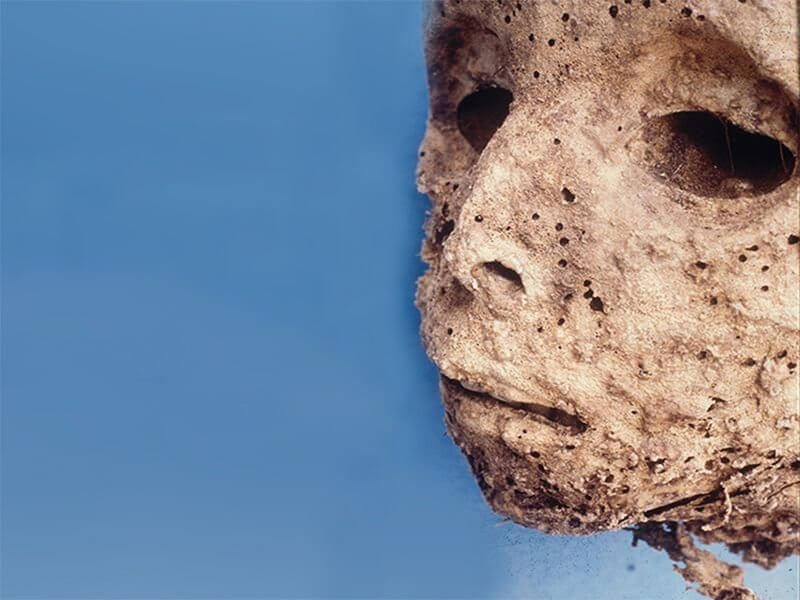
Once, this boy mummy was thought to have died of smallpox, but a new analysis of his now 450-year-old DNA reveals signs of hepatitis B, instead — the oldest known infection of the virus. The puzzling new diagnosis is made stranger still by the similarity between the mummy’s hepatitis B virus and modern-day strains, suggesting this virus has been infecting people for thousands of years.
…
[T]he findings suggest that this strain of hepatitis B hasn’t changed much over the past 450 years — which makes sense, says study author Edward Holmes. “HBV is a very unusual virus,” he told The Verge in an email. Its genome is short and rigid, so the mutations that would let it evolve could also just as easily break it. “On the one hand this makes the virus very small and efficient,” Holmes says, “but on the other it means that very few mutations actually work.”
So this remarkably efficient, slow-evolving virus must have been already well-adapted to people long before this little boy contracted it. That means hepatitis B has probably been spreading among humans for thousands, possibly tens of thousands, of years. Exactly how long, Holmes says, is still a bit of a mystery.
Two months ago, I joined a club nobody wants to be a member of – the 1 in 8 women who develop breast cancer at some point in their lifetimes. It turned up on a routine mammogram.
I’m happy it’s okay these days to talk about breast cancer – when my mom first had it in 1988, that wasn’t true. I haven’t thought much yet about marching and holding a sign next October for Breast Cancer Awareness Month. I don’t have the strength to hold up a sign right now, but I’m trying to help by explaining things on the Facebook groups of “pink sisters” I’ve joined recently. Many of their questions concern genetic testing.
The media tends to focus on celebrities like Angelina Jolie undergoing surgery before they have cancer because they’ve inherited a susceptibility mutation. But genetic testing is also critically important for those of us who have already been diagnosed.
Beyond BRCA
After my biopsy confirmed that I had ductal carcinoma in situ (DCIS) – a milk duct filled with cancer cells – I knew I needed genetic testing to tell whether I needed a single or double mastectomy. As a genetic counselor, I’d never sent myself for BRCA testing because my family history didn’t fit the classic profile of several young affected family members. Only my mom had it, and she was older. The guidelines now advise testing for anyone of Ashkenazi heritage.
Next up in this unexpected journey: choosing and meeting my breast surgeon. Before she could say much, I began babbling gene names: BRCA, but also CHK2, ATM, RB1, p53, BARD1. Several dozen genes disrupt natural DNA repair, allowing mutations in oncogenes and tumor suppressor genes to persist. A mutation in any one of them would mean both breasts had to go. I didn’t want to take the risk that cancer would develop in the healthy one and I’d need a second surgery.
As my anxiety escalated, the doc spoke up.
“Ricki. You can’t diagnose yourself. Find another genetic counselor.”
So I did. Bonnie Liebers runs Genetic Counseling Services.com, providing telecounseling and helping patients and their health care providers access the best tests for them. The clock was ticking because my husband Larry and I were about to leave on a trip to Costa Rica planned a year ago. Genetic testing would inform my treatment and also reveal whether my three daughters and my sister needed testing too.
The next day, still stunned, I sat down with Bonnie, a personal friend. She calmly laid out the brochures from six genetic testing labs, comparing the offerings and coverage as if we were ordering takeout. We selected Invitae’s 80-gene panel, a blood test. I’d hear about the most likely suspects first, such as the BRCA genes.
(Things are ramping up fast in the genetics of cancer diagnosis and treatment. My 2015 Angelina Jolie post mentioned Invitae’s test, which then covered 34 genes. And Memorial Sloan Kettering Cancer Center recently announced a 468-gene panel for cancer cells. And that’s just mutations. Gene expression profilingfor predicting recurrence is another story.)
A week later, right after we’d traversed the hanging bridges through the cloud forest near the Mount Arenal volcano in Costa Rica and were waiting for our group to catch up, a magical moment of wi-fi revealed my preliminary genetic test results. No mutations in the top tier of genes! A day later another blip of connectivity in the rainforest brought news that I didn’t have mutations in any of the other genes either.
Great news! So I faced a trio of time-based consequences:
Immediate: I’d only need a single mastectomy.
Short term: my daughters and sister were not at elevated risk of having inherited a susceptibility mutation in the genes I was tested for.
Long term: I could now focus on controllable risk factors. Let me explain.
Most cancers are not inherited
The public service announcement for breast cancer screening in New York state (Get Screened, No Excuses), featuring a patient proclaiming “but there’s no cancer in my family,” corrects the common misconception that cancer is inherited. It’s most often a genetic disease, but not an inherited one. There’s a difference.
In most breast cancer cases, the mutations are somatic, occurring only in the breast cells and therefore not inherited. The explanation goes back decades to the 2-hit hypothesis of cancer: Most cancers arise from two recessive mutations, or “hits,” in a single body (somatic) cell.
Only 5 to 10 percent of cancers are inherited, with a mutation coming in with the sperm or egg. People who inherit cancer-susceptibility mutations, like Angelina Jolie, present in all of their cells, are already halfway to cancer at conception. All they need is one mutation in a body cell to start the disease, and that’s why some elect prophylactic surgery.
My cancer was not inherited. Instead, it began when a gene whose protein product regulates the cell cycle (frequency of division) in a single cell within a single milk duct mutated. That first glitch was recessive – the normal gene counterpart on the second copy of whatever chromosome it was part of maintained the normal cell cycle. Maybe I was 7 when that initial hit happened, or 27, or 47. Who knows.
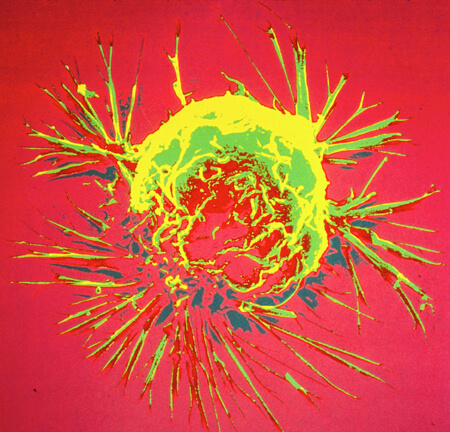
A breast cancer cell (NHGRI).
But sometime within the past few years, in that very same cell, a second mutation zapped that very same gene, but in the second copy of the chromosome. Having two mutations in the same gene lifted the protection of recessiveness, and that cell now had an advantage: it could divide more frequently than the cells around it.
The cell may have had an advantage, but I didn’t.
Soon the cancer cell divided. Then there were 2, then 4, then 8 cells, and on and on until a little lump jutted from the inner lining of a lone milk duct. The runaway cells had filled the little tube by the time I saw the “suspicious” mammogram mid-November 2017, sparkling with a trail of telltale calcifications bisecting my breast. The sparkles hadn’t been there a year earlier; it was a high-grade growth.
Analyzing my controllable risk factors
Some risk factors are out of our control: being female, menstruating young and/or entering menopause late, being older, inheriting mutations. Learning that I hadn’t inherited the most common breast cancer gene variants enabled me to focus on controllable risk factors. But there was one more uncontrollable circumstance to consider that’s rarely written about: spontaneous mutations.
These just happen, due to a chemical phenomenon (a tautomeric shift) in which any of the four types of DNA bases – A, T, C, and G – are fleetingly in a slightly different form that has to do with the position of hydrogen bonds. If a fork of replicating DNA comes along as a base is caught in this rare form – a little like catching an executive in her jammies – then the rare base can’t pair with its usual partner (A with T and G with C), and an incorrect DNA base pair is inserted. If the change to the encoded protein affects how it controls the cell cycle, cancer can result.
Spontaneous mutations are a fact of life, a consequence of chemistry. But environmental exposures can also trigger mutations, and these are likely behind many “2-hit” cancers.
The first cancer-environment link came from British physician Sir Percival Pott, who in 1770 attributed the high rate of scrotal skin cancer among chimney sweeps in London to their crotch-level exposure to a chemical in soot.
My family is riddled with cancers, but they all began later in life and had environmental explanations – lung and tongue cancers among smokers, lymphoma in a radiologist, skin cancer in a sun worshipper. I suspect that the thyroid cancer I had in 1993 was due to 5 years of orthodontia as a kid, unprotected from the x-rays. My exposure in utero to diethylstilbestrol (DES) upped my breast cancer risk. Pesticides that are estrogen mimics, such as DDT, cause breast cancer too.
I’ve done what I could to lower my risk – nursed 3 babies; exercised every day; avoided cigarettes, alcohol, or estrogen patches or pills; no long-term oral contraceptives; and I spread compost and manure on my garden, not organophosphate pesticides.
But diet is something else I can control and haven’t (other than low-carb), and it ties in with my recent visit to Costa Rica.
No more beef!
Clearing land to raise cattle is destroying rainforests, as bovine flatulence pours out the greenhouse gas methane. And beef consumption has long been associated with increased cancer risk.
Grilled beef releases heterocyclic aromatic amines (HAAs), which are absorbed into the bloodstream and sent to the liver, where they’re metabolized into mutagens – chemical compounds that raise the risk of certain cancers. Broccoli and Brussels sprouts produce glucosinolates, which activate xenobiotic metabolizing enzymes that take those nasty HAAs down a different, non-mutagenic pathway.
Spewing HAAs on the barbie isn’t the only risk of eating red meat. Absence of an enzyme makes the human immune system react to eating meat from organisms that do make the enzyme. And cattle and pigs make it.
Specifically, the enzyme, CMAH, encodes a cell surface sugar, Neu5Gc, a type of sialic acid. That sugar functions as a “xenoantigen” – when we encounter it, our immune systems crank out antibodies and promote inflammation, raising the risk of arthritis and cancer.
Last month David Alvarez-Ponce’s team at the University of Nevada described, in Genome Biology and Evolution, how muscle tissue (aka meat) safe for human consumption is in birds, reptiles, platypuses, spiny anteaters, and of course other primates. Interestingly, some breeds of dogs and cats make the offending sialic acid and some don’t – but I don’t think anyone is contemplating consuming their pets.
Surviving cancer is all about accepting what is, yet becoming empowered to live with what is while continuing to do whatever possible to lower risks. They persist. Treated cancers can return and new ones appear. Just do the math.
We have 30 trillion cells, all but the red blood cells harboring genomes where the mutation rate is 5 in 100,000 DNA bases per cell division for the youngest, rising to 5 in 20,000 among the oldest. At last count, at least 130 of those genes are oncogenes or tumor suppressor genes. That means that being “cancer-free” is probably impossible, for any of us, and that’s why “no evidence of disease” is a more honest way for oncologists to give good news to patients.
My journey from breast cancer to genetic testing to eliminating beef may have been circuitous, but it may lower the risk of my having to go through surgery again. I wish I’d started sooner, and I hope that this post helps folks.
Ricki Lewis has a PhD in genetics and is a genetics counselor, science writer and author of Human Genetics: The Basics. Follow her at her website or Twitter @rickilewis.
Rwanda Environment Management Authority (REMA) has drafted a law governing genetically modified organisms (GMOs) in Rwanda which will soon be forwarded to the Rwanda Law Reform Commission for review.
The draft bill was prepared along with the National Biosafety Framework, biosafety policy and regulations according to officials.
The objective of the legislation is to ensure an adequate level of protection in the field of the safe transfer, handling, and use of GMOs resulting from modern biotechnology that may have an adverse effect on the conservation and sustainable use of biological diversity.
The draft law also takes into account risks to human health, to provide a transparent and predictable process for review and decision-making on such genetically modified organisms and related activities, and to implement the Cartagena Protocol to which Rwanda is a signatory party.
…
[Emmanuel Kabera of the Cartagena Protocol on Biosafety] said that the draft legislation, the policy, the national biosafety framework and regulations consider various aspects of GMOs application, including placing on the market food or feed products, environmental release, contained use, emergency cases, among other things.
In Africa, Kenya, Egypt, Sudan, South Africa, Burkina Faso, Nigeria, and South Africa have biosafety laws in place, he said.
Plant biomass contains considerable calorific value but most of it makes up robust cell walls, an unappetising evolutionary advantage that helped grasses to survive foragers and prosper for more than 60 million years.
The trouble is that this robustness still makes them less digestible in the rumen of cows and sheep and difficult to process in bioenergy refineries for ethanol fuel.
But now a multinational team of researchers, from the UK, Brazil and the US, has pinpointed a gene involved in the stiffening of cell walls whose suppression increased the release of sugars by up to 60%.
…
In the team’s genetically modified plants, a transgene suppresses the endogenous gene responsible for feruloylation to around 20% of its normal activity. In this way, the biomass produced is less feruloylated than it would otherwise be in an unmodified plant.
…
The findings are undoubtedly a boon in Brazil, where a burgeoning bioenergy industry produces ethanol from the non-food leftovers of other grass crops, such as maize stover and sugarcane residues, and from sugar cane grown as a dedicated energy crop. Increased efficiency of bioethanol production will help it to replace fossil fuel and reduce greenhouse gas emissions.
The sometimes-preternatural similarity of identical twins is more profound than previously thought. Identical twins, known to science as “monozygotic”, may share more than identical looks and genes, according to new research in the field of epigenetics.
…
The team zeroed in on a class of epigenetic markers that are stable and exist in all cell types, called “metastable epialleles” (MEs). The epigenetic variation at MEs is determined randomly and is influenced by many environmental factors, ranging from the nutritional breakdown of the mother’s diet to the season. Consequently, it was expected that levels of epigenetic similarities and differences for MEs would be similar for both identical and fraternal, or non-identical, twins.
What they found was something of a shock.
Their research, published in Genome Biology, shows that monozygotic twins have identical epigenetics at MEs. “We found that the methylation patterns matched almost perfectly in identical twins, a degree of similarity that could not be explained by the twins sharing the same DNA,” says [researcher Robert] Waterland. “We call this phenomenon ‘epigenetic supersimilarity.’”
The striking finding had a simple explanation: “If, in this group of genes, the epigenetic markers are established before the embryo splits into two, then the markers will be the same in both twins,” says Waterland.
…
[T]he scientists have also detected a link between methylated MEs and the risk of developing certain types of cancer.






 V. destructor, more commonly known as the