
Taking cancers apart ‘piece-by-piece’ in search for vulnerabilities that could be attacked with precision medicine

4-17-2019 researchers
Image: BBC/Other

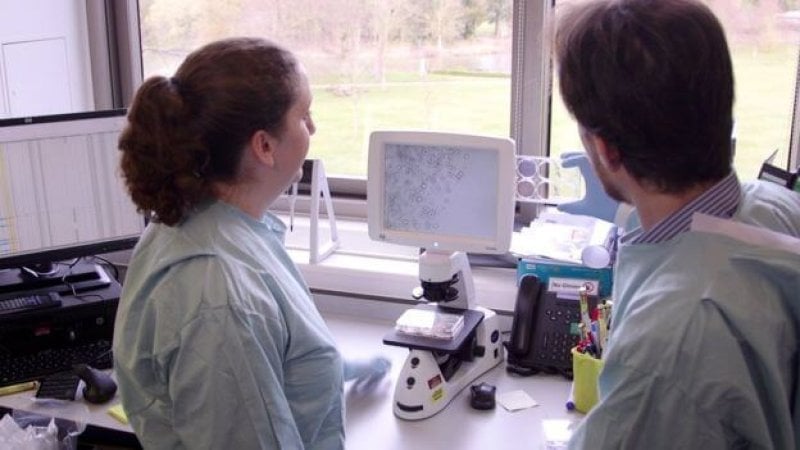
Scientists have taken cancer apart piece-by-piece to reveal its weaknesses, and come up with new ideas for treatment. A team at the Wellcome Sanger Institute disabled every genetic instruction, one at a time, inside 30 types of cancer.

It has thrown up 600 new cancer vulnerabilities and each could be the target of a drug.

…

The study heralds the future of personalised cancer medicine. At the moment drugs like chemotherapy cause damage throughout the body.

…

One potential target is “Werner syndrome RecQ helicase” also known more simply as WRN. The research team found it was essential for keeping some of the most genetically unstable cancers alive.


WRN plays a vital role in around 15% of colon cancers and 28% of stomach cancers, but there are no drugs that target it.

The work was a collaboration between Sanger, the European Molecular Biology Laboratory and pharmaceutical giant GSK. All the findings are publicly available.

The eventual aim of the research is to develop a “Cancer Dependency Map” of every vulnerability in every type of cancer. Then doctors would be able to test a patient’s tumour and give them a cocktail of precision drugs to kill the cancerous cells.

Read full, original post: ‘Dismantling cancer’ reveals weak spots

Related Articles

Infographic: Global regulatory and health research agencies on whether glyphosate causes cancer

Infographic: Global regulatory and health research agencies on whether glyphosate causes cancer

Does glyphosate—the world's most heavily-used herbicide—pose serious harm to humans? Is it carcinogenic? Those issues are of both legal and ...

Most Popular

Personalized-Cancer-mRNA-Vaccine-Vial
Personalized mRNA vaccines are poised to revolutionize cancer treatments. Here are the barriers.
ChatGPT-Image-Mar-10-2026-01_39_01-PM
Viewpoint—“Miracle molecule” debunked: Why acemannan supplements don’t work
Screenshot-2026-09-22-at-12.26.15-PM
‘Forever chemical’ concerns: Separating hysteria from reasonable concern in the debate over PFAS danger
Screenshot-2026-10-11-at-10.24.21-AM
Viewpoint: RFK Jr.’s new CDC head Erica Schwartz greenlights hepatitis B vaccine study critics call “unethical and designed to cast doubts on its safety”
Screenshot-2026-10-05-at-11.57.44-AM
Scaremongering or legitimate safety concerns? The political dogfight over America’s food safety system
Deepfake Democracy Media Mosaic
31 states have passed a patchwork of laws to limit election deepfake commercials. They’re not working very well.
Screenshot 2026-10-12 at 12.25
Tearful onions? CRISPR has a solution for that
AI-Force-Uniform-Insignia-Close-Up
Trump wants an AI Force like Space Force, but that could make AI’s risks harder to manage
Screenshot-2026-10-08-at-1.23.28-PM
Countries around the world are rushing to pass teenage social media bans. Could they backfire?
AI Doctor with a Digital Neural Head
Utah becomes first state to empower AI to bypass doctors and prescribe certain drugs
Radioactive-Americana-Collage-2
The kooky logic behind the raft of spurious cancer claims from Harvard’s T.H. Chan School of Public Health
generated-1790707585414
Facts & Fallacies podcast: America's health care system is broken. A doctor explains how to fix it
Screenshot-2026-09-22-at-10.54.12-AM
‘They misunderstand science’: Research attempting to tie autism to changes in the gut microbiome comes under fire
Concerned-Farmer-at-Golden-Hour
GAHA: The corporate-created “healthier America” movement challenging what it claims is MAHA misinformation about modern farming, chemicals, and food
glp menu logo outlined

Get news on human & agricultural genetics and biotechnology delivered to your inbox.





















