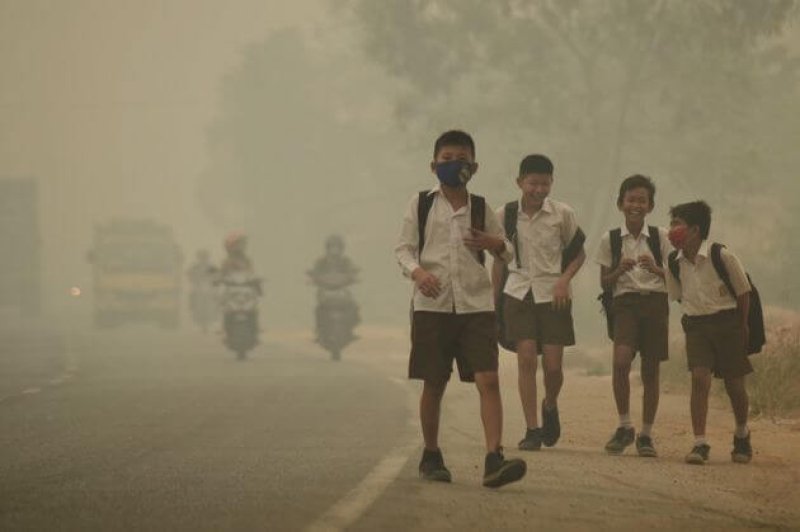
Air pollution dramatically harms childhood brain development

eec e f a
Credit: Wahdi Setiawan/Antara Photo Agency/Reuters

Between 1981 and 1989, 26 outbreaks of asthma were reported in [Barcelona] with many cases centred around the harbour. Local scientists eventually discovered that the cause was soybean dust released into the air when the cargo was unloaded.

The solution was simple enough – filters to cover the soybeans silos – however, the episode left a remarkable legacy in the scientific community in Barcelona, which could help us to identify a significant risk to brain development in children.

…

In 2015, Prof. [Jordi] Sunyer and his colleagues published research showing that higher pollution levels were linked to a 5% decrease on tests of working memory in children aged 7 to 10.

‘This is the same amount of change that was found several years ago between children with high levels of lead in the blood and children with lower levels in the blood,’ said Prof. Sunyer.

Mis- and disinformation are distorting science and public policy. Subscribe to our Daily and Weekly Digests for incisive coverage of ‘disruptive’ innovations in AI, agricultural biotechnology, food, chemicals, nuclear energy, vaccines, and other disruptive innovations.

When the lead pollution from petrol was found to be causing widespread harm, unleaded petrol was introduced from the 1970s. At an individual level, a 5% decrease on a test would not be enough to make an obvious impact, but on a population level it could have a significant economic cost says Prof. Sunyer.

He adds that 90% of brain development happens by the age of four, so he is now following up on his previous study to understand the effects of air pollution at the earliest stages of life.


Read the original post

Related Articles

Infographic: Global regulatory and health research agencies on whether glyphosate causes cancer

Infographic: Global regulatory and health research agencies on whether glyphosate causes cancer

Does glyphosate—the world's most heavily-used herbicide—pose serious harm to humans? Is it carcinogenic? Those issues are of both legal and ...

Most Popular

ChatGPT-Image-Mar-10-2026-01_39_01-PM
Viewpoint—“Miracle molecule” debunked: Why acemannan supplements don’t work
ChatGPT-Image-Sep-10-2026-10_36_07-AM
Viewpoint: Even lousy scientific articles can shield authors when they hype dubious health claims and products
sorghum farmers in kenya FARMERS TREND
Here are all the ways CRISPR gene editing is transforming Africa’s staple crops—and there’s a lot more innovation to come
Screenshot-2026-10-01-at-11.21.27-AM
Vaccine hesitancy, like malaria, surges globally, topping 35% in some countries
ChatGPT-Image-Sep-30-2026-01_25_34-PM
Blood tests for Alzheimer’s? The latest grifter, social media scam.
ChatGPT-Image-Sep-30-2026-01_11_07-PM
How U.S. teamed with Russia to block global human AI weapons oversight
ChatGPT-Image-Sep-30-2026-01_38_36-PM
Viewpoint: Died “with measles” vs. died “from measles”: RFK, Jr.’s dangerously subversive word games
ChatGPT-Image-Sep-21-2026-03_15_09-PM
Viewpoint: Chipotle-inspired lesson: 10,000 sick customers suggest that processed foods can be safer than fresh ones
ChatGPT-Image-Sep-29-2026-12_16_42-PM
Social media influencers are driving food misinformation across Europe
ChatGPT-Image-Sep-2-2026-02_03_32-PM
How much of a problem is AI’s water use?
glp menu logo outlined

Get news on human & agricultural genetics and biotechnology delivered to your inbox.