Meet the cyborg who can help decode the human brain

cyborg

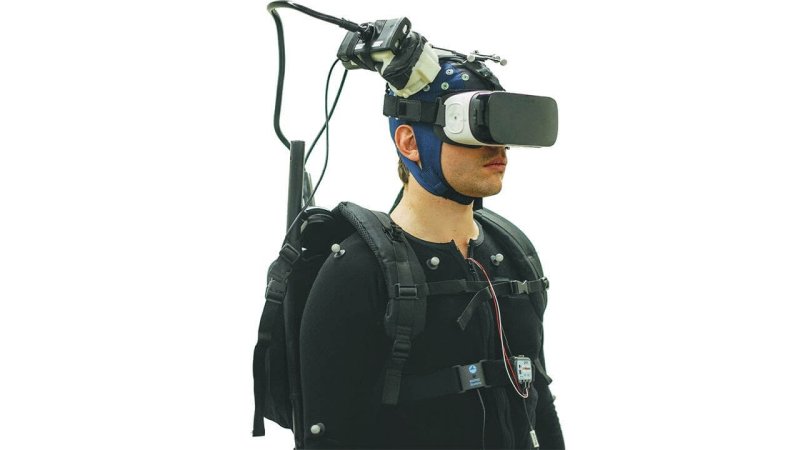
His motion capture suit, sensor-embedded gloves, and virtual reality eyewear were already enough to turn heads. But what stopped people in their tracks and made them stare was a bizarre headgear, tightly strapped to his head through a swimming cap-like device embedded with circular electrode connectors. Several springy wires sprouted from the headgear—picture a portable hard drive hooked up to a police siren enclosure—and disappeared into a backpack. The half-cyborg look teetered between sci-fi futurism and hardware Mad Libs.

Meet Mo-DBRS, a setup that could fundamentally change how we decode the human brain.

Follow the latest news and policy debates on sustainable agriculture, biomedicine, and other ‘disruptive’ innovations. Subscribe to our newsletter.

The entire platform is a technological chimera that synchronizes brain recordings, biomarkers, motion capture, eye tracking, and AR/VR visuals. Most of the processing components are stuffed into a backpack, so that the wearer isn’t tethered to a “landline” computer. Instead, they can freely move around and explore—either in the real world or in VR—something not usually possible with brain scanning technology like MRI.

Movement may seem like a trivial addition to brain scanning, but it’s a game changer. Many of our treasured neural capabilities—memory, decision-making—are honed as we explore the world around us. Mo-DBRS provides a window into those brain processes in a natural setting, one where the person isn’t told to hold still while a giant magnet clicks and clangs around their head.


Read the original post

{{ reviewsTotal }}{{ options.labels.singularReviewCountLabel }}
{{ reviewsTotal }}{{ options.labels.pluralReviewCountLabel }}
{{ options.labels.newReviewButton }}
{{ userData.canReview.message }}

Related Articles

Infographic: Global regulatory and health research agencies on whether glyphosate causes cancer

Infographic: Global regulatory and health research agencies on whether glyphosate causes cancer

Does glyphosate—the world's most heavily-used herbicide—pose serious harm to humans? Is it carcinogenic? Those issues are of both legal and ...

Most Popular

ChatGPT-Image-Apr-20-2026-11_17_18-AM-2
10,000 scientists gone: Trump’s cuts create an unprecedented brain drain
ChatGPT-Image-Apr-22-2026-04_31_20-PM
‘Irresponsible decision’? On mandatory military flu shots, Hegseth chooses ‘freedom’ over health
Screenshot-2026-04-15-at-1.22.58-PM
Anti-biotechnology activists smear hybrid wheat breakthrough that could surge yields in poorer countries
Screenshot-2026-04-22-at-4.10.32-PM
Viewpoint — ‘Completely unethical’: RFK, Jr.’s medical ignorance deprives melanoma cancer-sufferers of a life-saving therapy
ChatGPT-Image-Apr-20-2026-12_28_36-PM
Vaccine skepticism is a growing global problem
ChatGPT-Image-Apr-17-2026-03_30_52-PM
Food labels, decoded: What they really mean
ChatGPT-Image-Apr-21-2026-11_30_48-AM
Stupid study of the month: Eating fresh fruits and vegetables can lead to cancer
images
The never-ending GMO debate: Pros and cons
ChatGPT-Image-Mar-11-2026-11_58_46-AM
The Trump administration has run out more than 4,000 National Institutes of Health employees. Here are the consequences
ChatGPT-Image-Mar-2-2026-03_22_54-PM
Why ‘support supplements’ for GLP-1 users are mostly a waste of money
Screenshot-2026-04-20-at-3.34.46-PM
Viewpoint: How do you sell evidence-based health and science in a world where facts don’t matter?
Screenshot-2026-04-12-135256
Bixonimania: The fake disease scam that AI swallowed whole
glp menu logo outlined

Get news on human & agricultural genetics and biotechnology delivered to your inbox.