Some people got deliberately sick from COVID for science. Here’s what we learned from them

Credit: Davide Bonazzi/Salzmanart

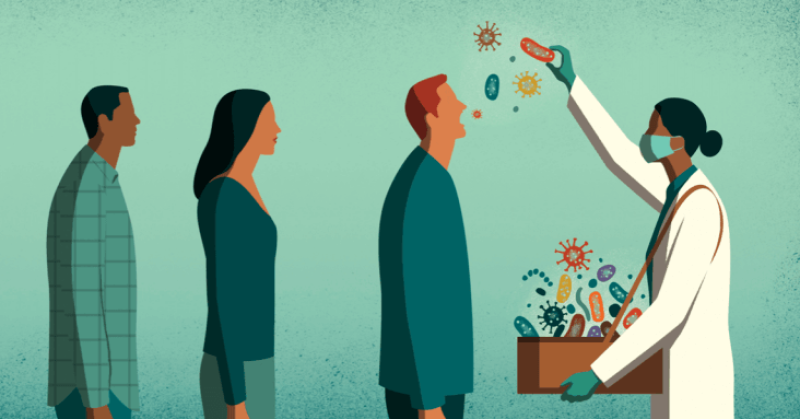
It takes just a tiny virus-laden droplet – about the width of a human blood cell – to infect someone with Covid-19.

That’s just one of the findings from research that deliberately infected healthy volunteers with the SARS-CoV-2 virus.

Follow the latest news and policy debates on sustainable agriculture, biomedicine, and other ‘disruptive’ innovations. Subscribe to our newsletter.

Under these carefully controlled conditions, researchers were able to learn a lot about the virus and how it moves through the body:

  • Tiny amounts of virus, about 10 microns – the amount in a single droplet someone sneezes or coughs – can make someone sick.
  • Covid-19 has a very short incubation period. It takes about two days after infection for a person to start shedding virus.
  • People shed high amounts of virus before they show symptoms (confirming something epidemiologists had figured out).
  • On average, the young, healthy study volunteers shed virus for 6½ days, but some shed virus for 12 days.
  • Infected people can shed high levels of virus without any symptoms.
  • About 40 hours after the virus was introduced, it could be detected in the back of the throat.
  • It took about 58 hours for virus to show up on swabs from the nose, where it eventually grew to much higher levels.
  • Lateral flow tests, the rapid at-home kind, work really well for detecting when a person is contagious. The study found that these kinds of tests could diagnose infection before 70% to 80% of viable virus had been generated.


This is an excerpt. Read the original post here.

{{ reviewsTotal }}{{ options.labels.singularReviewCountLabel }}
{{ reviewsTotal }}{{ options.labels.pluralReviewCountLabel }}
{{ options.labels.newReviewButton }}
{{ userData.canReview.message }}

Related Articles

Infographic: Global regulatory and health research agencies on whether glyphosate causes cancer

Infographic: Global regulatory and health research agencies on whether glyphosate causes cancer

Does glyphosate—the world's most heavily-used herbicide—pose serious harm to humans? Is it carcinogenic? Those issues are of both legal and ...

Most Popular

ChatGPT Image May 26, 2026, 08_42_17 AM (1)
Viewpoint: Greenpeace and poison: How environmental advocacy groups rely on compliant (and often ignorant) journalists to spread disinformation and spark litigation
Screenshot 2025-07-30 at 10.48
Can gene editing eliminate Down syndrome? Scientists have done it in lab-grown cells
Screenshot-2026-05-28-at-1.36.28-PM
Viewpoint: Can mRNA research survive the Trump administration?
Screenshot-2026-06-02-at-11.59.11-AM
Magnifica Humanitas: Pope’s encyclical broadside against AI naivete and overreach
Screenshot 2025-11-18 at 3.45
Viewpoint—GMOs and sustainability: Why buying organic foods is the least environmentally-sensitive food choice—without offering any health benefits
ChatGPT-Image-May-26-2026-07_51_21-AM-2
Viewpoint: There are more than 1,000 chemicals in a cup of coffee—including many substances that can cause cancer. Why isn’t it banned?
ChatGPT-Image-Jun-2-2026-11_39_58-AM
Viewpoint: Who is RFK, Jr.’s newly-appointed CDC senior counselor, Sara Brenner — Vaccine skeptic and self-proclaimed “MAHA mom”
Picture1
Sounds we can’t hear — the hidden planetary signals behind science, fear, and misinformation
ChatGPT Image May 28, 2026, 08_16_38 PM
Viewpoint: Why the EPA mismeasures cancer risk of chemicals and what should be done to fix it
Screenshot-2026-04-14-at-11.11.06-AM
‘Turbo cancer’ or mRNA cancer cure? Strategies to counter misinformation
glp menu logo outlined

Get news on human & agricultural genetics and biotechnology delivered to your inbox.