Acne affects half of people over 25 in Western countries — but it’s ‘basically nonexistent’ in non-industrialized societies. Why?

Credit: Boy_Anupong/Healthline

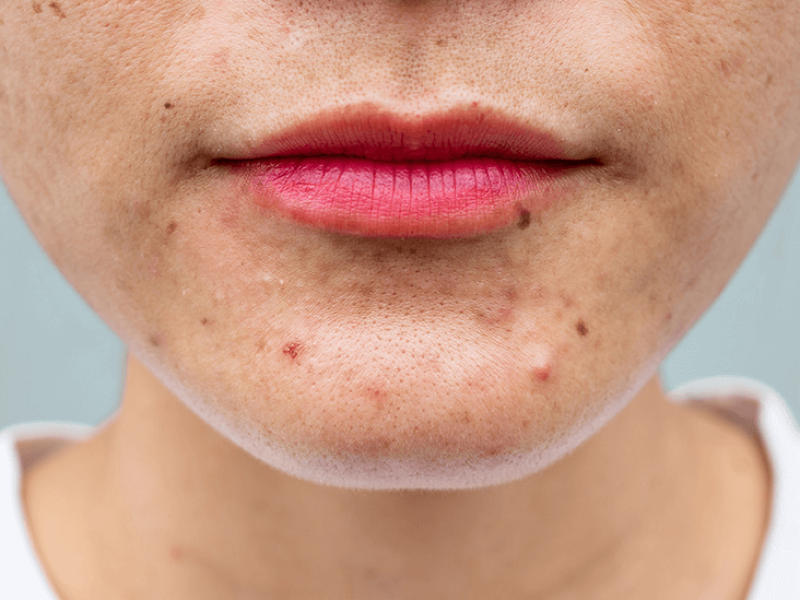
In the Western world, it’s rare to find someone who hasn’t faced a bout of acne at least once. Regardless of race, everyone seems to succumb to this unsightly skin condition, which occurs when hair follicles become plugged with oil and dead skin cells. At 80% to 90% prevalence among adolescents living in modernized countries, acne is basically a rite of passage.  It persists for about half of people over age 25.

But fascinatingly, researchers have discovered that acne is essentially nonexistent among non-industrialized communities.

Follow the latest news and policy debates on sustainable agriculture, biomedicine, and other ‘disruptive’ innovations. Subscribe to our newsletter.
This isn’t simply due to genetics, either. When individuals from [non-Westernized] cultures move to the U.S., Europe, Australia, industrialized parts of Asia, or pretty much anywhere where modernization has taken hold, they get acne just as much as the rest of us. This implies that a few, or many, facets of modern society predispose people to pimples. So what are these factors?…

Science hasn’t pinpointed one overriding cause. Comparing how we live with how acne-free cultures live can yield insights, however.
  • Our diets are much different. Particularly, acne-free peoples tend to consume far fewer refined carbohydrates and simple sugars that spike insulin levels and are devoid of fiber. Although when studies have been pooled and analyzed together, there really isn’t a clear signal linking any aspect of diet to acne.
  • We exercise less. Regular physical activity can lower stress, reduce inflammation, and increase blood flow to the skin, all of which can reduce acne. But again, studies haven’t revealed a clear link between exercise and acne.

{{ reviewsTotal }}{{ options.labels.singularReviewCountLabel }}
{{ reviewsTotal }}{{ options.labels.pluralReviewCountLabel }}
{{ options.labels.noReviewsLabel }}
{{ options.labels.newReviewButton }}
{{ userData.canReview.message }}

Related Articles

Infographic: Global regulatory and health research agencies on whether glyphosate causes cancer

Infographic: Global regulatory and health research agencies on whether glyphosate causes cancer

Does glyphosate—the world's most heavily-used herbicide—pose serious harm to humans? Is it carcinogenic? Those issues are of both legal and ...

Most Popular

ChatGPT-Image-Jul-17-2026-12_42_10-PM
Viewpoint: RFK, Jr. is setting up a panel to compensate people who claim they were injured by a COVID vaccine–no proof needed 
Screenshot-2026-07-17-at-12.55.22-PM
Viewpoint: Is bagged salad a dangerous science experiment? Challenging an online misinformation campaign
ChatGPT-Image-Mar-10-2026-01_39_01-PM
Viewpoint—“Miracle molecule” debunked: Why acemannan supplements don’t work
ChatGPT-Image-Jul-6-2026-02_25_26-PM
40 million Americans take glucosamine. If you have memory loss, it could accelerate cognitive decline.

Screenshot-2026-07-01-at-2.49.48-PM
Dr. TikTok and male fertility: Viral claims tout GLP-1 drugs as fertility boosters. What does the science say?
px-Minced-beef-meat-cow-cattle
Can we trust Trump’s USDA to accurately report farm data? Beef export numbers suggest ‘no’.
Screenshot 2026-07-11 094410
Growing animal muscle and fat cells inside rice grains and calling it beef: One of numerous genetically engineered products shaking up our ecosystem
UK scientists support loosening restrictions limiting embryo research
Are we edging closer to precisely, and safely, editing human embryos?
file-f-d-d-
Facts & Fallacies Podcast: Europe's AC debacle underscores fatal flaw in green activism
ChatGPT-Image-Jul-9-2026-02_39_22-PM
Viewpoint: Polyphenols or NAD+ supplements to combat aging: No, Gwenyth Paltrow and followers, don’t waste your money.
ma art page image
‘It’s time to have a conversation’: Once adamantly opposed to human gene editing, UK’s The Guardian acknowledges likely benefits
ChatGPT-Image-Jun-17-2026-03_29_08-PM
Viewpoint: What’s the impact of the U.S. abandoning support for global health?
reverse-aging
Rapamycin: Here’s the skinny on the anti-aging pill that increases the lifespan—of mice by 10%
afb-a-b
As the EU loosens restrictions on agricultural gene editing, it remains years behind the rest of the world on equally-safe GMO foods
glp menu logo outlined

Get news on human & agricultural genetics and biotechnology delivered to your inbox.