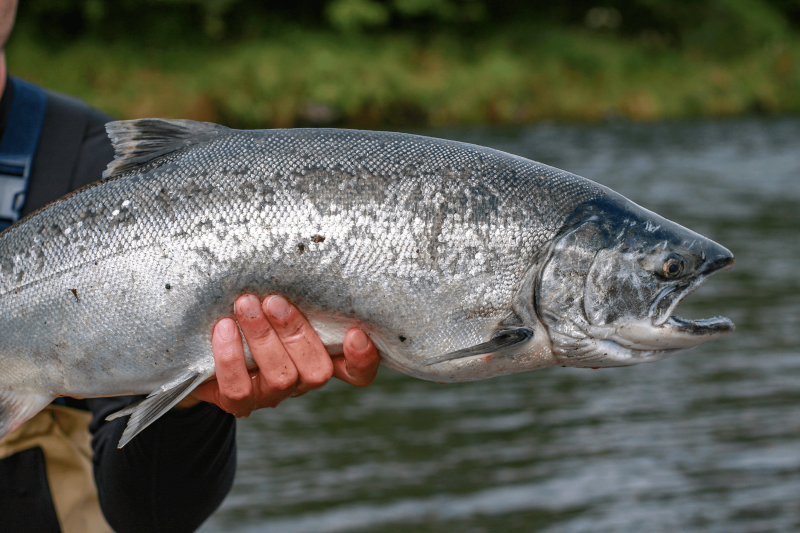

Although wild salmon remains one of Alaska’s most lucrative seafood industries, it’s also one of the state’s most vulnerable, as climate change and population growth increase pressure on the world’s oceans. As it looks more and more likely that demand will eventually outstrip the productivity of salmon and other wild seafood stocks, researchers have turned to another method for producing protein from fish – by culturing it in a lab.
“The basic idea is we cultivate real salmon cells,” said Justin Kolbeck, co-founder and CEO of Wildtype. “And we combine those with a plant based scaffold or sort of a three dimensional matrix to help create a really nice appearance and taste and texture.”
…
Kolbeck says the company’s aim is only to supplement the existing seafood industry – not supplant it. The company has even gone so far as to invest in conservation efforts around one of the world’s biggest sockeye salmon fisheries in Bristol Bay, Alaska.



“If you look at the long run trends, returning stocks of Pacific salmon in general along the Pacific coast have been declining pretty substantially over the last 40-50 years,” Kolbeck said. “The FAO (Food and Agriculture Association) predicts we’re going to need something like 30 million more tons of seafood to satisfy demand by the end of this decade. I found myself asking – and I know a lot of others have asked – where’s all that fish gonna come from?”