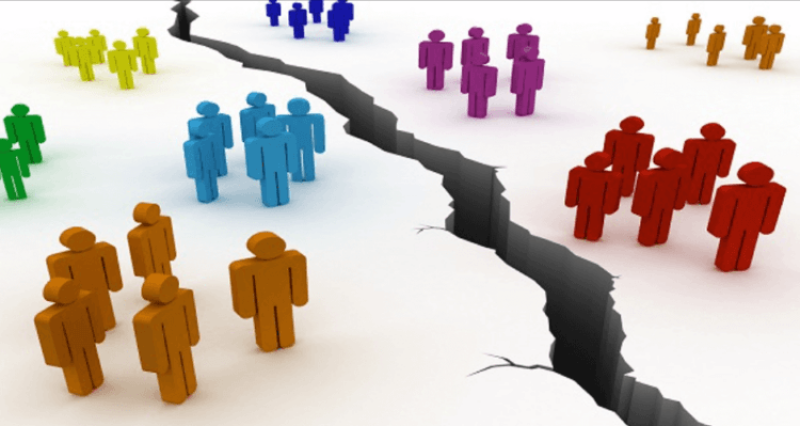
According to a new study published in the inaugural issue of the journal Collective Intelligence, evolutionary forces may be contributing to collective tendencies to discriminate. Researchers from the MIT Sloan School of Management and Peking University used a mathematical model of natural selection on behavior to examine the concept of “group selection,” in which evolutionary forces affect groups of individuals.
Their model showed that in situations where technological changes challenge the dominance of one group and allow newly emerging groups to gain popularity, political polarization, bias, and discrimination can emerge.
The global rise of authoritarianism has intensified over the last few years, making their results more relevant than ever. The 2021 Freedom in the World Report found that countries with declines in political rights and civil liberties outnumbered those with gains by the largest margin in the past 15 years. Anti-immigration sentiment and policies have also continued or increased in many countries (Gallup, September 2020). At the same time, social media use has continued to rise, with an estimated 4.70 billion users globally (DataReportal, July 2020).

“One of the central ideas of economics—the Efficient Markets Hypothesis—is that the random interactions of many individuals can produce a remarkable degree of collective intelligence,” says Lo. “For instance, by harnessing this wisdom of crowds, financial markets fuel tremendous economic growth and innovation such as new cancer drugs, self-driving cars, smartphones, and the Mars rover among many others. But failures in collective intelligence also give us economic bubbles, crashes, and global financial crises—the madness of mobs rather than the wisdom of crowds.”
Groups can form based on hate—often unconsciously—through the forces of natural selection, and such alliances can reduce our collective intelligence and cause great societal harm, the researchers say.

Humans naturally tend to anchor toward their original beliefs (Tversky and Kahnemen, 1974). Lo and Zhang’s research explores the present-day implications of this principle. When people are presented with new information—whether via news services or social media posts—there will be a group that believes this information regardless of its accuracy. And despite the small size of the initial group, engagement-based recommender systems can quickly amplify these beliefs, causing exponential growth of populations with polarized beliefs via typical evolutionary dynamics.
“Simply put, evolution can drive our prejudices,” says Zhang. “Since Darwin’s publication of Origins of Species in 1859, we have known that groups compete in order to survive. Competition exists alongside cooperation in ways that can propel us to new heights—such as the global collaboration that produced our COVID-19 vaccines. But it can also plunge us to new lows—such as state-sponsored terrorism, societies with polarized opinions, and hate crimes toward underrepresented groups.”
The authors recommend fostering environments in which the desired behavior of collective intelligence will emerge naturally through evolutionary dynamics, rather than simply regulating against the undesired outcome—which could create selective pressures that make things worse. Strategies to encourage such an environment include proactively providing social, educational, and economic opportunities for underrepresented groups to counteract negative feedback loops, as well as providing lessons and activities for children to interact with each other with diverse backgrounds, to develop more accurate perceptions of people from other groups. The most effective policies will prevent negative feedback loops from emerging.
“Given today’s near-instantaneous transmission of news, it’s now more important than ever to make sure we have the right tools and the right environment in which the wisdom of crowds can emerge naturally to forestall the madness of mobs,” says Lo.