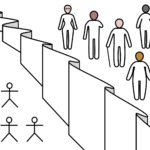
The scene: any number of human labor and delivery rooms. Watch as the pink newborn lays still in the fetal position and makes no attempt to do anything. At all. Ever. For the first 1,000 hours after its birth.
Newborn human infants have it rough (or easier depending on how you look at it) compared to other mammals. Even compared to other primate infants, humans enter the world in ridiculously helpless shape. Non-human primates can, for example, regulate their own body temperature and have a grasp reflex that can support their body weight, so they can hold onto their moms on the move. Scientists have naturally tried to find a hypothesis that could explain this developmental difference.
The well-established answer is near dogma in the anthropological field. Named the ‘obstetrical dilemma,’ it strings together a whole slew of particularly human characteristics. We are born so ‘early’ because if our brains and heads got any bigger we could not reliably slip down our relatively narrow birth canals and into the world. Our birth canals are ‘relatively narrow’ compared to our primate relatives because we need narrower hips to move efficiently walking upright. Put those facts all together, and you get a nice story.
Holly Dunsworth from the University of Rhode Island sums it up in blog at the Mermaid’s Tale:
“The [Obstetrical Dilemma] skillfully ties together many unique or fascinating phenomena in human evolution, such as human bipedalism, human encephalization, hellish human childbirth, helpless (i.e. hellish?) human babies, male-biased human athletic ability, and broad ladies’ hips.
But when Dunsworth went to look for evidence that evolutionary pressures favored early human births or narrow pelvic bones, she couldn’t find any. Instead she found that humans gestated longer than other primates when compared by maternal body size. She also found that our gaits are not affected by the natural variation in our hip width. People with wider hips are not less efficient or constrained movers.
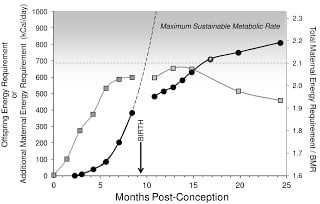
What Dunsworth did find was that birth weight and gestation time were related to the size of the mom across mammals. That even includes those species that have litters like cats or have no bones in their pelvis like whales. Following a possible link between maternal size, birth size and gestation Dunsworth and her colleagues suggested that it was mom’s metabolic limits that determined when her little one needed to be born. Beginning in the 2nd trimester, fetal calorie requirements grow exponentially until birth. But human bodies don’t do well when asked to go beyond two times our resting metabolic rate. That, coincidentally, is about at 38 to 40 weeks gestation for a pregnant woman.

And so, a second hypothesis was generated. The energetics, growth and gestation proposal says that humans and other mammals give birth when fetal energy consumption threatens to over stress mom’s metabolic resources:
The Obstetrical Dilemma and Energetics hypothesis don’t have to be exclusive. It is possible that evolutionary pressures were favoring narrow pelves for movement and bigger and bigger brains while at the same time, gestation was determined by energetics and fetal growth. We’re not sure yet. We need more evidence from primates to lend more support. But, Dunsworth points out, perhaps this is a case of humans mistakenly thinking we’re naturally special. Our big brains and bipedalism can kind of skew us away from thinking of ourselves primarily as mammals:
The OD is not dead. It’s just put in a less omnipotent place. The heaviest burdens should always be on supporting hypotheses for human exceptionalism; we should never default to them. Humans are animals/mammals/primates/hominoids and when we fail at that default view, that’s when we can claim human exceptionalism.
Our brain size and bipedalism are special. Our brains are much larger, when compared relative to our body size, than any other primate and most other mammals excepting some rodents. During gestation, fetuses get to about full length at the end of the 2nd trimester, but our brains continue to add new neurons at a tremendous rate, which requires a lot of energy to support. They were not always so big, however. The Smithsonian says human brains didn’t expand to their exceptional proportions until between 800,000 and 200,000 years ago. Bipedalism among mammals is also special, but our avian friends also evolved the trait. T-rex was a biped.
Whether or not the EGG hypothesis ultimately holds up, it begs the question of what other phenomena we’ve projecting our human exceptionalism onto at the expense of seeing science clearly.
Meredith Knight is a contributor to the human genetics section for Genetic Literacy Project and a freelance science and health writer in Austin, Texas. Follow her @meremereknight.