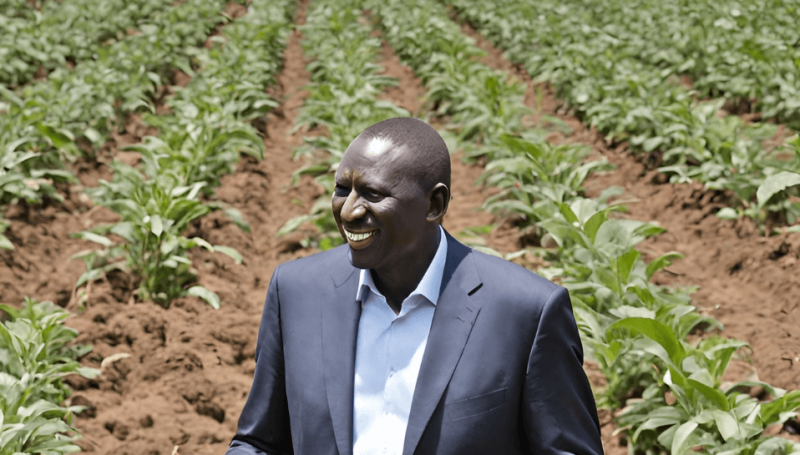
‘No woman has grown a beard because of GMOs’: Kenyan president William Ruto challenges hysteria claiming biotech crops cause health problems

screenshot pm
Credit: Canva

“I haven’t grown breasts despite taking Genetically Modified food. No woman has grown beards because of consuming GMOs.”

This expression by President William Ruto on the myths and fears of Genetically-Modified Organisms might be as controversial as the issue might be.

Follow the latest news and policy debates on sustainable agriculture, biomedicine, and other ‘disruptive’ innovations. Subscribe to our newsletter.

The Kenyan Peasants League represented by lawyer Kevin Oriri argues that lifting the ban would gravely affect farmers’ productivity and sustainability, their fundamental human rights and the general public’s right to life.

BT cotton is currently still going through its trials and is now under cultivation by select farmers around Kenya.

Last year, on June 15, 2021, Kenya approved GMO cassava that was resistant to Cassava Brown Streak Disease following a comprehensive safety assessment that showed the crop did not pose any risk to human and animal health or to the environment.

The genetically modified cassava crop was developed by the Kenya Agricultural and Livestock Research Organisation (KALRO) and was evaluated for a period of five years in field trials conducted in Mtwapa (Kilifi), Kandara (Muranga) and Alupe (Busia).

Oriri says stakes are extremely high since it involves Kenyan’s right to health, life and even the survival of future generations, while on the other hand, multinational food companies have invested heavily in the Kenyan market.


This is an excerpt. Read the original post here

{{ reviewsTotal }}{{ options.labels.singularReviewCountLabel }}
{{ reviewsTotal }}{{ options.labels.pluralReviewCountLabel }}
{{ options.labels.newReviewButton }}
{{ userData.canReview.message }}

Related Articles

Infographic: Global regulatory and health research agencies on whether glyphosate causes cancer

Infographic: Global regulatory and health research agencies on whether glyphosate causes cancer

Does glyphosate—the world's most heavily-used herbicide—pose serious harm to humans? Is it carcinogenic? Those issues are of both legal and ...

Most Popular

Screenshot-2026-04-20-at-2.26.27-PM
Viewpoint — Food-fear world: The latest activist scientists campaign: Cancer-causing additives
Screenshot-2026-05-04-at-12.54.32-PM
How Utah became the country’s supplement capital  — and a haven for unregulated, ineffective and fake products
Screenshot-PM-24
Viewpoint: The herbicide glyphosate isn’t perfect. Banning it would be far worse.
Screenshot-2026-03-13-at-12.14.04-PM
The FDA wants to make many popular prescription drugs OTC—a great idea. Here’s why it’s unlikely to happen
Screenshot-2026-04-12-135256
Bixonimania: The fake disease scam that AI swallowed whole
Screenshot-2026-05-01-at-11.56.24-AM
‘Science moves forward when people are willing to think differently’: Memories of DNA maverick Craig Venter
ChatGPT-Image-May-1-2026-02_20_13-PM
How RFK, Jr.’s false vaccine claims are holding up $600 million to fight diseases in poor countries
bigstock opioids on chalkboard with rol
GLP podcast: 'Safe injection sites': enabling drug addiction or saving lives?
images
The never-ending GMO debate: Pros and cons
glp menu logo outlined

Get news on human & agricultural genetics and biotechnology delivered to your inbox.