Should we be concerned that gene-editing seeds will cascade into unpredictable changes?

Credit: Raana Roohanitaziani et. al. via CC-BY-4.0

For tens of thousands of years, evolution shaped tomatoes through natural mutations. Then, humans came along. For centuries, we’ve bred and cherry-picked tomatoes with our preferred traits. Today, CRISPR genome editing allows us to make new crop mutations that improve traits even further. However, individual mutations, whether natural or engineered, don’t work alone. Each operates in a sea of thousands of so-called “background” mutations. These changes have been sowed by evolution and agricultural history. And what if just one could dramatically alter the desired outcome of an engineered mutation?

Now, a plant geneticist and a computational scientist at Cold Spring Harbor Laboratory (CSHL) have teamed up to explore just how predictable plant breeding actually is with natural and CRISPR mutations.

Follow the latest news and policy debates on sustainable agriculture, biomedicine, and other ‘disruptive’ innovations. Subscribe to our newsletter.

To do so, they turned back the evolutionary clock.

CSHL Professor & HHMI Investigator Zachary Lippman and Associate Professor David McCandlish wondered if different natural and engineered mutations could have similar effects on tomato size depending on the presence of two other gene mutations.

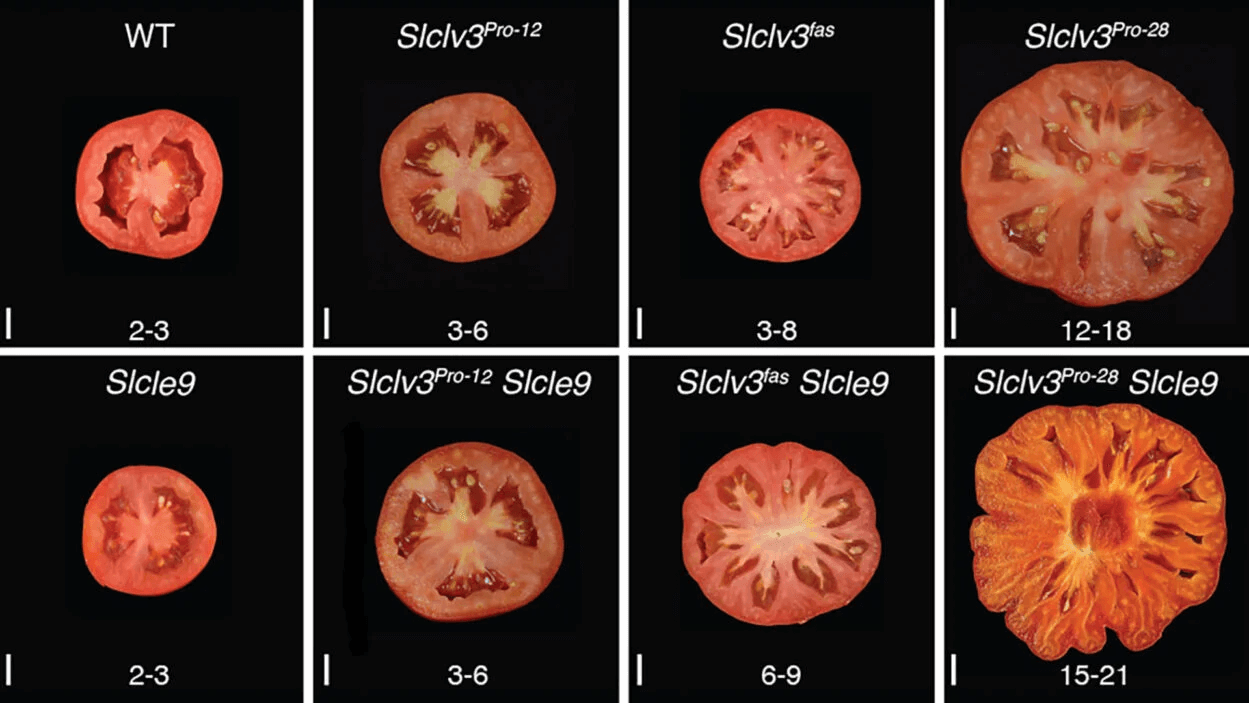
Using CRISPR, they created a series of mutations in the SlCLV3 gene.

(Natural mutation of this gene is known to increase fruit size.) They then combined those mutations with others in genes that work with SlCLV3.
lippman mccandlish science inline x
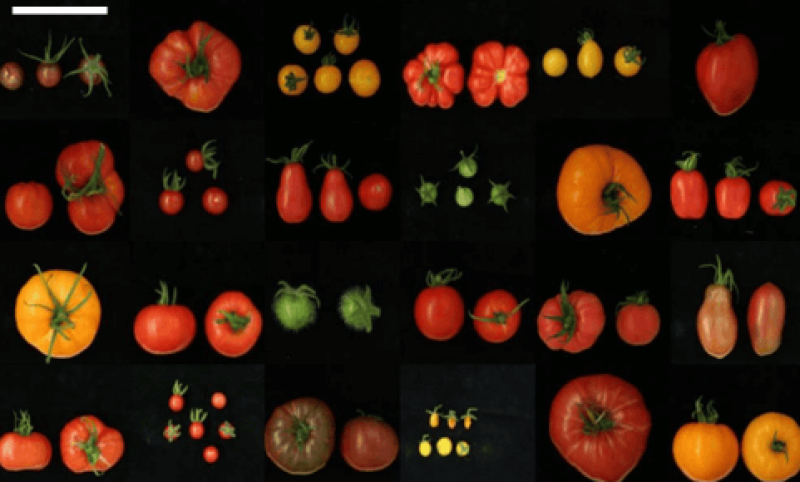
A collection of tomatoes with different combinations of artificial and natural mutations. The mutations affected the number of locules, or seed pockets, resulting in different fruit sizes. Lyndsey Aguirre, a CSHL School of Biological Sciences graduate, led the project.

Altogether, they created 46 tomato strains with different combinations of mutations.

They found the SlCLV3 mutations produced more predictable effects when certain other mutations were also present.

Mutations in one gene produced predictable changes in tomato size, but mutations in another yielded random outcomes.

Remarkably, the most beneficial effect involved two mutations that arose millennia ago and were central in tomato domestication.

New research by McCandlish and Lippman may help us better understand genetic predictability.

But one thing’s certain. Context matters when introducing new crop mutations.

Lippman explains:

“Is genome editing a way to quickly bring in consumer benefits — better flavor, nutrition? The answer is probably yes. The question is how predictable is it going to be.”

Lippman and McCandlish’s work suggests the role of background mutations demands reassessment.

“The field will have to grapple with this as we start to make more highly engineered organisms,” says McCandlish.

“Once you start making 10, 20 mutations, the probability of having unanticipated results may increase.”

The book of evolution has been written in all different languages, many of which we’re still learning. Plant genetics and computational biology offer two means of deciphering the text. Lippman and McCandlish hope their collaborative interpretation will help science meet the challenge. Looking ahead, it may also help humanity adapt crops to meet the ever-evolving needs of society.


{{ reviewsTotal }}{{ options.labels.singularReviewCountLabel }}
{{ reviewsTotal }}{{ options.labels.pluralReviewCountLabel }}
{{ options.labels.newReviewButton }}
{{ userData.canReview.message }}

Related Articles

Infographic: Global regulatory and health research agencies on whether glyphosate causes cancer

Infographic: Global regulatory and health research agencies on whether glyphosate causes cancer

Does glyphosate—the world's most heavily-used herbicide—pose serious harm to humans? Is it carcinogenic? Those issues are of both legal and ...

Most Popular

ChatGPT Image May 10, 2026, 08_16_59 PM 2
Overmedicalization? RFK Jr.’s antidepressant crackdown raises conflict questions over his fee stake in Wisner Baum, the tort firm built on suing drug makers
Picture1-5
Science Disinformation Gap: The transatlantic battle over social media and censorship
Screenshot-2026-05-08-at-3.40.33-PM
Seeds of power: China turns to genetic engineering to become global superpower
Picture1-14
When superbugs threaten vulnerable children: Can AI help solve antibiotic resistance?
S
As vaccine rejectionism spreads, measles may be taking a more dangerous turn
ChatGPT-Image-Apr-13-2026-02_20_22-PM
Viewpoint: Misinformation infodemic? Why assessing evidence is so challenging 
Screenshot-2026-05-01-at-1.29.41-PM
Viewpoint: What happens when whole grains meet modern food manufacturing? Labels don’t tell the whole story.
Screenshot 2026-05-08 at 3.01
Transforming farming and nutrition with AI and robotics? Larry Ellison’s half-billion-dollar Hawaii greenhouse dream goes bust
Farmers can talk to plants
Farmers are a major source of misinformation—about farming
ChatGPT-Image-May-8-2026-01_41_33-PM-3
Viewpoint: Surge of climate misinformation traced to right wing and anti-wind activists 
Screenshot-2026-04-20-at-2.26.27-PM
Viewpoint — Food-fear world: The latest activist scientists campaign: Cancer-causing additives
ChatGPT-Image-Mar-27-2026-11_47_30-AM-2
FDA’s expedited drug reviews are hailed in some quarters but other approval practices are problematic
Screenshot-2026-03-13-at-12.14.04-PM
The FDA wants to make many popular prescription drugs OTC—a great idea. Here’s why it’s unlikely to happen
Screenshot-2026-04-12-135256
Bixonimania: The fake disease scam that AI swallowed whole
glp menu logo outlined

Get news on human & agricultural genetics and biotechnology delivered to your inbox.