The story of MSG is mostly unknown to the general public, but I guarantee that if you mentioned the substance among a group, you would hear someone recount that their parents warned them about avoiding MSG, or that they seek out “no MSG added” foods, right?
So let’s take a trip down memory lane, not just because this story is fascinating, but because it is a perfect illustration of Brandolini’s law, also known as the bullshit asymmetry principle:
The amount of energy needed to refute bullshit is an order of magnitude bigger than that needed to produce it
And yes, it has been 56 years and the bullshit about MSG is still persistent. And in reality, unfounded fears about MSG started with a New England Journal of Medicine letter to the editor that was based on zero evidence.
In 1968, the New England Journal of Medicine published a 3-paragraph letter to the editor titled “Chinese Restaurant Syndrome”, attributed to a Dr. Robert Ho Man Kwok (although even the true identity of this person remains controversial). In it, the author describes how they feel poorly after eating at American Chinese restaurants, and suggests a variety of potential causes for this: soy sauce, cooking wine, high sodium levels, and also MSG.
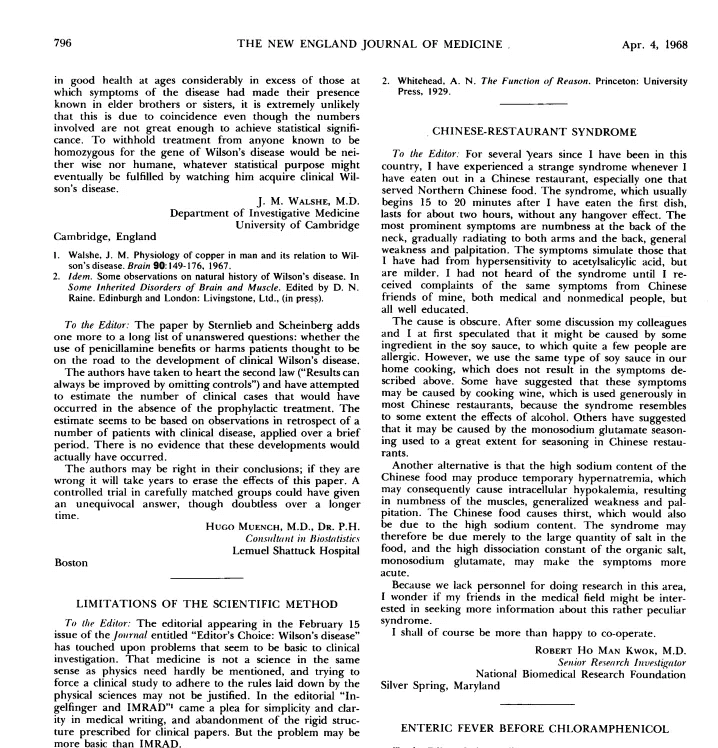
None of these had any evidence to begin with, and clearly this was merely an anecdote riddled with confounders, so why NEJM published it in the first place is beyond me. I suppose their editors didn’t anticipate the ensuing media frenzy.
Now while the author suggested a myriad of potential sources for why they felt badly, the media and the public clung to the “MSG” bit and held on. MSG was demonized, and restaurants using it as a flavor enhancer were shunned.
Anecdotes were rampant, people attributing an array of symptoms to this food additive villain: headaches, flushing, numbness, nausea, chest pain, allergies, difficulty breathing, obesity, and more. In addition, the predictable claims about MSG being “artificial” and “harmful” were widely held to be true.
MSG is a naturally occurring substance found in tomatoes, cheeses, mushrooms and more
Surprise! Now if you’re reading my content, you know that the appeal to nature fallacy is a common theme in pseudoscience and health misinformation, and the source of a chemical has no bearing on potential harm (or safety), but yep, MSG is a natural chemical.
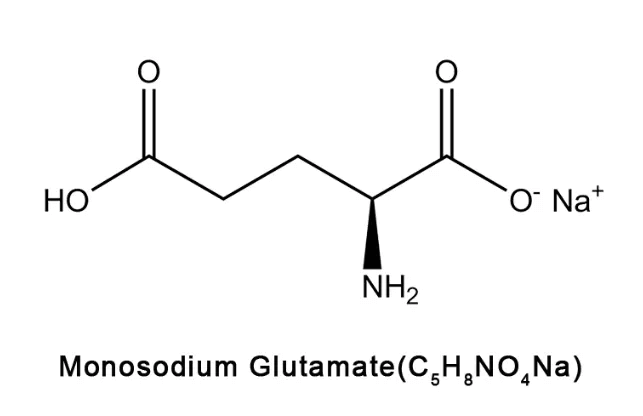
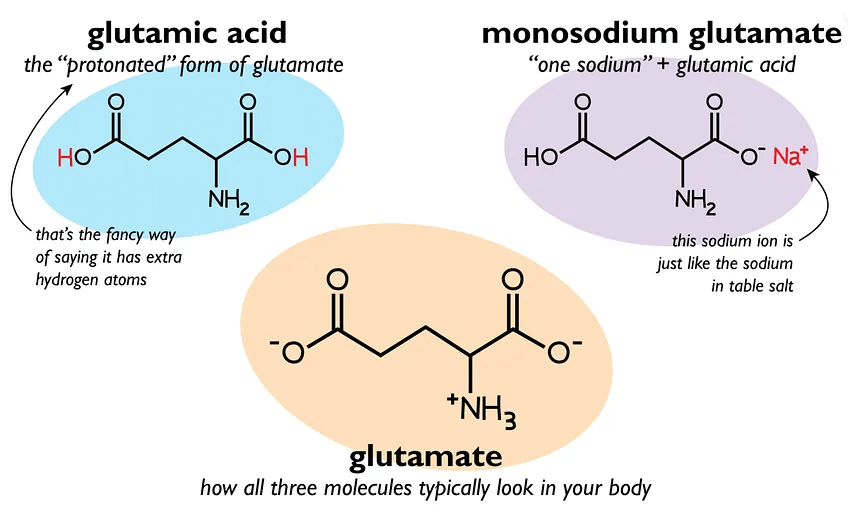
MSG is the sodium salt of glutamic acid. Remember, salts are any ionic compound formed after an acid:base neutralization reaction.
Glutamic acid (functionally glutamate, but we are getting there) is one of the most common amino acids. Humans produce it in our bodies, and it is also found widely in many foods.
A little bit more chemistry…
Salts and weak acids (like glutamate) dissociate into their ions in water (which our body is composed of). So when we eat glutamic acid or MSG, or when we synthesize glutamate, the positive ion “falls off”. In the case of glutamic acid, that’s an H+ (hydrogen ion, the ion that makes it an acid), and in MSG, that’s the Na+ (the monosodium bit). So in our bodies, glutamic acid and MSG look exactly the same, and are used exactly the same for a variety of physiological processes, to make proteins, and more.
MSG was first extracted from seaweed in 1908
It was first extracted and synthesized from seaweed in 1908 by Japanese biochemist Kikunae Ikeda who was trying to replicate the umami flavor of kombu, a seaweed used widely in Japanese cuisine (for example, it is an essential component of making dashi).
Now, MSG is synthesized from a precursor amino acid called L-glutamic acid, produced by fermenting corn, sugar cane, sugar beets, tapioca or molasses. We have been using MSG as an umami enhancer globally for over a hundred years.
However, this New England Journal of Medicine letter in 1968 inflamed completely unsubstantiated fears about MSG, and particularly, added MSG.
The reality? You’re consuming far more glutamate from proteins than you ever could in added MSG
An average adult consumes approximately 13 grams of glutamate each day from protein in foods, while consumption of added MSG is estimated at 0.55 grams per day.
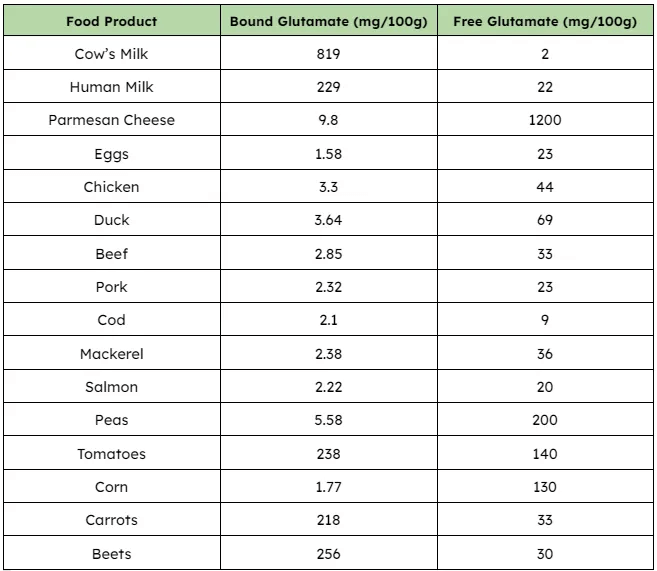
Unfortunately, thanks to Brandolini’s law, decades of research were conducted wasting millions of dollars simply to reaffirm what science had demonstrated all because of an anecdote and exaggerated media attention that led to completely unsubstantiated consumer fears.
The conclusion? MSG is perfectly safe to consume
Just like all other sources of glutamate, you can consume MSG with no concerns for your health.
Decades of blinded clinical studies show no health effects of MSG when consumed at levels that would be used in foods.

Global food safety organizations including the FDA, European Food Safety Authority, Flavor and Extract Manufacturer’s Association, & the Joint FAO/WHO Expert Committee on Food Additives (JECFA) all conclude MSG is safe. JECFA has not even set an acceptable daily intake level (ADI) because even when consuming a single dose bolus of 10 grams of MSG, there has been no measurable health impact. Studies attempting to induce the anecdotally-reported “tightness of chest” or difficulty breathing have failed to do so.
Even the commonly reported claim of headaches associated with MSG consumption are not supported by robust clinical evidence: perhaps those individuals are ignoring confounding variables? Maybe you drank some alcohol with your dinner out at a restaurant?
But even 50 years later, MSG still ranks in the top 10 of things people are afraid of in their food

Why does stigma and misinformation persists, even though it was based on nothing more than a random person’s musings?
A few contributors:
Confirmation bias: People are not receptive to information that conflicts with strongly held beliefs, even if those beliefs are based on falsehoods.
Low science literacy: The fact that MSG as a food additive is chemically the same as glutamate found in foods (and synthesized by our body) is not understood by many people as a result of low science literacy and a general lack of chemistry knowledge.
Anecdotes being used as evidence: Claims about MSG’s negative effects were solely based on anecdotes. Once established in popular culture, anecdotes can be challenging to dispel, even when robust scientific data demonstrates the opposite.
Media coverage: Sensationalist media headlines and intentional misinformation campaigns propagate these falsehoods. Misleading headlines and exaggerated claims impact public perception, even when they lack credibility.
Xenophobia: The “Chinese Restaurant Syndrome” myth and associated negative publicity was strongly linked to Chinese cuisine and cultural stigma.
“Wellness” movements: The wellness industry, social media influencers, and the targeted attempts to erode trust in science-based medicine has perpetuated these falsehoods. Some alternative health advocates promote the idea that MSG is a harmful “chemical additive,” even though 1) it is a natural substance and 2) there is zero evidence to support this. However, the exploitation of chemophobia and the appeal to nature fallacy are common themes in this space.
Society needs to stop giving misinformation a public platform
The harms of legitimizing anecdotes, weak data, unsubstantiated claims, and prominent public figures that spread pseudoscience are far-reaching.
In this case, this started with the New England Journal of Medicine publishing this letter to the editor. While the caveat should be that a letter to the editor is not scientific evidence, the general public sees the name of a reputable journal and they can’t automatically discern what is a robust peer-reviewed study and what is a random musing.
We saw a similar phenomenon with The Lancet and platforming Andrew Wakefield’s obviously flawed and ultimately fabricated study that undermined vaccines – another persistent piece of misinformation that is causing harm several decades later.
And yes, people like Andrew Huberman who use their terminal degree and academic credentials to spread falsehoods, undermine public health, promote pseudoscience, and profit off of unproven “wellness” interventions.
What’s the harm?
It misleads people into doing things that have no benefit or might be actively harmful while dissuading them from interventions that have evidence to support them.
It erodes trust in robust evidence-based science, undermines public health, and propagates medical conspiracism.
It also causes people to avoid perfectly safe foods or consumer products and increases health anxiety.
It can lead people to avoid actual medical treatments while seeking unproven alternative practitioners (much more to come on this as it relates to Lyme disease and other topics).
And on top of all of that, many people make a lot of money promoting pseudoscience and misinformation.
Dr. Andrea Love has a PhD in Immunology and Microbiology. Andrea is a subject-matter expert in infectious disease immunology, cancer immunology, and autoimmunity and is adept at translating complex scientific data and topics for the public and healthcare providers. Follow Andrea on X @dr_andrealove