Sunghir: What the strange paleolithic burial site tells us about ancient humans

ac

Around 34,000 years ago, hunter-gatherers who roamed the Russian plains started to bury their dead at the site of Sunghir, about 200 kilometers east of what is today Moscow.

โ€ฆ

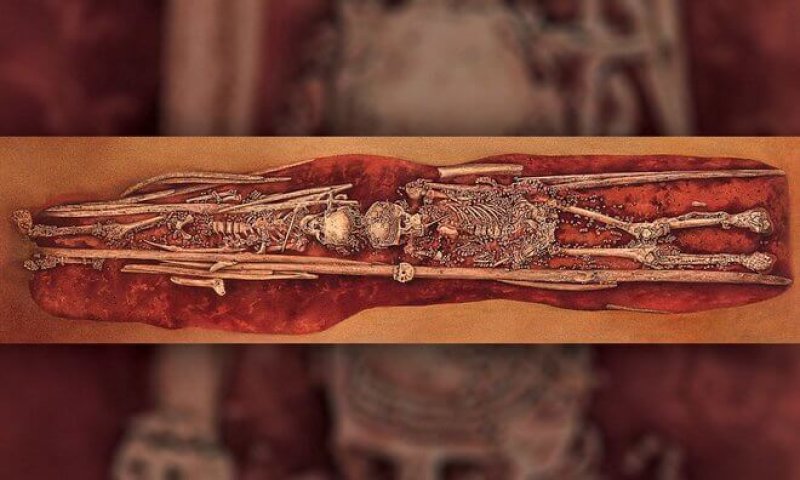
[T]he site has never ceased to fascinate archaeologists. The mortuary site contains extremely elaborate burials of an adult male covered in beads and ochre (a red clay earth pigment), and a juvenile and an adolescent, approximately 10 and 12 years old, buried head to head.

โ€ฆ

Exploring this complexity and the diverse ways with which these ancient people seemed to have thought about and treated their dead at Sunghir could open a new window into the complex social world of some of the firstย Homo sapiensย in Europe.

โ€ฆ

These analyses have led the authors to conclude that at least three different forms of burials were practiced at Sunghir.

โ€ฆ

The contrast between lavish burials and isolated skeletal elements at the site also suggests that there was some kind of differentiation between individuals during their lifetimes that was then reflected in death. Although it is not clear what the social structure of these people looked like or how it was determined, the evidence at Sunghir suggests that individuals didnโ€™t necessarily acquire a status through their actions. Something else may have determined their position within their communities and how they were eventually treated in death.

Read full, original post:ย Why This Paleolithic Burial Site Is So Strange (and So Important)

{{ reviewsTotal }}{{ options.labels.singularReviewCountLabel }}
{{ reviewsTotal }}{{ options.labels.pluralReviewCountLabel }}
{{ options.labels.newReviewButton }}
{{ userData.canReview.message }}

Related Articles

Infographic: Global regulatory and health research agencies on whether glyphosate causes cancer

Infographic: Global regulatory and health research agencies on whether glyphosate causes cancer

Does glyphosateโ€”the world's most heavily-used herbicideโ€”pose serious harm to humans? Is it carcinogenic? Those issues are of both legal and ...

Most Popular

Picture1-5
Science Disinformation Gap: The transatlantic battle over social media and censorship
ChatGPT Image May 10, 2026, 08_16_59 PM 2
Overmedicalization? RFK Jr.โ€™s antidepressant crackdown raises conflict questions over his fee stake in Wisner Baum, the tort firm built on suing drug makers
Picture1-1
Cooling the planet with balloons: Could a geoengineering gamble slow global warming?
Screenshot-2026-05-12-at-9.58.31-PM
'He seems fine': Marty Makary out as FDA commissioner
ChatGPT-Image-May-12-2026-08_39_41-PM
GLP podcast: Big Pharma, Big Ag, Big Foodโ€”health harming industries or life-saving innovators?
Screenshot 2026-05-11 at 11.30
Despite politicized disinformation, Midwest AI data centers are fueling a solar energy boom
Screenshot-2026-04-23-at-11.00.36-AM
Regulators' dilemma: Thalidomide, Metformin, and the cost of getting drug approvals wrong
Screenshot-2026-05-11-104424
Hantavirus outbreak research: Trump administration shut down study last year on rodent-to-human transmission
Picture1-14
When superbugs threaten vulnerable children: Can AI help solve antibiotic resistance?
Screenshot-2026-04-12-135256
Bixonimania: The fake disease scam that AI swallowed whole
images
The never-ending GMO debate: Pros and cons
glp menu logo outlined

Get news on human & agricultural genetics and biotechnology delivered to your inbox.