East Africa faces two plagues: Once-in-a-generation insect infestation and swarms of European activists trying to block the only effective tool, pesticides

desert locust swarms further threaten food insecure east africa
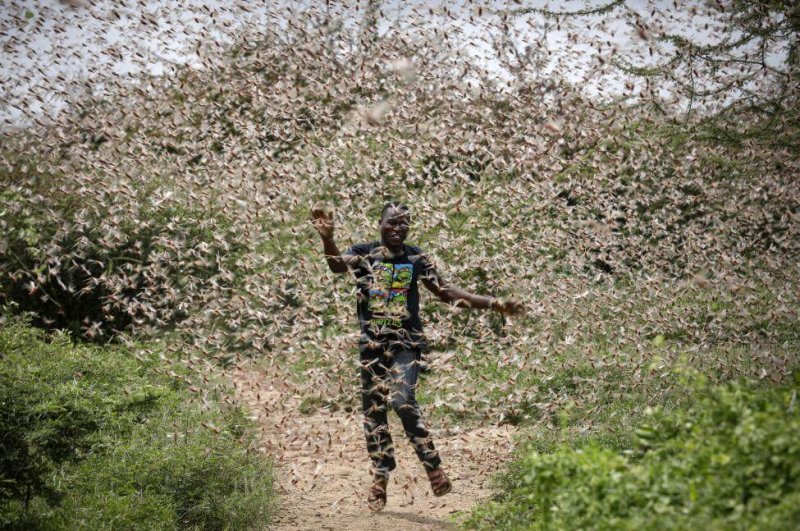
Farmer Theophilus Mwendwa trying to chase away desert locusts near Enziu, Kenya. Credit: Dai Kurokawa/EPA-EFE

European activists are putting lives at risk in East Africa, turning a plague of insects into a real prospect of widespread famine. The fast-breeding desert locust has invaded Kenya, Somalia and Ethiopia, creating a state of emergency. The pests recently landed in Djibouti, Eritrea, Oman and Yemen. Swarms have also struck Tanzania and Uganda. … According to the Food Agriculture Organization (FAO), “this is the worst situation in 25 years.”

These beasts consume every plant in their path, leaving behind devastated croplands and pastures, and can migrate up to 150km in a day. They’ve already covered a million hectares in Kenya, with no signs of slowing down.

The human toll is staggering. Twenty-five million people have been left hungry, by Oxfam’s estimate. Yet, instead of rallying around African nations in this time of great peril, more EU-funded NGOs have descended on the Kenyan parliament to demand that the government disarm itself in the battle against locusts. They want the Kenyan government to outlaw the pesticides used to fight locusts, the only effective tool that can stop these insects, and prevent the crisis from spiraling out of control.

…

In effect, these Europeans want Africa to give up the idea of ever becoming an advanced world economy, or ever even reaching true food security. The “agro-ecology” fad embraced by European elites in international organizations — including some in FAO — extols “peasant farming” and the “right to subsistence agriculture,” as if that were some kind of ideal, while denying Africans the modern technologies used in countries like the United States and Brazil.


Read the original post

Related Articles

Infographic: Global regulatory and health research agencies on whether glyphosate causes cancer

Infographic: Global regulatory and health research agencies on whether glyphosate causes cancer

Does glyphosate—the world's most heavily-used herbicide—pose serious harm to humans? Is it carcinogenic? Those issues are of both legal and ...

Most Popular

ChatGPT-Image-Mar-10-2026-01_39_01-PM
Viewpoint—“Miracle molecule” debunked: Why acemannan supplements don’t work
Screenshot-2026-09-17-at-1.07.08-PM
'We are dangerously addicted to antidepressants': Should we heed RFK Jr.’s sobering warning?
ChatGPT-Image-Sep-2-2026-02_03_32-PM
How much of a problem is AI’s water use?
ChatGPT-Image-Sep-22-2026-10_32_46-AM
There has been a slew of recent reports of food recalls and foodborne outbreaks. Do we face an escalating problem?
Screenshot-2026-09-10-at-12.20.19-PM
'Jet fuel didn't melt the steel': 9/11 conspiracy theories debunked
Screenshot-2026-09-03-at-10.51.20-AM
Viewpoint: Why do online health lies outlive the evidence that debunks them? Read "Everyone Else Is Lying to You"
eaeb d b
Viewpoint: The organic food industry is a $180 billion marketing fraud
ChatGPT-Image-Sep-23-2026-01_52_03-PM
Viewpoint: 4 very real AI doomsday scenarios
Screenshot-2026-09-22-at-11.40.28-AM
After Idaho criminalized abortion providers in 2022, one-third of obstetricians fled. Health care advocates are making rural health the case for repealing the ban
glp menu logo outlined

Get news on human & agricultural genetics and biotechnology delivered to your inbox.