What brain wiring has to do with cognitive differences in humans and other animals

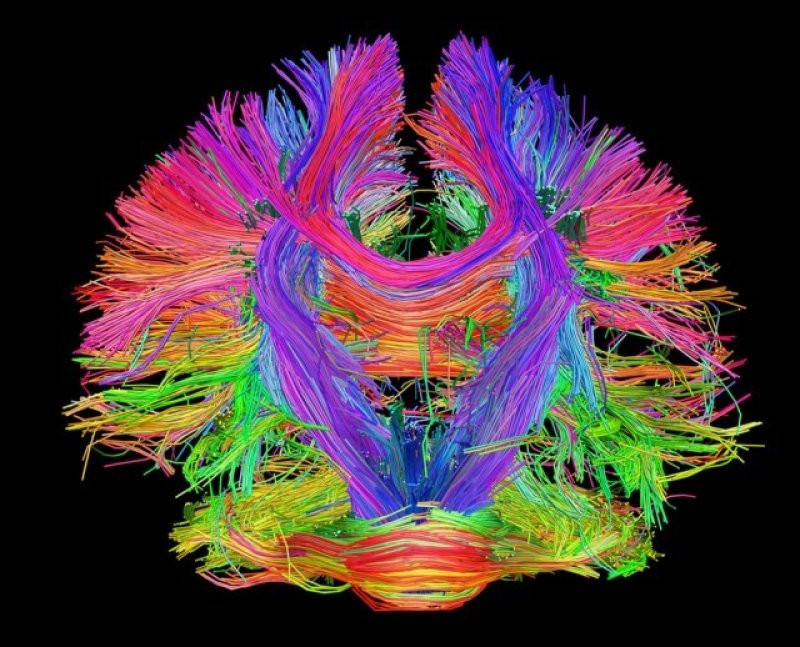
connectome x
Credit: Human Connectome Project

A persistent question about [brain] connectomes has to do with what, if anything, distinctive wiring patterns have to do with the evident cognitive differences in a mouse, a monkey or a human. 

Hypothetically, the most efficient connectome would follow a one-to-many design, with each nerve cell connecting to all of the others. But this approach is prohibitively unworkable because it requires a lot of space to house all these connections and energy to keep them functioning. Alternatively, a one-to-one design, in which each neuron connects to only a single other neuron would be less challenging—but also less efficient: information would have to traverse enormous numbers of nerve cells like stepping-stones to get from point A to point B.

“Real life is in the middle,” says [researcher] Yaniv Assaf.

Species with few long-range connections linking the two hemispheres of their brain tended to have more short connections within each hemisphere in which nearby areas “talked” intensively with each other. Species with more long-range connections, such as humans and other primates, thinned out these local networks.

This approach to connectivity may reflect geometric constraints on packing a nervous system into a skull. But variations in these links within a species might also track with different abilities. “If you have denser connectivity in one region, you might have a certain ability others wouldn’t,” Assaf says.


Read the original post

{{ reviewsTotal }}{{ options.labels.singularReviewCountLabel }}
{{ reviewsTotal }}{{ options.labels.pluralReviewCountLabel }}
{{ options.labels.newReviewButton }}
{{ userData.canReview.message }}

Related Articles

Infographic: Global regulatory and health research agencies on whether glyphosate causes cancer

Infographic: Global regulatory and health research agencies on whether glyphosate causes cancer

Does glyphosate—the world's most heavily-used herbicide—pose serious harm to humans? Is it carcinogenic? Those issues are of both legal and ...

Most Popular

ChatGPT-Image-Mar-10-2026-01_39_01-PM
Viewpoint—“Miracle molecule” debunked: Why acemannan supplements don’t work
ChatGPT-Image-Jun-15-2026-01_04_14-PM
Viewpoint: How politicized science became a political religion 
DtAieAIkCZy-uchn-oqg
Viewpoint: In the science misinformed grifter game plan, the organic-food-is-healthier myth might be the worst.
ChatGPT-Image-Jun-15-2026-03_00_23-PM
World’s first AI-designed vaccine explained
d a ca e c c beb x
Facts & Fallacies podcast: The 'woke' crusade against anthropology? Dr. Elizabeth Weiss
Screenshot-2026-07-07-at-10.48.33-AM
700,000-person study reaffirms that getting a flu and Covid shot on the same day is safe
ChatGPT-Image-Jun-25-2026-12_23_17-PM
No, Bill Gates did not secretly engineer ticks to promote veganism
GMOprotest
Viewpoint: CRISPR-hating activists air their grievances about gene editing farming innovation
ChatGPT-Image-Jul-7-2026-03_07_17-PM
Kennedy blocks preventive health care panel that reviews treatments for HIV, diabetes, and cancer from meeting — for fourth time
eu-farming-policy
EU bureaucrats are finally catching up to the gene editing revolution in food and agriculture
Screenshot-2026-07-06-at-11.30.08-AM
AI is making even its founders uneasy: ‘We find evidence of introspection, joy, satisfaction, fear, grief and unease.’
Picture1
Viewpoint: The Lackland flu outbreak is fading but Hegseth’s military anti-vaccine fiasco is not
chjpdmf zs sci pbwfnzxmvd vic l zs ymdiylta l zsmtu nty otkwmtetaw hz uta a dzjyy euanbn
Technical milestone or designer baby obsession: Latest gene-editing advance reignites a familiar ethical debate
glp menu logo outlined

Get news on human & agricultural genetics and biotechnology delivered to your inbox.