In the wake of Christopher Columbus’s voyages of exploration, Europeans arrived in the Americas in ever-increasing numbers. They brought with them a range of viruses, such as smallpox, influenza, measles, mumps and chickenpox, to which Native Americans had no prior exposure and no immunity. Historians call the resulting epidemics “virgin soil epidemics”.
Coronavirus has demonstrated the impact that epidemic disease can have on a vulnerable population. Similarly, these virgin soil epidemics rapidly swept through Native American communities. Societies were overwhelmed. Everyone fell sick at once: there was no one to care for the sick and no one to plant or harvest crops.
The impact of the epidemics was extensive. At one level, they removed the people who could have resisted European expansion. Studies now suggest that the population of the Americas may have been as high as 100 million before contact with Europeans. In many regions, within a century of exposure to these diseases, 95% of the population died.
We are well aware of the Aztec and Inca empires, but similar, if not quite so complex, societies existed elsewhere. When Hernando de Soto explored what is now the south-eastern United States in the 1540s, he found the local population living in large towns, which could raise armies with thousands of men. When English explorers entered the region at the end of the following century, they found only a few scattered tribes.
For many years, historians questioned the validity of the accounts of de Soto’s expedition. However, archaeology has now verified many of the descriptions that his men brought back. These societies were eradicated by virgin soil epidemics, even though their direct contact with Europeans was limited.

These epidemics not only killed the people, but they also destroyed culture and morale. Most Native American societies were non-literate – they did not have a written language. Consequently, when elders died simultaneously, much of the community’s culture and knowledge also disappeared. This loss fed into a cycle of despair and demoralisation, which both undermined Native American resistance and provided a justification for European expansion.
Manifest destiny
Some observers in east Asia have viewed the failure of western governments to control the coronavirus as evidence of the weakness and fragility of western democracy. Similarly, in the 16th century, Europeans saw the virgin soil epidemics as proof of their moral and biological superiority. They were evidence that God intended Europeans to take control of the Americas.
When the Pilgrims arrived in New England in the 1620s, they found the local population already decimated by disease. Along the coast were abandoned villages that provided perfect settlement sites. It was as if God had blessed the Pilgrims’ mission.

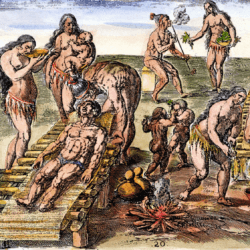




The epidemics themselves helped to rationalise colonialism – it was God’s will, after all. They allowed Euro-Americans to appropriate native lands while abrogating them of any blame, and to view their imperialism as some divinely preordained “manifest destiny”.
We do not yet know how extensive the long-term social and economic effects of coronavirus will be, but these virgin soil epidemics had unexpected consequences. Many of the early European adventurers anticipated that Native Americans would provide the labour to work their fields. When they began to produce lucrative staple crops such as sugar, coffee and tobacco, the demand for labour became intense. Without a local population to exploit, Europeans turned to Africa to provide them with that workforce.
Atlantic slave trade
The slave trade had long existed in various forms, but its scale in the 17th and 18th centuries, the methods used, and the justifications provided, were unprecedented. The absolute ownership of people – chattel slavery – justified by concepts of racial superiority was, in many respects, a result of these virgin soil epidemics.
While “alternative history” can be difficult and dangerous, it is apparent that had these virgin soil epidemics not swept the Americas, the modern world would have developed very differently. The American nations, not least the US, would not have existed in their current form.
The clearly defined racism and sense of European superiority that emerged in the 18th century, and that has plagued the world ever since, would not have developed in the same way. We might also consider whether, without the profits from the natural wealth of the Americas, Europe would have become so predominant in the world.
Without virgin soil epidemics, the world would have been very different. It remains to be seen how far coronavirus will also transform the world.
Matthew Ward is a Senior Lecturer in History at the University of Dundee. His current research examines the Seven Years’ War in North America and its effects on Native Americans, French-Canadians and Anglo-American settlers.
A version of this article was originally published at the Conversation and has been republished here with permission. The Conversation can be found on Twitter @ConversationUS